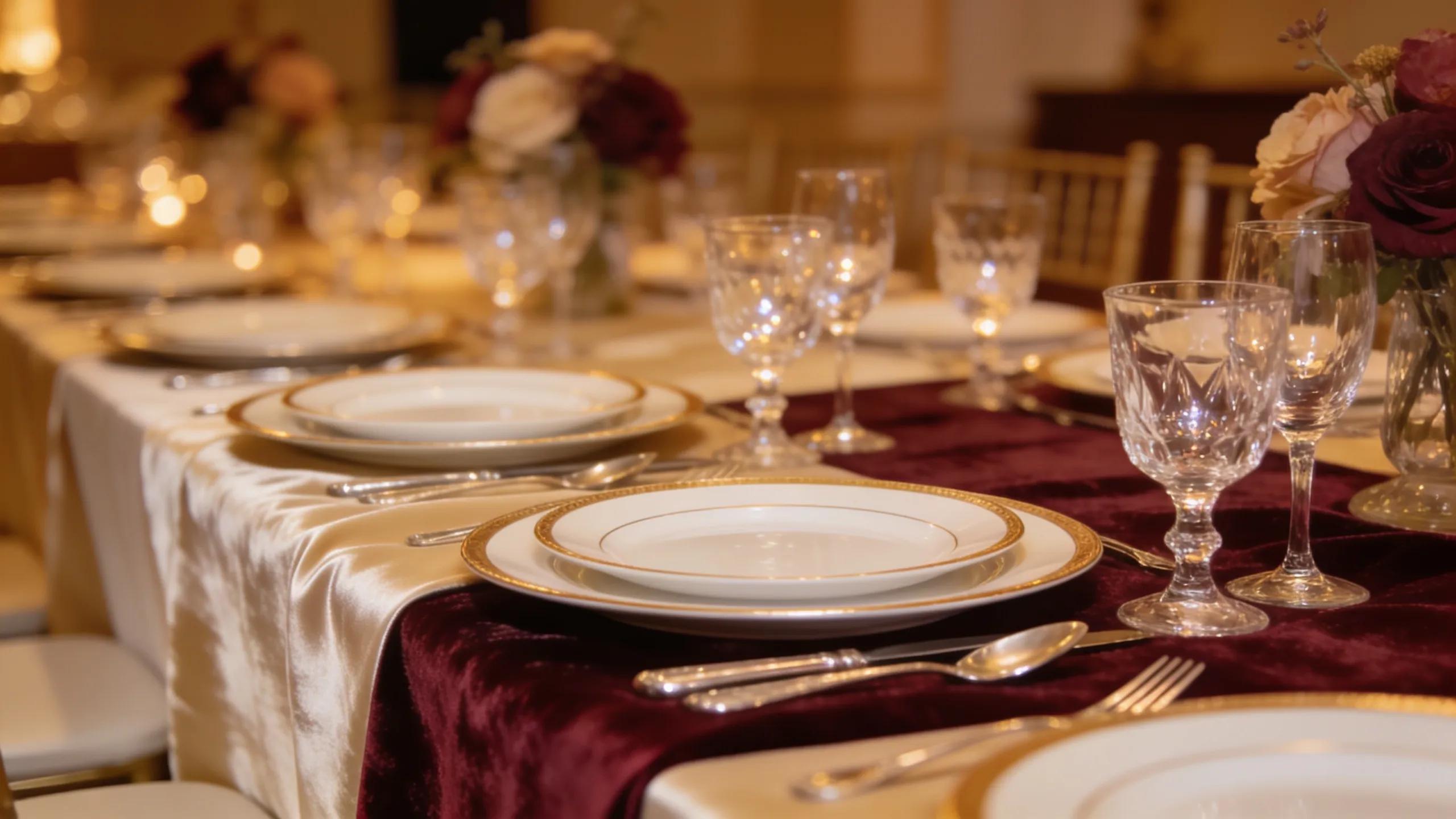
Luxury tablecloth rentals can shape the appearance of an entire wedding reception. Because tablecloths cover some of the room’s largest repeated surfaces, their color, pattern, and texture affect far more than the individual place settings arranged on top of them.
A patterned tablecloth may look balanced on one sample table but appear much stronger when repeated across twenty guest tables. The same is true of rich solids and dimensional textures. Once distributed throughout a ballroom, tent, garden, or historic venue, they become part of the room’s architecture and influence how guests perceive the florals, chairs, lighting, flooring, and focal installations.
Wedding professionals often describe table linens as a foundation for the reception design because they occupy so much visual space and connect the tabletop details with the surrounding venue. The challenge is not simply finding a beautiful linen. It is deciding where that linen belongs, how often it should appear, and what should surround it.
A successful reception-wide plan creates hierarchy. One statement treatment leads, supporting solids provide visual rest, and focal tables receive distinction without appearing disconnected. This guide explains how to balance statement tablecloths across the full room so the celebration feels expressive, cohesive, and intentionally composed.
Start With the Room Rather Than the Linen Swatch
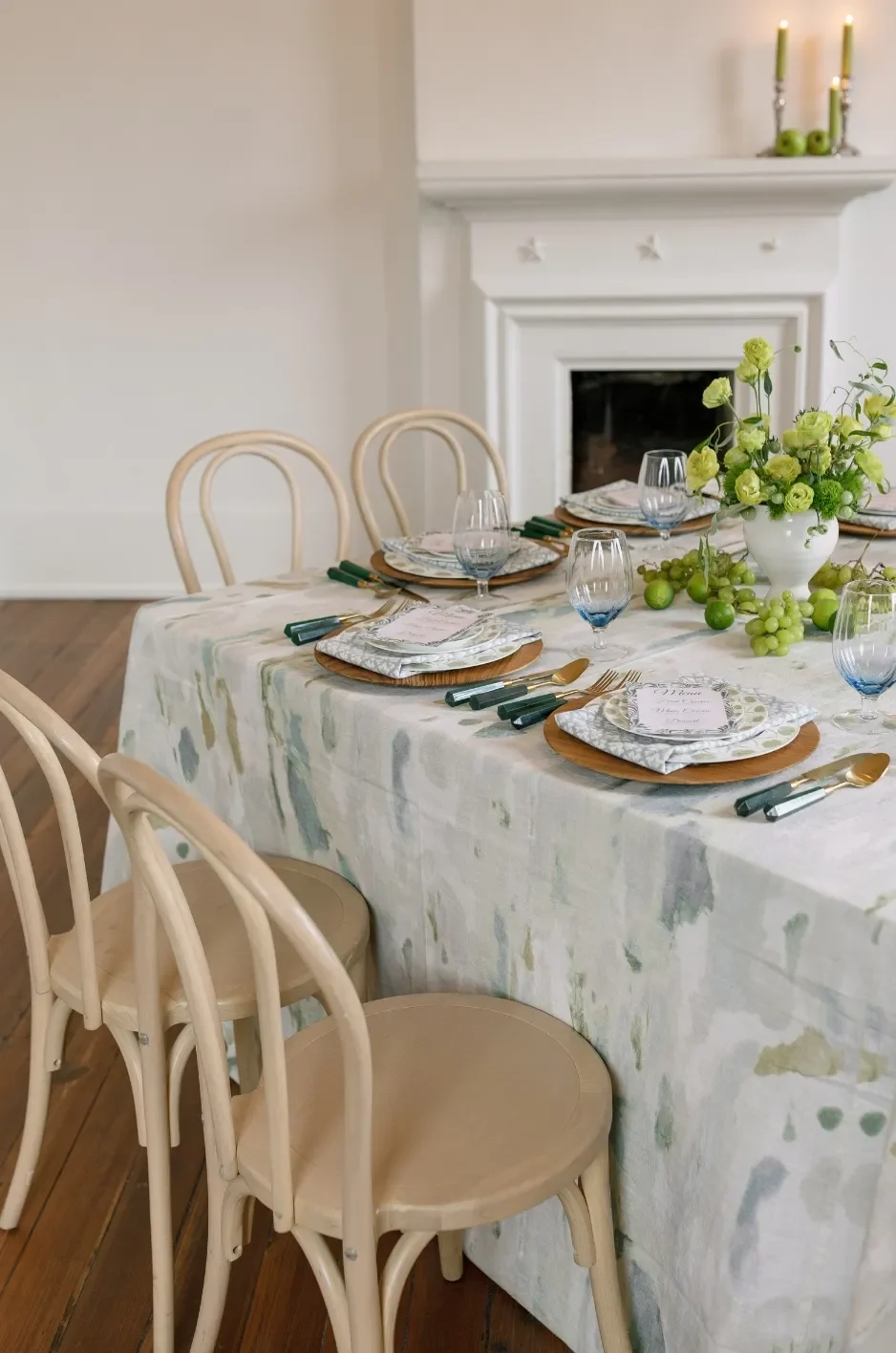
A fabric sample shows color, pattern, and texture at close range, but it cannot show how the linen will interact with the complete reception. Before selecting a statement tablecloth, planners should study the venue from the same positions guests and photographers will experience it.
The architecture, flooring, lighting, furniture, and number of visible tables determine how much pattern the room can support.
Identify the Reception’s Dominant Visual Features
Begin by documenting the permanent and planned elements that already command attention.
These may include:
- Patterned carpet or tile
- Decorative walls or wallpaper
- Ornate ceilings and chandeliers
- Strong architectural moldings
- Colored draping
- Large windows
- Garden, coastal, or city views
- Statement bars or stages
- Floral installations
- Existing furniture finishes
A venue with patterned floors and elaborate walls may require more restrained linens. A clear tent or minimalist hall may provide enough visual space for a stronger tablecloth to become one of the room’s defining features.
The goal is not necessarily to match the venue. The tablecloth should respond to it through compatible scale, color, texture, or contrast.
Study the First View Into the Reception
The entrance reveals how the linen plan will read before guests approach an individual table.
Stand where guests will enter and evaluate:
- How many tables are immediately visible
- Which tables occupy the foreground
- Whether an aisle directs attention through the room
- Where the sweetheart or head table appears
- Whether the dance floor divides the layout
- Which architectural feature forms the visual endpoint
A group of patterned tables near the entrance will have more immediate impact than the same linens positioned around the outer edge of the room. The first view should establish a clear design direction rather than introduce several competing statements at once.
Review the Room From Several Sightlines
The reception may look balanced from the entrance but visually heavy from the dance floor or couple’s table.
Review the proposed linen placement from:
- The main entrance
- The center of the dance floor
- The stage or entertainment area
- The bar
- The sweetheart table
- The room’s corners
- Balconies, staircases, or raised photography positions
Each view reveals a different pattern distribution. Reviewing several sightlines helps prevent one side of the room from carrying significantly more visual weight than the other.
Count the Visible Linen Surfaces
The total number of tables affects how a linen behaves.
A detailed botanical print used on six tables across separate rooms may feel selective. The same print used on thirty tables in one open ballroom may become the dominant visual field.
Count how many full tablecloths will be visible simultaneously. Include guest tables, focal tables, cake tables, cocktail tables, and display surfaces when they appear within the same view.
Note Changes in Lighting Across the Space
One linen may look different throughout the room.
Tables near windows may show the pattern and fabric texture clearly, while those in dimmer corners may appear darker and less detailed. Direct fixtures can increase shine, while colored uplighting can change the apparent undertone.
Review samples in conditions similar to the event, including natural light, warm interior lighting, candlelight, and any planned colored illumination.
Set a Pattern Budget Before Selecting Individual Linens
A pattern budget defines how much visual activity the reception can carry. It is not a financial calculation. It is a design framework for deciding how many patterned surfaces should appear and how strong those patterns can be.
Without this framework, details are often approved one product at a time. A floral tablecloth, patterned napkin, illustrated menu, decorative plate, and textured chair may each look attractive separately but become overwhelming when repeated together.
Determine Whether Pattern Will Lead or Support
First decide what role patterned tablecloths will play.
Pattern may serve as:
- The reception’s primary visual feature
- A supporting layer beneath prominent florals
- A selective accent among solid guest tables
- A focal treatment for specific zones
- A detail reserved for the couple’s and display tables
When pattern is the leading feature, the surrounding tableware and décor should usually be more restrained. When florals, lighting, or architecture lead, patterned linens may need to appear less frequently or with lower contrast.
Estimate the Percentage of Patterned Tables
There is no single ratio that works for every reception. The appropriate amount depends on the pattern density, venue size, floor plan, and competing décor.
Possible strategies include:
- Using one statement tablecloth on every guest table
- Mixing patterned tables with coordinating solids
- Reserving pattern for a central cluster
- Placing pattern around the room’s perimeter
- Using statement linens only on focal and display tables
- Assigning different linens to separate reception zones
A bold pattern used on one-third of the tables may have more impact than a quiet tonal design used throughout the room.
Account for Patterns Beyond the Tablecloths
The full pattern budget should include more than fabric.
Review:
- Carpet and flooring
- Upholstered chairs
- Printed napkins
- Patterned china
- Illustrated menus
- Floral vessels
- Draping
- Wallpaper
- Bars and lounge furniture
- Custom installations
When several of these elements already contain strong motifs, a solid or lightly textured tablecloth may give the room greater clarity.
Leave Intentional Areas of Visual Rest
Visual rest allows statement linens to remain distinctive.
A room in which every surface contains equal color, detail, and movement can feel flat despite being highly decorated. Solid tablecloths, restrained place settings, and open linen surfaces give the eye somewhere to pause.
These quieter areas also make the stronger tables easier to appreciate.
Avoid Adding Patterns One Product at a Time
Review the complete surface composition before confirming any individual textile.
Place the tablecloth beside the proposed napkin, menu, plates, charger, florals, glassware, and chair. Then consider how that combination will repeat throughout the room.
The question is not only whether the products coordinate. It is whether their combined visual activity is appropriate at reception scale.
Assign One Tablecloth Treatment the Leading Role
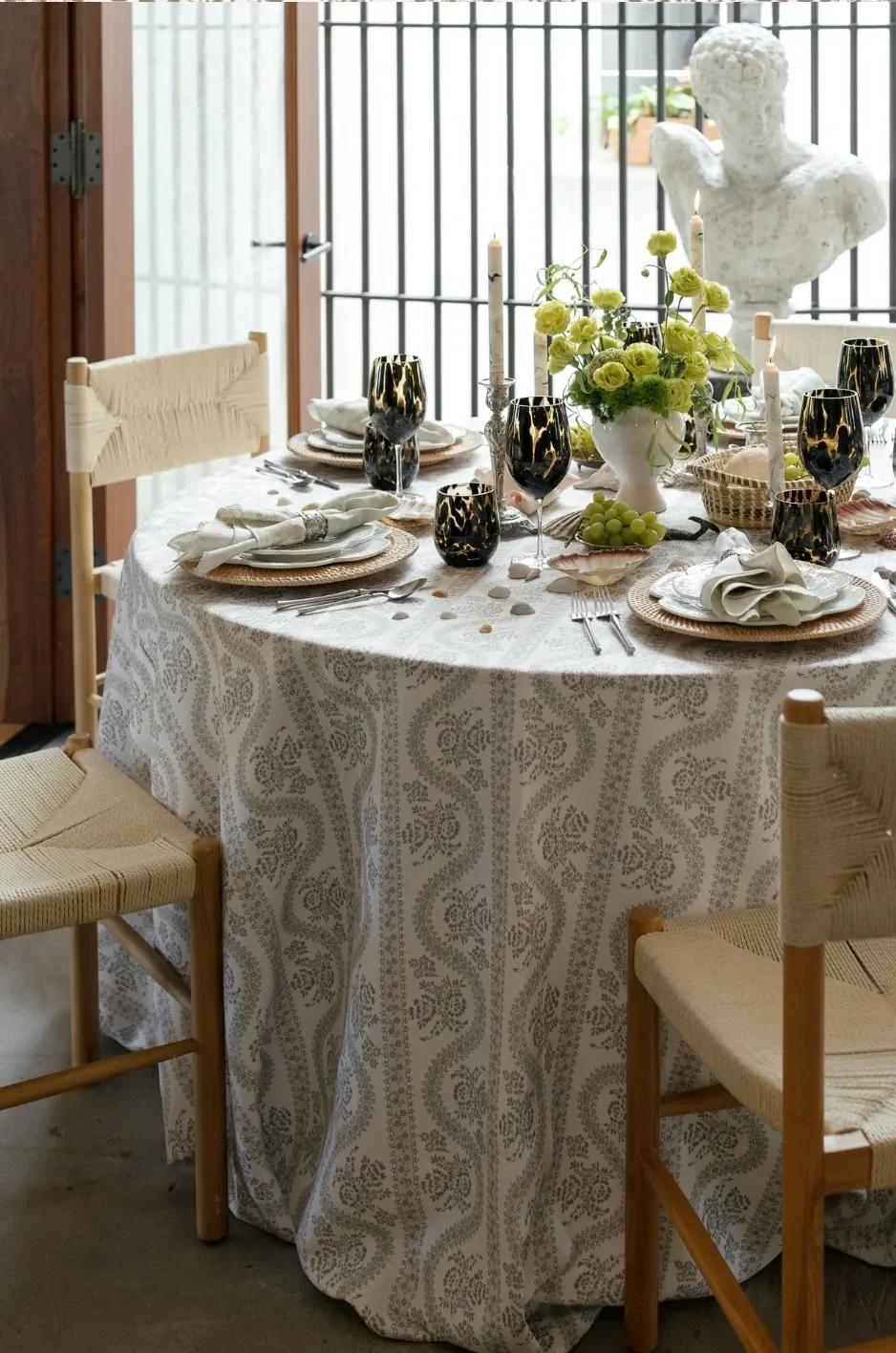
A cohesive linen plan usually needs one dominant direction. Additional tablecloths may support it through related colors or textures, but they should not all compete with equal intensity.
Curated Linen Collection’s own design guidance recommends beginning with a hero linen and using supporting solids, controlled texture, and repeated accents to prevent the tablescape from becoming crowded.
Select the Hero Linen
The hero tablecloth is the textile that carries the room’s main linen statement.
It may be:
- A botanical or floral print
- An abstract pattern
- A stripe or geometric design
- A rich solid velvet
- A dimensional woven linen
- A custom-printed tablecloth
- A saturated solid color
- A distinctive neutral texture
Identify what gives it authority. It may lead through pattern scale, contrast, color, texture, or finish.
Define Its Room-Wide Function
Once selected, decide where the hero linen will appear.
It might:
- Cover every dining table
- Define a central table group
- Appear on alternating table categories
- Mark the tables closest to the dance floor
- Lead guests toward the sweetheart table
- Highlight focal and display surfaces
- Differentiate one section of a divided reception
The distribution should be explainable through the floor plan. Random placement makes even a beautiful linen look less intentional.
Keep Supporting Linens Visibly Quieter
Supporting tablecloths should share a relationship with the hero textile without demanding the same level of attention.
They may use:
- A secondary color from the hero pattern
- A related neutral
- A quieter tonal design
- A complementary solid
- A similar fabric weight
- A different texture with restrained color
The supporting linen should look deliberate when viewed alone, but its primary purpose is to create balance around the statement tables.
Avoid Multiple Equal-Strength Statements
Using several bold prints in equal quantities can make the room feel divided.
Multiple patterns can work when their visual strength is clearly different. One might contain a large, open botanical motif, while another uses a small tonal repeat. A third treatment could be a solid texture that carries one color from the two prints.
Control the hierarchy through:
- Pattern density
- Motif scale
- Color contrast
- Quantity
- Placement
- Fabric finish
Repeat a Recognizable Detail
The hero and supporting tables do not need identical fabrics.
A repeated detail can create continuity, such as:
- The same napkin color
- A shared border tone
- Similar floral accents
- Coordinating glassware
- A repeated chair style
- A matching menu detail
- A related textile texture
This allows the room to feel connected while preserving variation.
Judge Pattern Scale From Across the Reception
Pattern scale changes with distance. A motif that appears detailed while holding a swatch may read primarily as color when viewed from the entrance.
The room should be evaluated from both close and wide perspectives.
Understand How Large Motifs Change at a Distance
Large botanicals, florals, or abstract forms often become broad areas of color from across the room.
This can create strong movement and an editorial quality, especially when the background color remains visible between motifs. The pattern may work well across large tables or in a venue with restrained architecture.
However, oversized designs need enough exposed linen to remain recognizable. Dense florals and extensive tabletop décor may hide the most important parts.
Recognize the Strength of Small Repeats
Small patterns can appear quiet on a single swatch but become visually dense when repeated across many tables.
Rows of small geometric, damask, or floral repeats may create an almost continuous textured field. This can be effective, but the surrounding tableware and florals may need greater simplicity.
Compare Open and Dense Patterns
An open pattern leaves more visible background between motifs. It generally provides more space for plates, florals, and menus to remain distinct.
A dense pattern contains less negative space and creates greater visual energy. It may work best when:
- The palette is controlled
- The place settings are simple
- Floral vessels have clear shapes
- The venue is relatively restrained
- The pattern is not used on every table
Check Directional Designs Across the Floor Plan
Stripes, vines, borders, and directional florals need consistent orientation.
A striped tablecloth may create a clear rhythm when every rectangular table runs in the same direction. When some pieces are rotated, the room can feel disorganized—especially in elevated photographs.
Document pattern direction before setup rather than leaving it to event-day interpretation.
Test More Than One Fully Styled Table
A single table mockup shows local balance but not cumulative repetition.
Where possible, style the hero table beside a supporting table. Additional covered tables, digital renderings, or a floor-plan visualization can help show how the pattern will repeat throughout the venue. Digital event-design tools can also be used to preview combinations of linens, furniture, and centerpieces within a room layout.
Use Solid Tablecloths as Deliberate Visual Pauses
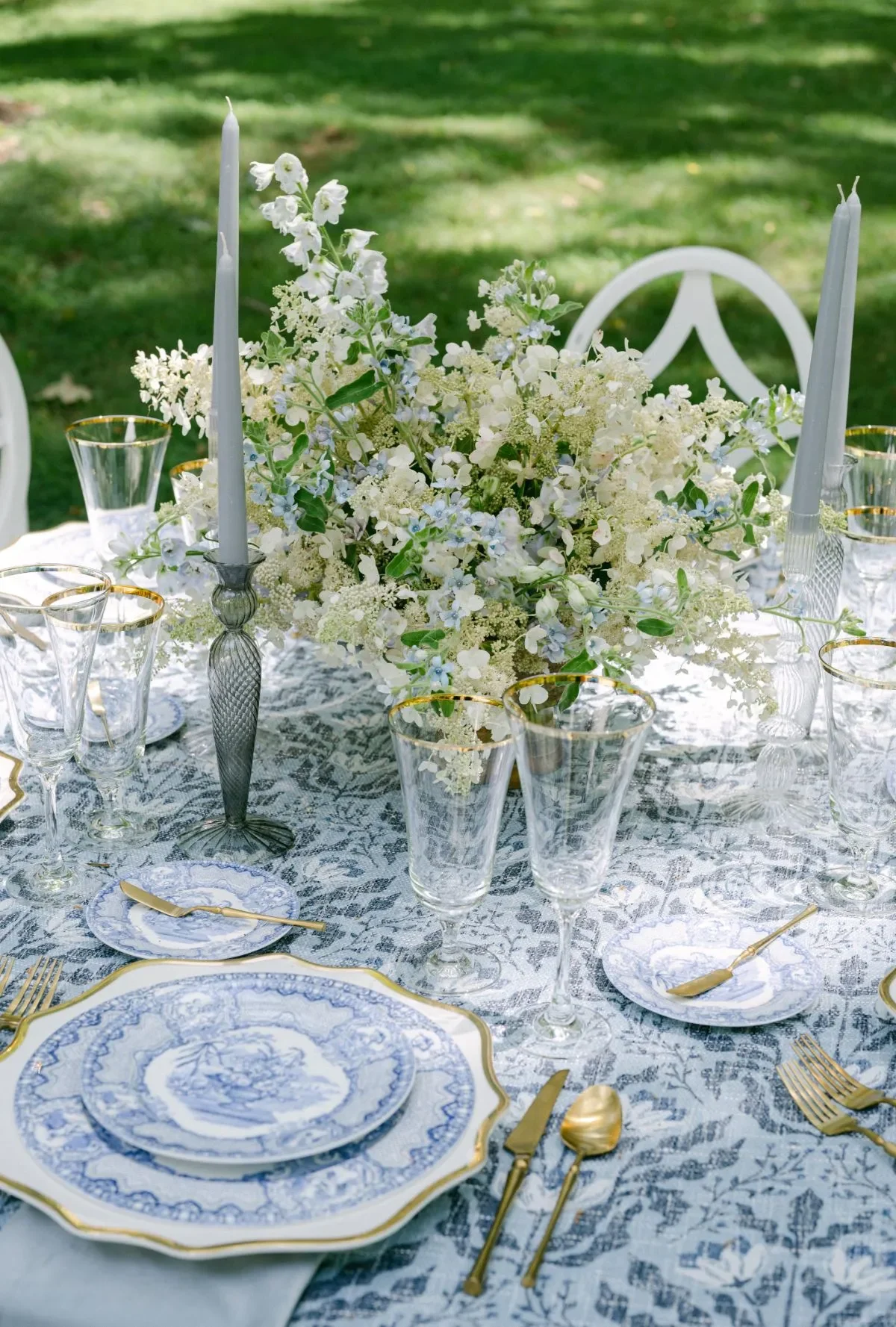
Solid linens are not secondary because they lack pattern. Within a statement-tablecloth plan, they perform the essential role of creating negative space.
A solid can also provide significant depth through texture, color, weight, and finish.
Pull a Secondary Shade From the Statement Pattern
Select a quieter color from the hero textile rather than automatically using its dominant shade.
For example, a floral tablecloth may contain a small amount of muted green, soft blue, clay, or warm ivory. Using that supporting tone on solid tables creates a connection without repeating the strongest color throughout the room.
Introduce Depth Through Texture Instead of Print
A solid tablecloth can remain visually rich through:
- Velvet
- Textured linen
- A woven surface
- A custom blend
- A subtle tonal finish
- Controlled sheen
Curated Linen Collection offers patterned and solid linens alongside fabrics such as velvet, linen, and custom blends, allowing texture to support a room-wide design without adding another print.
Match the Visual Weight of the Statement Linen
A supporting linen should feel substantial enough to belong beside the hero textile.
A lightweight-looking solid may appear disconnected beside a rich velvet or dimensional pattern. Visual weight can be matched through deeper color, stronger texture, a more structured drape, or a finish that responds similarly to the lighting.
Position Solids Where the Venue Is Most Detailed
Quiet tablecloths are particularly useful near:
- Patterned walls
- Decorative fireplaces
- Large floral installations
- Stages and bands
- Strong architectural details
- Busy flooring
- Bars or lounge displays
They allow the surrounding feature to lead without losing the reception’s linen identity.
Avoid Making Every Solid Table Identical by Default
Supporting tables may share the same tablecloth while varying selected details.
A controlled difference in napkin placement, floral height, candle arrangement, or glassware can prevent the solid tables from feeling like an afterthought. The variation should remain subtle enough to preserve their role as visual rest.
Place Statement Tables With a Clear Floor-Plan Logic
The distribution of luxury tablecloth rentals should make sense when viewed on the seating plan. Pattern placement can establish a center, frame a dance floor, guide a sightline, or distinguish a reception zone.
Anchor the Center of the Room
A group of statement tables near the room’s center can create a visual core.
Supporting solid tables can then radiate outward, allowing the pattern to remain concentrated and clearly intentional. This works well when the dance floor, central floral installation, or chandelier already establishes a focal center.
Frame the Room’s Edges
In some layouts, patterned perimeter tables can frame a central group of solid tables or a dance floor.
This approach works best when the outer walls and architecture are relatively restrained. If the perimeter already includes decorative windows, draping, murals, or installations, the added pattern may compete with them.
Use Clusters Instead of Isolated Tables
Groups of statement tables usually look more deliberate than individual patterned tables scattered randomly throughout the room.
Clusters may be organized by:
- Family group
- Table shape
- Reception zone
- Proximity to the couple
- Architectural area
- Floral treatment
The boundaries do not need to be rigid, but the placement should create recognizable repetition.
Create Repetition Along an Aisle or Sightline
Statement linens can guide attention toward:
- The sweetheart table
- A stage
- The dance floor
- A scenic window
- A floral installation
- A prominent architectural feature
Repeated patterned tables along the sightline create movement without requiring pattern everywhere.
Avoid an Unplanned Checkerboard
Alternating every statement table with a solid table may create a rigid checkerboard, particularly when tables are arranged in rows.
A looser sequence, grouped distribution, or weighted repetition often feels more natural. Alternation can still work, but it should be reviewed from above and from the entrance before approval.
Balance Both Sides of the Reception
Perfect symmetry is not always necessary. However, the room should not feel visually heavy on one side unless that imbalance intentionally directs attention to a focal feature.
Compare the number, size, and placement of statement tables across the complete floor plan.
Let the Venue Set the Maximum Linen Intensity
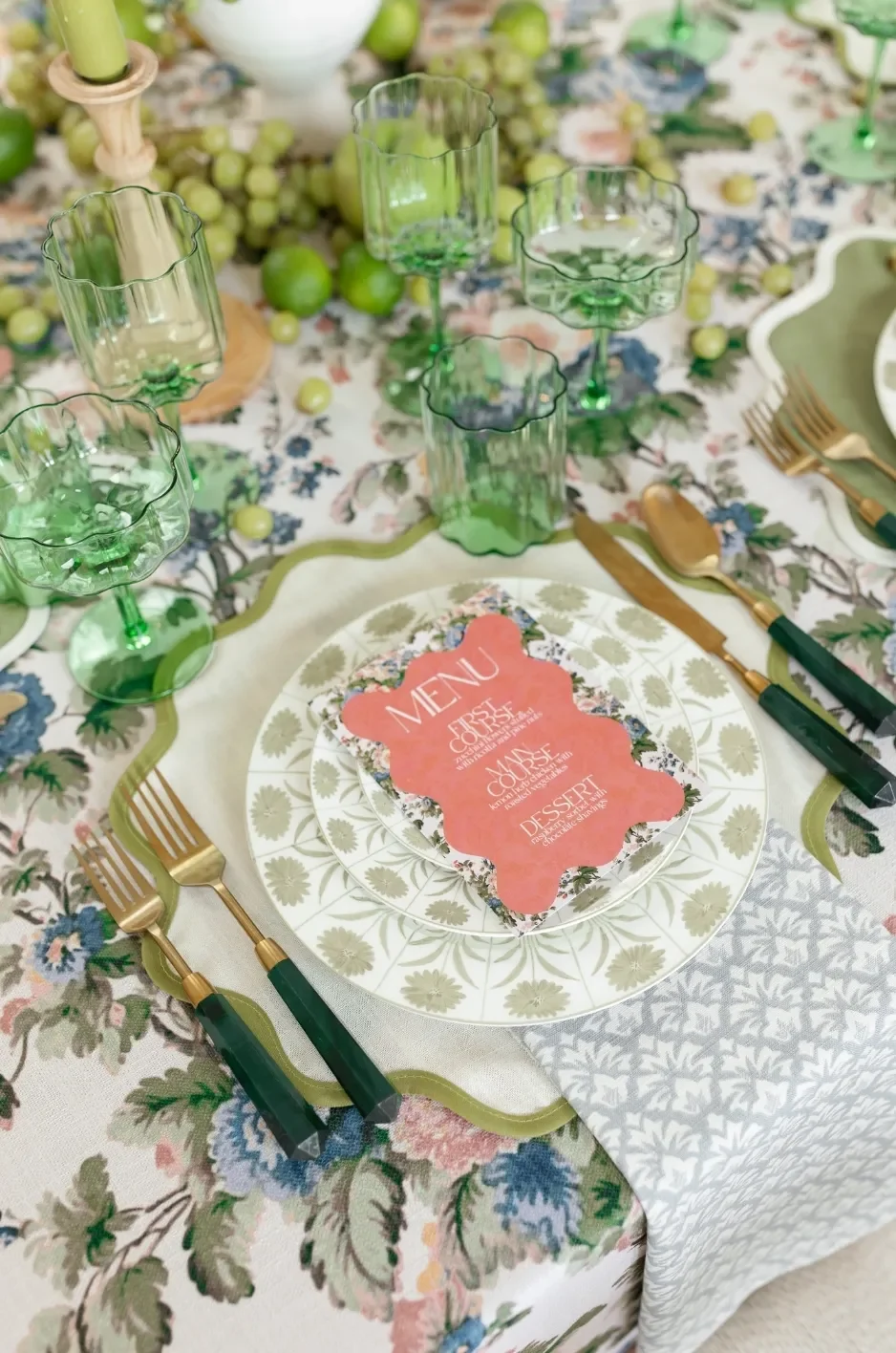
The room establishes an upper limit for pattern, color, and texture. Luxury tablecloth rentals should enhance the venue rather than compete with every existing detail.
Reduce Pattern in Highly Decorative Interiors
Historic ballrooms, patterned carpets, murals, carved walls, and ornate ceilings already contain substantial visual information.
In these spaces, pattern may be most effective on:
- Selected focal tables
- A small central group
- Cocktail or display tables
- Tables placed in visually quiet areas
Supporting solids can maintain the palette while allowing the architecture to remain clear.
Increase Textile Presence in Minimal Spaces
Clear tents, white galleries, modern halls, and restrained interiors can support stronger linens.
Here, tablecloths may supply much of the room’s color, movement, and personality. Pattern can be repeated more widely because there are fewer competing architectural surfaces.
Respond to Outdoor Views
Gardens, vineyards, coastal landscapes, and city views already provide color and movement.
The linen may:
- Echo a selected environmental color
- Create contrast against greenery
- Introduce structure to an organic setting
- Remain quieter so the view stays dominant
A literal interpretation is unnecessary. A garden reception does not require a floral tablecloth if the surrounding landscape already provides abundant botanical detail.
Account for Colored Draping and Lighting
Draping and uplighting can change how tablecloths appear.
Teal, amber, pink, or purple light may shift neutral and patterned fabrics in unexpected ways. Samples should be viewed near the actual draping and beneath lighting similar to the reception conditions.
Consider Flooring in Wide Room Views
Flooring occupies a large portion of wide photographs.
A tablecloth may coordinate with the place setting but conflict with a patterned carpet or tile. Review fabric samples at floor level or within a room rendering so the complete combination can be evaluated.
Keep Tabletop Details From Competing With the Cloth
A statement tablecloth needs enough visible surface to contribute to the design. Overly dense florals, layered china, patterned stationery, and excessive decorative objects can conceal or compete with it.
Scale Florals to the Linen’s Strength
A colorful or densely patterned tablecloth often benefits from:
- A more controlled floral palette
- Fewer flower varieties
- Clear vessel shapes
- Smaller arrangement footprints
- Open spaces between floral groupings
A quiet solid tablecloth can support more elaborate florals because it provides a calmer foundation.
Simplify Tableware Over Detailed Patterns
When the tablecloth carries the main pattern, consider restrained:
- China
- Chargers
- Menus
- Place cards
- Napkins
- Glassware
One patterned surface should generally lead. Other patterns may be included, but they should differ clearly in scale and visual intensity.
Use Napkins to Bridge Hero and Supporting Tables
A shared napkin can connect statement and solid tables.
The napkin might repeat a secondary color from the hero print, use a border related to the pattern, or provide a common texture across the room. This creates continuity without requiring the same tablecloth on every surface.
Preserve Visible Linen Around the Place Settings
Enough tablecloth should remain visible between:
- Plates
- Glassware
- Florals
- Candles
- Menus
- Decorative vessels
If nearly all of the linen is covered, the room-wide tablecloth plan loses much of its intended impact.
Include the Chairs in the Composition
Chair color, material, and upholstery affect how the tablecloth appears.
A detailed floral linen may need a simpler wood or metal chair. A restrained solid tablecloth may support upholstered or decorative seating. Review the chair and linen together rather than treating them as separate rentals.
Check How the Linen Plan Will Photograph
The tablecloths will appear in close tabletop details, room reveals, guest photographs, and elevated images. The plan needs to work at each distance.
Review the Reception-Reveal View
The wide room photograph should show clear hierarchy.
The hero linens should be recognizable, supporting tables should provide space around them, and focal areas should remain distinct. If every table looks equally strong, the room may lack a clear visual priority.
Check Pattern Repetition in Elevated Photographs
Balconies, stairs, platforms, and aerial photography reveal linen distribution more clearly than ground-level views.
Directional designs, random placement, and unbalanced clusters become particularly noticeable from above.
Protect Detail-Shot Backgrounds
Menus, rings, napkins, place cards, florals, and tableware are often photographed directly against the tablecloth.
A very detailed pattern may reduce legibility or compete with small objects. Where close-up photography is important, preserve areas of clearer color or negative space.
Evaluate Contrast Around the Couple and Guests
Consider how the linens will appear behind seated guests and the couple.
A tablecloth that closely matches chair upholstery or clothing tones may reduce separation in photographs. Clear but controlled contrast helps the people remain visually distinct from the table design.
Photograph the Mockup With Event Lighting
Camera exposure and flash can alter:
- Color depth
- Pattern contrast
- Reflectivity
- Fabric texture
- Highlight and shadow detail
Photograph the sample table rather than evaluating it only by eye.
Test the Linen Plan at Room Scale
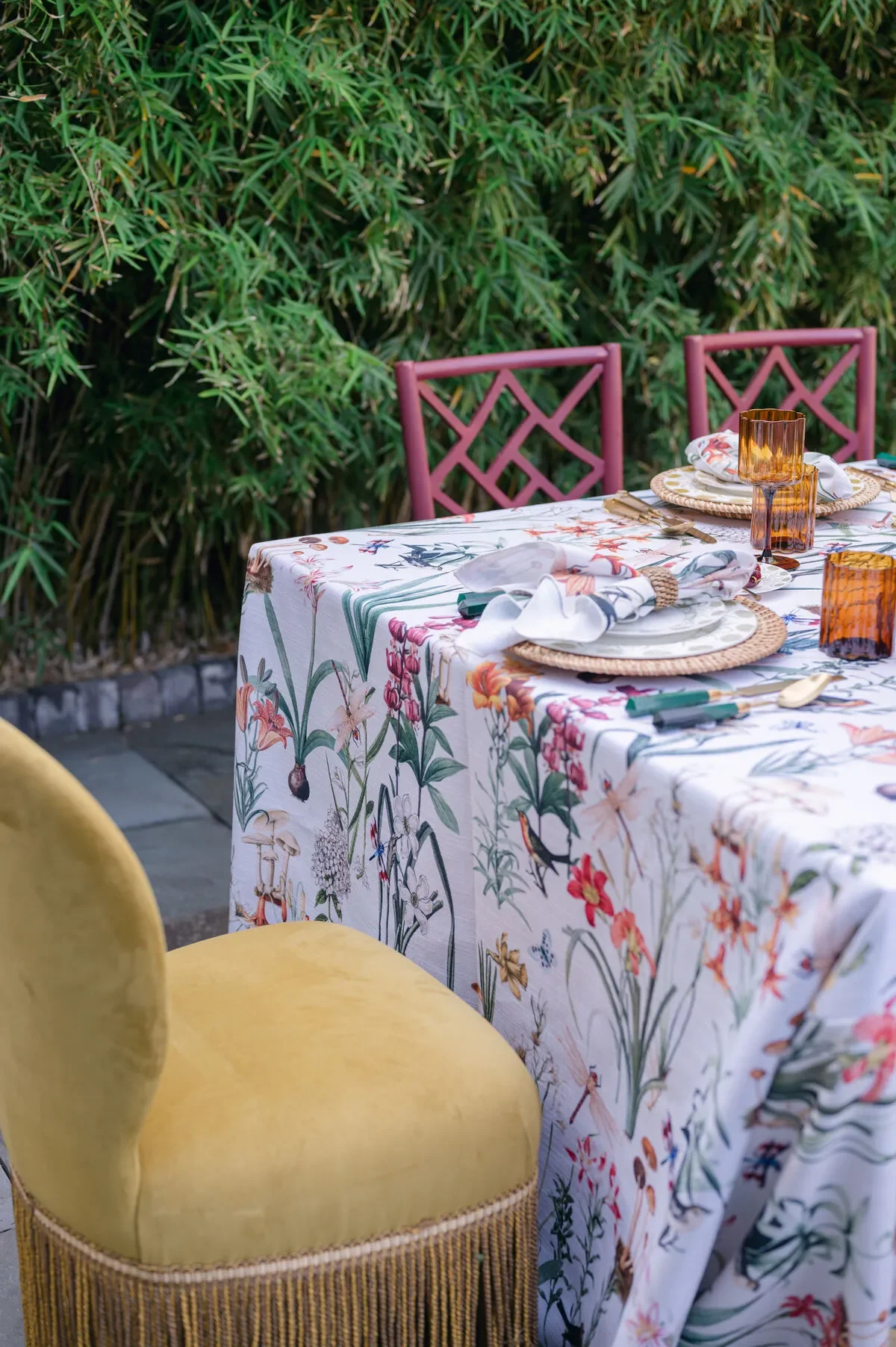
The final review should assess the individual table and the cumulative room effect.
Build the Fully Styled Hero Table
Assemble the tablecloth with:
- Chairs
- Plates and chargers
- Glassware
- Napkins
- Menus
- Florals
- Candles
- Table numbers
This confirms whether the supporting details allow the hero textile to remain visible.
Build a Supporting Solid Table Beside It
Viewing the hero and supporting treatments together shows whether the hierarchy is working.
The solid table should feel complete, not unfinished. At the same time, it should not compete with the statement linen through equally strong color, texture, or decorative detail.
Create a Scaled Floor-Plan Mockup
Assign a symbol or color to each linen treatment on the floor plan.
Include separate markers for:
- Hero tablecloths
- Supporting solids
- Sweetheart or head-table linens
- Custom pieces
- Cake and display tables
- Cocktail tables
The floor plan will reveal accidental clustering, imbalance, or overly rigid alternation.
View Several Repetitions Together
Use covered sample tables, digital room renderings, or printed images placed over the floor plan to simulate repetition.
This step is especially important for small-scale patterns, which may become denser when multiplied throughout the room.
Review the Design From Key Sightlines
Check the entrance, dance floor, couple’s table, room edges, and likely photography locations.
Ask whether the statement tables guide the eye or simply appear scattered.
Remove Pattern Where the Room Feels Heavy
When the hero linen begins to lose its distinction because it appears too frequently, replace selected tables with a supporting solid.
Reducing repetition often strengthens the statement more effectively than adding further variation.
Convert the Design Into a Room-Wide Linen Schedule
Once the design is approved, every table should receive a precise linen assignment. A room-wide schedule reduces setup errors and ensures the planned hierarchy is preserved.
Assign Each Table a Linen Code
Create a simple code for each treatment, such as:
- Hero pattern
- Supporting solid
- Focal-table linen
- Display-table linen
- Custom-sized tablecloth
The code should appear on both the linen schedule and the final floor plan.
Record the Table Number and Location
Do not rely only on total quantities.
List where every tablecloth belongs, including table number, reception zone, and nearby landmark where useful. This is particularly important when the same table shape uses more than one linen treatment.
Confirm the Product and Dimensions
For each table, document:
- Product name
- Color or pattern
- Table shape
- Table dimensions
- Linen dimensions
- Quantity
- Pattern orientation
- Custom setup notes
Separate Standard and Custom Tablecloths
Custom-sized or directional pieces should be clearly labeled.
A custom cloth designed for the sweetheart table or a long joined table should not be placed with standard guest-table inventory.
Create a Visual Setup Reference
Include product images, swatches, or mockup photographs beside the linen codes.
Visual references make the schedule easier to follow and reduce dependence on product names alone.
Confirm Shipping, Receiving, and Return Responsibilities
Curated Linen Collection offers patterned and solid linens, runners, napkins, pillows, specialty overlays, custom sizing, custom designs, and nationwide shipping. Standard orders are generally recommended at least four to six weeks before the event, while custom projects should begin at least eight to twelve weeks in advance.
Assign responsibility for:
- Receiving the shipment
- Checking quantities and sizes
- Preserving the packaging
- Directing linen placement
- Collecting the pieces after the event
- Preparing the return
Frequently Asked Questions About Statement Tablecloths
Should every wedding reception table use the same tablecloth?
No. Using one linen throughout can create continuity, but mixing a statement tablecloth with supporting solids often produces greater hierarchy and visual balance. The choice depends on the venue, table quantity, pattern strength, and surrounding décor.
How many patterned tablecloth designs can be used in one room?
There is no fixed maximum, but one pattern should usually lead. Additional prints should be quieter, used in smaller quantities, or separated by solid linens so the room retains a clear visual direction.
Can statement linens work in a venue with patterned carpet?
Yes, but the linen should be tested against the flooring. A lower-contrast or more open pattern may work better than a dense print. Solid tables can also be placed where the carpet or architecture is most detailed.
Should patterned tables be alternated with solid tables?
They can be, but strict alternation may create a checkerboard effect. Clusters, reception zones, or weighted repetition may feel more intentional depending on the floor plan.
How can solid linens feel connected to a statement print?
Pull a secondary color from the pattern, select a related texture, or repeat the same napkins, chairs, florals, or menu details across both table treatments.
What pattern scale works best in a large ballroom?
Large ballrooms can support both broad motifs and smaller repeats, but the pattern must be evaluated from across the room. Large motifs often read as color fields, while small repeats can become visually dense when multiplied.
Can different table shapes use the same patterned linen?
Yes, provided the pattern scale, orientation, and dimensions suit each table. Directional designs may need different placement on round and rectangular surfaces.
How should floral arrangements change over a patterned tablecloth?
A detailed tablecloth may need a more controlled floral palette, smaller arrangement footprint, or fewer varieties. Enough linen should remain visible for the pattern to contribute to the table.
Do focal tables need a completely different tablecloth?
Not necessarily. A focal table can use the hero linen in a custom size, a deeper related solid, or a coordinating variation. It should remain connected to the guest tables through color, texture, or pattern.
How can a linen plan be tested before the reception?
Build a fully styled hero table and a supporting table, photograph them under event lighting, and place each linen treatment on a scaled floor plan. Room renderings can also help simulate repetition.
Can statement tablecloths be custom sized or custom printed?
Yes. Curated Linen Collection offers custom sizing and bespoke design options for standard, specialty, and focal tables. Its team can develop custom textiles from pattern ideation and color selection through printing, cutting, sewing, and finishing.
When should luxury tablecloth rentals be reserved?
Standard selections should generally be reserved at least four to six weeks before the wedding. Custom designs should begin at least eight to twelve weeks in advance to allow time for design development and production. Availability may vary.
Design the Reception as One Complete Linen Composition
Luxury tablecloth rentals should be selected as part of the full reception rather than one table at a time. The same fabric can behave very differently depending on how often it appears, where it is placed, and what surrounds it.
Begin with the venue. Study the architecture, flooring, lighting, and main sightlines before deciding how much pattern the room can support. Establish a pattern budget, select one hero tablecloth, and use quieter solids to provide visual rest. Place the statement tables according to a clear floor-plan logic rather than scattering them randomly.
The tabletop details should support the linen hierarchy. Florals, china, napkins, menus, chairs, and glassware all affect whether the statement cloth remains visible or becomes one competing surface among many. A complete mockup and scaled room plan will reveal issues that cannot be seen from a swatch alone.
Curated Linen Collection offers luxury tablecloth rentals in patterned and solid designs, along with runners, napkins, specialty overlays, custom sizing, and bespoke printed textiles. With a room-wide linen strategy, these options can be used to create a reception that feels varied without becoming fragmented and expressive without losing visual clarity