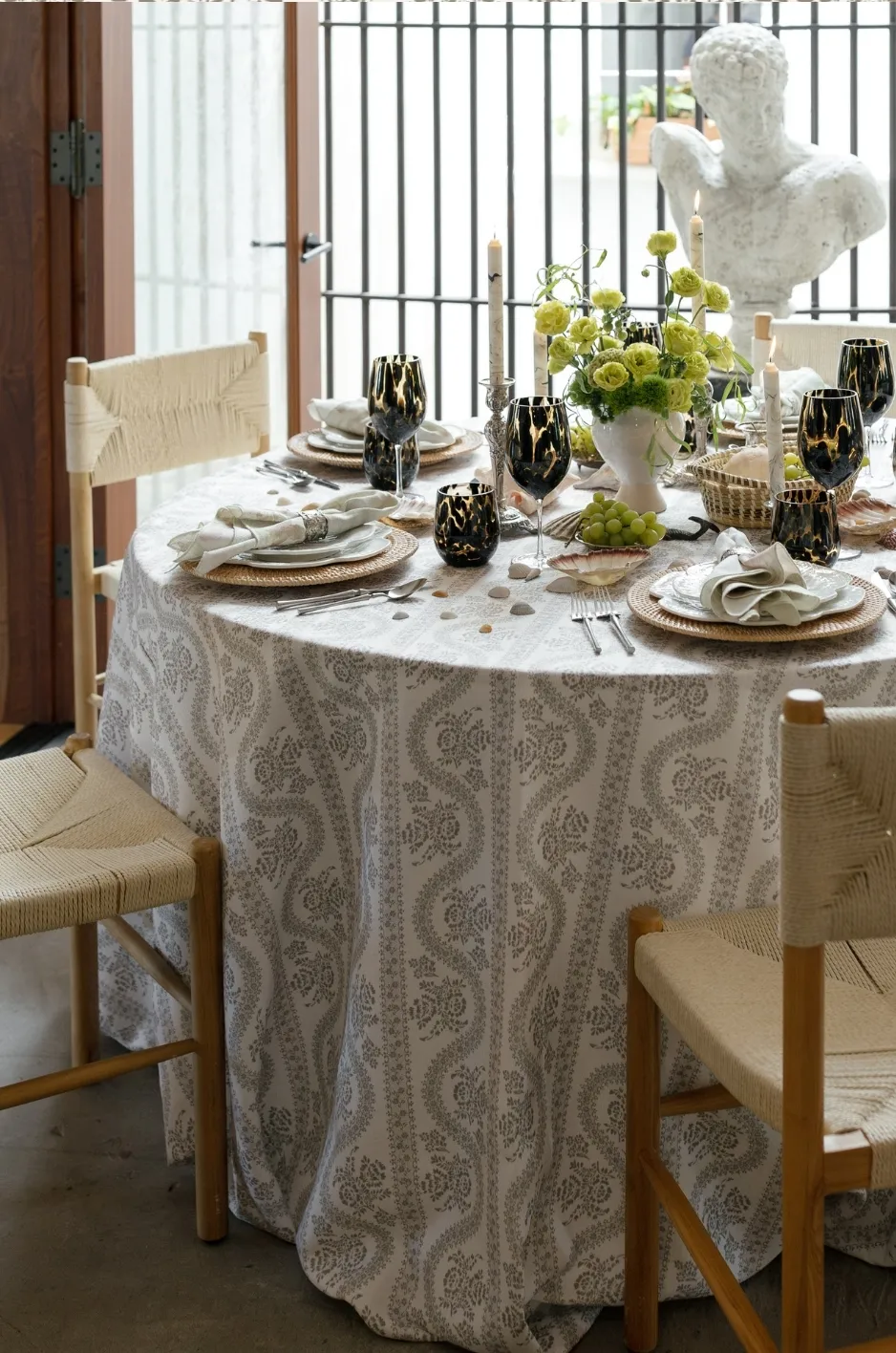
A tablecloth may appear to be the largest design surface on a wedding table, but much of it disappears once the complete setting is installed. Chargers, dinnerware, glassware, menus, floral arrangements, candles, chairs, and service pieces can conceal large sections of the fabric, leaving only selected areas visible to guests.
This changes how luxury wedding tablecloth rentals should be evaluated. A pattern that looks striking in a product image may lose its defining motif beneath a centerpiece. A custom detail placed in the center of the cloth may never be seen, while a border positioned near the table edge could remain visible throughout the reception. Even the hanging drop may have more influence on the room than the tabletop itself.
A linen visibility map helps planners identify which sections of a tablecloth will remain exposed after installation. By reviewing the center, place-setting area, perimeter, and drop separately, the linen can be selected according to how it will function within the completed tablescape rather than how it appears as an empty cloth.
Create a Linen Visibility Map Before Selecting the Tablecloth
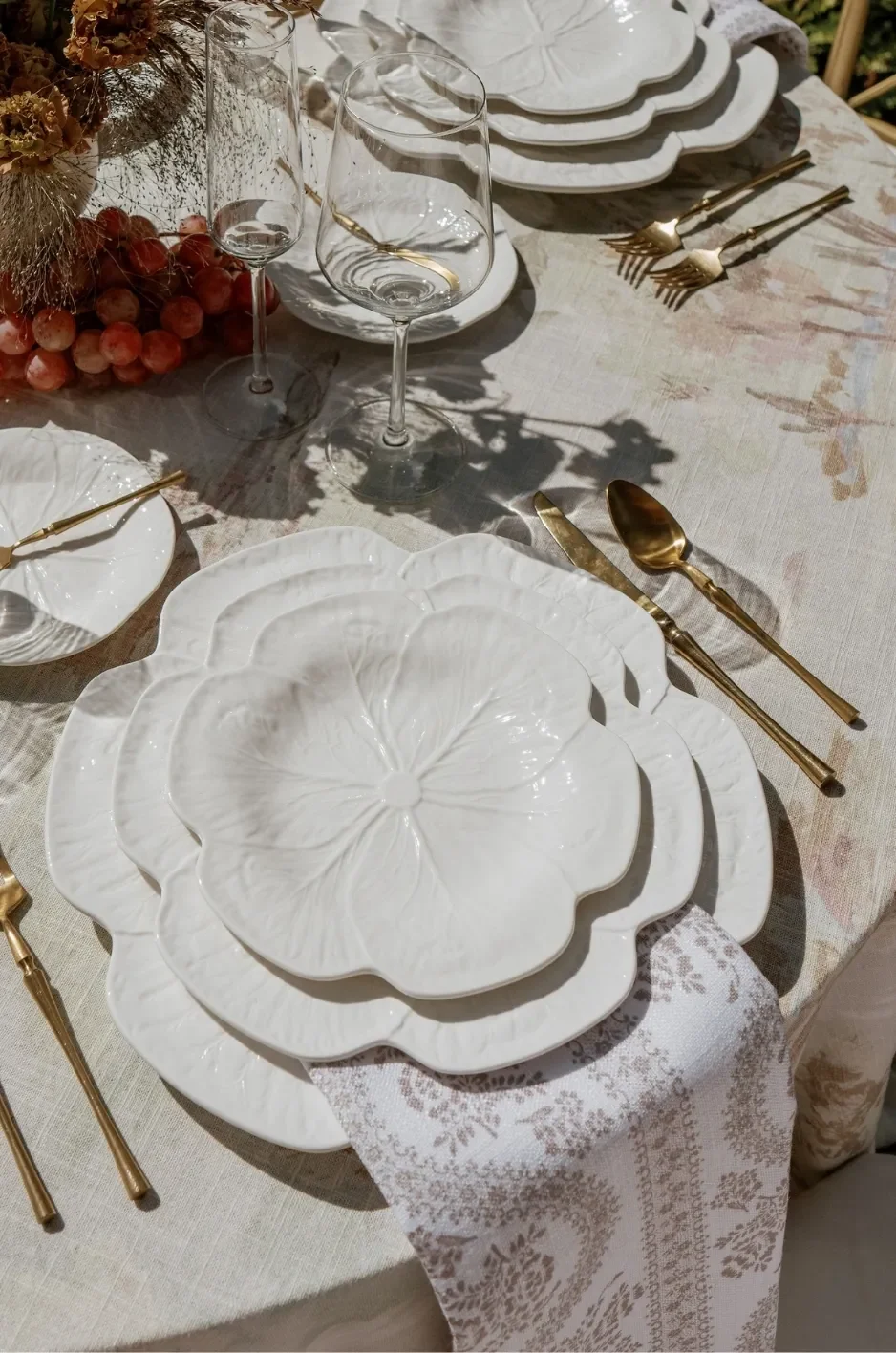
A linen visibility map divides the tablecloth into the areas that guests are most likely to see. It accounts for the objects that will cover the fabric, the angles from which the table will be viewed, and the sections that will remain visible after guests are seated.
This exercise should take place before the final tablecloth, pattern, border, or custom detail is approved. It can be used for patterned rentals, solid linens, specialty textures, custom-printed tablecloths, and engineered border designs.
Divide the Tablecloth Into Four Visible Zones
Begin by separating the tablecloth into four functional zones.
- The center zone sits beneath floral arrangements, candles, vessels, shared dishes, and other decorative elements. Depending on the centerpiece footprint, this area may be almost completely concealed.
- The place-setting zone contains plates, chargers, flatware, menus, place cards, and glassware. Portions of the linen remain visible between these objects, but a dense setting can substantially interrupt a pattern.
- The perimeter zone is the exposed tabletop between the place settings and the edge of the table. This may be one of the most consistently visible sections, particularly when the table has a restrained setting.
- The drop zone extends from the tabletop toward the floor. Although it is partially interrupted by chairs and natural fabric folds, it may create the strongest room-scale impression.
These areas do not need equal design emphasis. The goal is to identify which zone will communicate the color, texture, or pattern most effectively.
Estimate How Much of Each Zone Will Be Covered
The amount of visible linen depends on the footprint of every tabletop item. Before selecting a pattern, estimate the space required for:
- Chargers and dinner plates
- Flatware
- Water, wine, and specialty glassware
- Menus and place cards
- Floral vessels
- Candles and candleholders
- Bread plates or shared service pieces
- Favors and decorative objects
- Table numbers
- Beverage or food service
Exact percentages are not necessary. Instead, determine whether the cloth will be viewed primarily through the center, perimeter, or hanging drop.
For example, a table with a wide floral arrangement, layered place settings, several glasses per guest, and individual menus may reveal very little of the center or place-setting zones. A large print placed there could become fragmented. A restrained solid, woven texture, or perimeter border may provide greater visual impact.
Mark the Primary Guest and Camera Views
A tablecloth may appear differently depending on the viewing angle. Identify the locations from which the tables will be seen most often, including:
- The room entrance
- Main guest walkways
- The dance floor
- The stage or entertainment area
- Seated guest positions
- Staircases or balconies
- The ceremony-to-reception transition
- Primary photography angles
An overhead pattern may perform well in flat-lay photographs but have a limited effect from across the room. A decorative border may be highly visible from a seated position but disappear in an elevated image.
The strongest tablecloth choice supports the views that matter most for the actual event rather than only the product photograph.
Determine Which Linen Zone Should Carry the Design
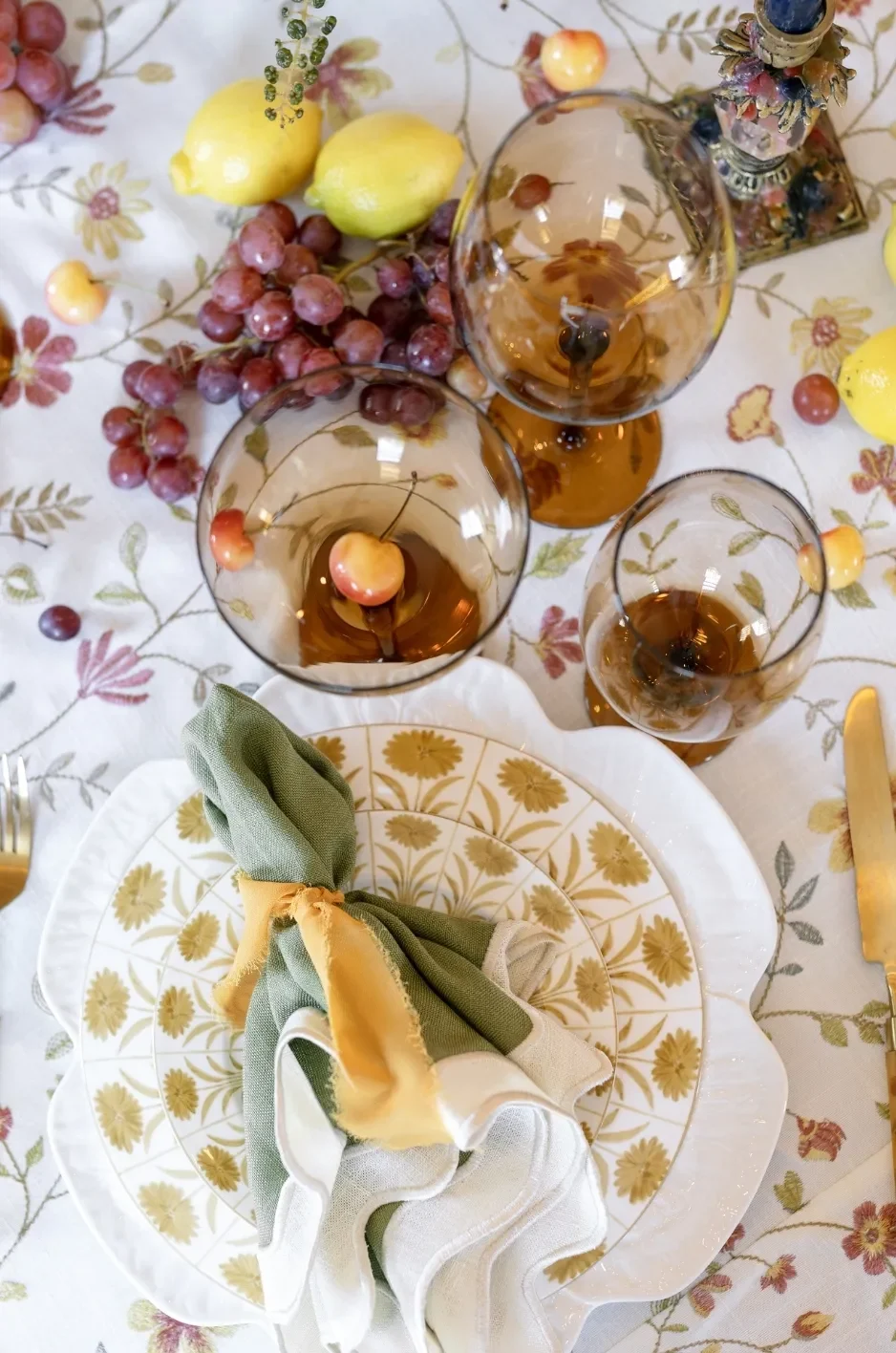
Once the visible sections have been mapped, decide where the strongest design information should appear. A luxury tablecloth does not need an equally intense pattern across its entire surface.
The design may be concentrated in an all-over print, a perimeter border, a framed edge, a visible drop, or a controlled textural finish. The right approach depends on how much of the cloth will remain exposed and where guests will encounter it.
Use Allover Patterns When Broad Areas Remain Visible
An allover pattern can work effectively when large portions of the tablecloth remain exposed.
It may be appropriate when:
- Centerpieces have a limited footprint
- Place settings are visually restrained
- The table is visible from above
- The design must read from several directions
- The pattern remains recognizable when partially covered
- The linen is intended to establish the main room-wide statement
The repeat should still be reviewed at full table scale. A small pattern may become visually restless when multiplied across a large cloth, while an oversized motif may disappear beneath plates and florals.
The strongest allover patterns remain coherent even when interrupted. Guests should still be able to understand the rhythm, color relationship, or motif without seeing the complete repeat.
Use Borders When the Perimeter or Drop Is Most Visible
A border or framed treatment can be more effective when the center of the table will be heavily covered.
Potential applications include:
- A border surrounding a round guest table
- A framed edge on a rectangular banquet table
- A contrasting hem
- A scalloped perimeter
- An engineered motif positioned close to the table edge
- A decorative panel along the primary room-facing side
Borders need to be placed according to the exact table dimensions and desired drop. If the border sits too close to the center, place settings may conceal it. If it is positioned too far down the drop, chairs may interrupt it.
Custom development can be especially valuable when a border must align with a specific table size or viewing angle.
Use Solids or Quiet Textures When Décor Covers the Center
A solid or restrained woven linen may provide greater impact than a detailed print when the tabletop is already visually active.
This approach is useful when the table includes:
- Large floral arrangements
- Layered place settings
- Patterned dinnerware
- Graphic menus
- Multiple candle groupings
- Detailed chargers
- Strong metallic finishes
- Several decorative objects
A quiet linen can still feel luxurious through its color, drape, weave, softness, or reflective quality. It creates a controlled foundation that allows the objects above it to remain distinct.
The absence of a large pattern does not make the table less considered. In many cases, restraint gives the entire setting greater clarity.
Adapt the Visibility Strategy to the Table Shape
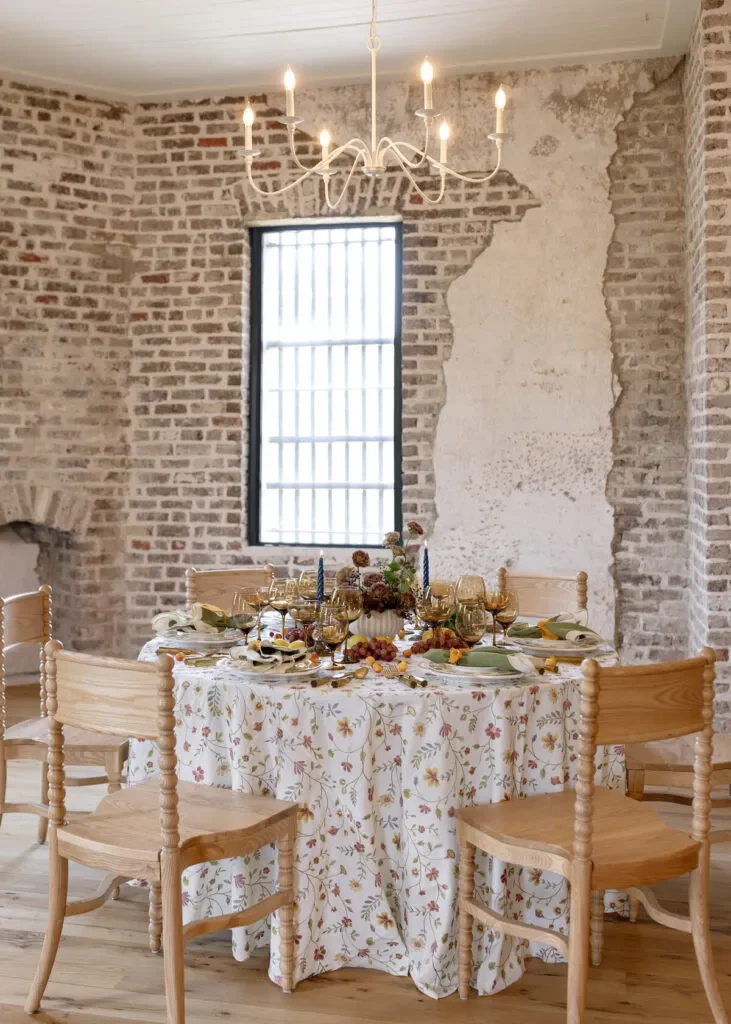
Table shape changes how fabric is exposed. Round tables create a continuous perimeter, rectangular tables produce long side views, and specialty tables introduce corners, curves, or directional surfaces that may not suit a standard pattern layout.
The visibility strategy should therefore respond to the furniture rather than treating every tablecloth as a flat, uninterrupted canvas.
Plan for Continuous Visibility on Round Tables
A round table has no natural front or back. Guests sit around the full circumference, and the linen is viewed from every direction.
Consider how this affects:
- Repeating borders
- Radial patterns
- Directional motifs
- Large-scale florals
- Pattern orientation
- The spacing between chairs
- The consistency of the hanging drop
A directional illustration may appear upright to some guests and inverted to others. A continuous repeat or radial layout may be more effective when the pattern needs to read evenly around the table.
Borders should also remain consistent around the circumference. Irregular placement becomes especially noticeable when guests can view the cloth from several sides.
Use Long Side Views on Banquet Tables
Rectangular and estate tables often create long, uninterrupted visual lines. Guests and photographers may see one extended side before noticing the tabletop.
Review:
- Pattern repetition along the length
- Border placement beside seated guests
- Decorative treatment at the table ends
- Runner interaction
- Alignment between joined tables
- Motif interruption at seams
- Whether end chairs conceal important details
A border positioned along the long sides may create a strong visual rhythm, while a central design may disappear beneath florals and place settings.
The table ends should be assessed separately. They may become focal positions, remain fully visible, or be concealed by chairs and surrounding décor.
Treat Square and Specialty Tables Individually
Square, oval, serpentine, curved, or custom-built tables can expose fabric in less predictable ways.
Identify:
- Prominent corners
- Curved drop sections
- Custom seams
- Directional transitions
- The primary room-facing side
- Areas hidden by service equipment
- Sections visible from guest pathways
A standard repeat may become distorted around curves, while a border designed for a rectangular table may not transition cleanly around an irregular edge.
These surfaces may require custom sizing, simplified pattern placement, or a stronger focus on color and texture rather than detailed motifs.
Coordinate Pattern Strength With Tabletop Density
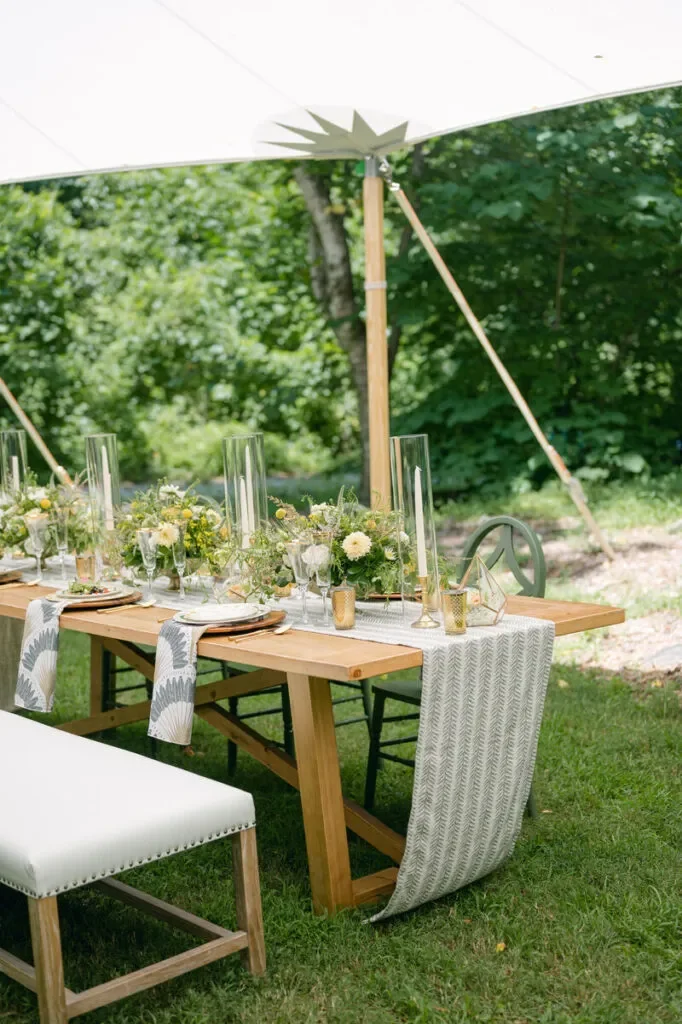
The tablecloth and tabletop design occupy the same visual field. Plates, florals, candles, stationery, glassware, and decorative objects all affect how much attention the linen can carry.
The pattern should therefore be selected according to the density of the completed setting rather than viewed as an independent design decision.
Pair Dense Tabletop Designs With Controlled Linens
A restrained tablecloth may be the stronger choice when the setting already contains several visually active elements.
These may include:
- Patterned plates
- Ornate chargers
- Multiple glasses
- Layered menus
- Elaborate florals
- Decorative favors
- Numerous candleholders
- Sculptural flatware
The linen can still add depth through a woven texture, tonal variation, soft sheen, or saturated color. It does not need another detailed motif to feel luxurious.
A controlled foundation helps preserve the distinction between the tabletop materials and prevents the place setting from appearing crowded.
Use Stronger Tablecloths Beneath Restrained Place Settings
A statement tablecloth can become the principal design element when the objects above it are deliberately simple.
It may be paired with:
- Clean dinnerware
- Clear glassware
- Minimal stationery
- Controlled floral colors
- Simple chair silhouettes
- Limited decorative layering
The tablecloth should remain visible around the place settings and between the centerpiece elements. If the pattern is almost entirely concealed, its design value will be reduced.
A mockup can reveal whether the statement cloth still reads as a complete surface once the table is fully set.
Prevent the Centerpiece From Dividing the Linen Design
A centerpiece can interrupt a tablecloth pattern in several ways. It may cover the primary motif, split a continuous composition, conceal the most saturated color, or create too much visual concentration in the center.
Review whether the centerpiece:
- Covers the principal design feature
- Divides a pattern awkwardly
- Competes with a border
- Repeats the same motif too literally
- Conceals most of the printed surface
- Creates excessive density in one area
The floral and linen plans should be reviewed together. If the centerpiece is highly detailed, the tablecloth may need to become quieter. If the linen carries the main pattern, the floral arrangement may need more open space or a more controlled palette.
Design the Drop as Part of the Wedding’s Room View
The hanging drop may be the largest uninterrupted area of fabric, particularly when the tabletop is heavily styled. It contributes to the silhouette of the table and to the repeated visual rhythm created by rows of covered tables.
The drop should be designed as part of the room rather than treated as leftover fabric below the tabletop.
Evaluate the Drop Between Chairs
Chairs obscure portions of the cloth but leave narrow panels visible between seats.
Assess whether:
- A large motif becomes fragmented
- Stripes appear uneven
- The pattern feels too busy in narrow sections
- The color remains consistent
- The chair backs compete with the linen
- Important details disappear behind seating
A large floral design may look balanced on a flat cloth but become difficult to read once divided into repeated panels between chairs.
Solids, tonal patterns, and smaller repeats may remain more coherent in these narrow visible areas.
Review the Drop From Main Walkways
Determine which side of the table will face the strongest sightlines.
Guests may see:
- The long side of a banquet table
- A continuous row of round-table drops
- The front of the sweetheart table
- Only the corners of guest tables
- A fully covered bar or display surface
- A prominent table facing the dance floor
The most visible face may justify a border, custom panel, controlled motif, or stronger textural treatment.
For directional designs, the placement schedule should identify which side must face the room.
Check How Fabric Folds Affect the Pattern
A tablecloth does not hang as a perfectly flat surface. Natural folds can distort:
- Large floral motifs
- Geometric lines
- Stripes
- Illustrated scenes
- Borders
- Lettering
- Monograms
A pattern should remain attractive when gathered naturally around the table. Designs that depend on precise flat alignment may lose their intended effect once draped.
For custom linens, the fabric behavior should be considered during pattern development rather than after production.
Account for the Table’s Changing Appearance During Service
A wedding table changes throughout the reception. Napkins are unfolded, menus are removed, plates are cleared, glasses are moved, and personal items begin to occupy the perimeter.
The linen should remain coherent during these transitions rather than looking balanced only in the initial installation photographs. You may also find The Ultimate Guide to Event Linens for Elegant Events helpful.
Review the Fully Set Table
Before guests arrive, examine whether: You may also find Are High-End Event Linens Worth It for Luxury Events helpful.
- The principal pattern remains visible
- Place settings interrupt the design evenly
- Borders align with the chairs
- The cloth supports the floral arrangement
- The drop appears consistent
- The room-wide repetition feels controlled
- The table photographs well from key angles
This is the most formal version of the table, but it should not be the only version considered.
Anticipate the Table After Guests Are Seated
Once guests sit down:
- Chairs move closer to the table
- Napkins leave the place settings
- Menus may be removed
- Handbags and personal items may appear
- Glassware may shift
- Service pieces may be added
- Portions of the drop become less visible
A directional border may become partially concealed by chairs, while more of the place-setting zone may appear after menus are removed.
The tablecloth should still feel intentional when the setting becomes less controlled. You may also find Discover Why Luxury Tablecloth Rentals Are Worth It helpful.
Consider How the Linen Reads Between Courses
As plates are cleared, more of the tabletop may become visible. A statement pattern that appeared restrained beneath a full place setting may become much stronger later in the evening.
This gradual reveal can be effective, but it should be anticipated. A dense design may begin to compete with used glassware, candles, and remaining service pieces once more of the cloth is exposed.
The most successful linen supports every stage of the meal rather than only the opening presentation.
Use Repetition to Control the Room-Wide Linen View
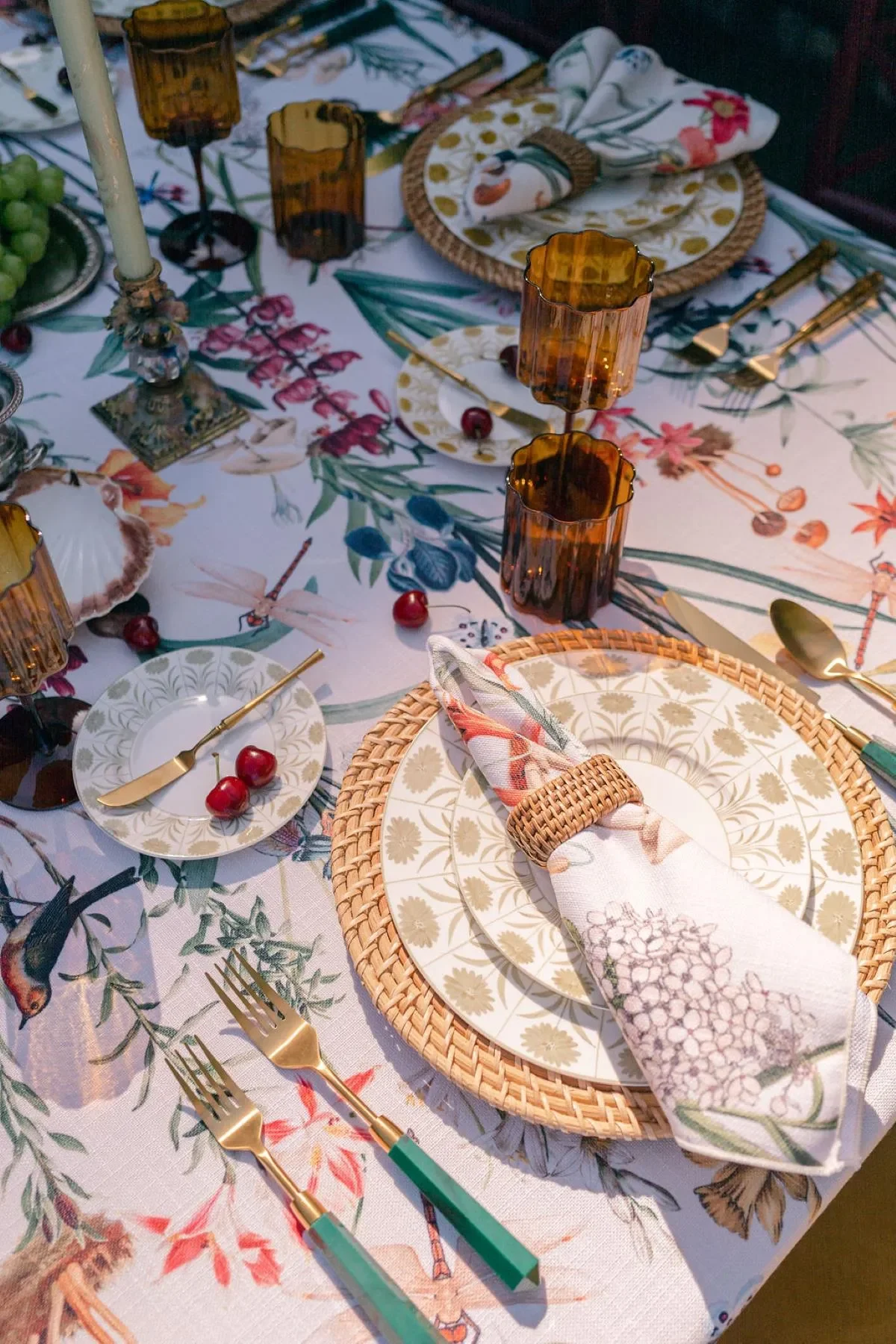
A single tablecloth may appear subtle on its own but become visually dominant when repeated across an entire reception. Color, pattern, texture, and drop all multiply with the table count.
The linen should therefore be assessed both as one table and as part of a larger room composition.
Test One Table Before Multiplying the Design
A mockup should be considered in relation to the full number of tables.
Ask:
- Will the color dominate when repeated across the room?
- Will the pattern create too much visual movement?
- Does the linen retain enough contrast from the flooring?
- Will repeated borders create a clear rhythm?
- Can focal tables still stand apart?
- Does the design work beside the venue architecture?
A pattern that feels controlled on one table may become overwhelming when used 20 or 30 times.
Alternate Exposure Rather Than Introducing Unrelated Linens
Variation does not require several unrelated textile stories.
A cohesive plan may use:
- Patterned tables alternating with coordinating solids
- One foundation linen with selected bordered tables
- The same motif in different textile formats
- Solid guest tables with one custom focal cloth
- Shared napkin colors connecting several tablecloths
- A patterned head table supported by quieter guest tables
This approach changes the amount of pattern exposure while maintaining a consistent palette and design language.
Preserve Visual Rest Between Statement Tables
Statement linens need quieter surroundings to remain visible.
Identify where the room requires:
- Solid tablecloths
- Reduced pattern density
- Softer tonal contrast
- Fewer textile layers
- Greater spacing between strong prints
- Simpler tabletop arrangements
Visual rest prevents the room from feeling uniformly busy and gives focal surfaces greater significance.
Evaluate Tablecloth Samples at Full Scale
A small fabric swatch can show color and texture, but it cannot reveal how a repeat, border, or large motif will behave across a complete table.
Full-scale review is particularly important for custom-printed linens, engineered designs, strong patterns, and textiles with directional details.
Build a Representative Table Mockup
The mockup should include:
- The actual table or an accurately sized equivalent
- The proposed tablecloth
- Representative dinnerware
- Chargers
- Flatware
- Glassware
- Menus
- Place cards
- Floral vessels
- Candles
- Chairs
The purpose is to identify how much linen remains visible and which zones carry the design.
A styled mockup can also reveal whether the cloth is too active, too quiet, or positioned incorrectly.
Photograph the Table From Several Angles
Capture the mockup from:
- The room entrance
- A seated position
- The end of the table
- An overhead or elevated view
- A close-up of the place setting
- A wide angle with adjacent tables represented
Compare which parts of the linen appear consistently and which disappear.
A border may be highly effective in the seated photograph but absent from the overhead view. An allover print may read strongly from above but appear only as a color field from across the room.
Test the Cloth Under Relevant Lighting
Review the linen under conditions similar to the wedding.
Consider:
- Daylight
- Candlelight
- Overhead venue lighting
- Evening conditions
- Uplighting
- Camera flash
- Reflections from glassware or metallic objects
Lighting can change the perceived color, contrast, texture, and sheen of the tablecloth. A subtle pattern may disappear in low light, while a reflective finish may become more prominent than expected.
Use Custom Design When Pattern Placement Must Be Controlled
Custom tablecloth design is most valuable when an existing rental cannot place the required detail in the section that will remain visible.
Customization should solve a defined placement problem rather than function as a general indicator of luxury.
Create an Engineered Border for the Visible Perimeter
A custom border may be appropriate when:
- The center of the table will be heavily covered
- The perimeter will remain exposed
- A framed design supports the stationery or venue architecture
- The table requires a tailored rather than allover composition
- The border must align with a specific drop
Exact measurements are essential. The border width and position should be determined according to the tabletop dimensions, place-setting depth, and desired hanging drop.
Position a Motif Around Place Settings
A custom pattern can be developed around the actual table layout.
Placement may account for:
- Plate diameter
- Guest spacing
- Centerpiece footprint
- Seating count
- Table shape
- Primary viewing angle
- The space between place settings
Motifs can be positioned outside the charger area, between guests, along the perimeter, or within other consistently exposed zones.
This allows the pattern to remain visible rather than being concealed by the objects placed above it.
Adapt One Design Across Different Linen Formats
A custom motif does not need to appear identically on every piece.
It may be translated into:
- An allover tablecloth pattern
- A simplified napkin detail
- A runner border
- A placemat edge
- A panel for the bar
- A smaller motif for the cake table
- A coordinating pillow accent
Changing the scale and placement allows the design to remain recognizable while responding to each textile’s function.
Coordinate the Custom Piece With Existing Rentals
A custom tablecloth can be supported by existing solid and patterned rentals. We cover this further in Affordable Luxury Table Linen Rentals for Your Event.
Coordinating pieces may include:
- Solid guest-table linens
- Complementary napkins
- Restrained runners
- Specialty overlays
- Placemats
- Lounge pillows
- Related patterned linens
The custom piece should occupy a defined role within the wider linen program. It does not require every surrounding textile to be produced from the same fabric.
Prepare a Linen Visibility Specification for Installation
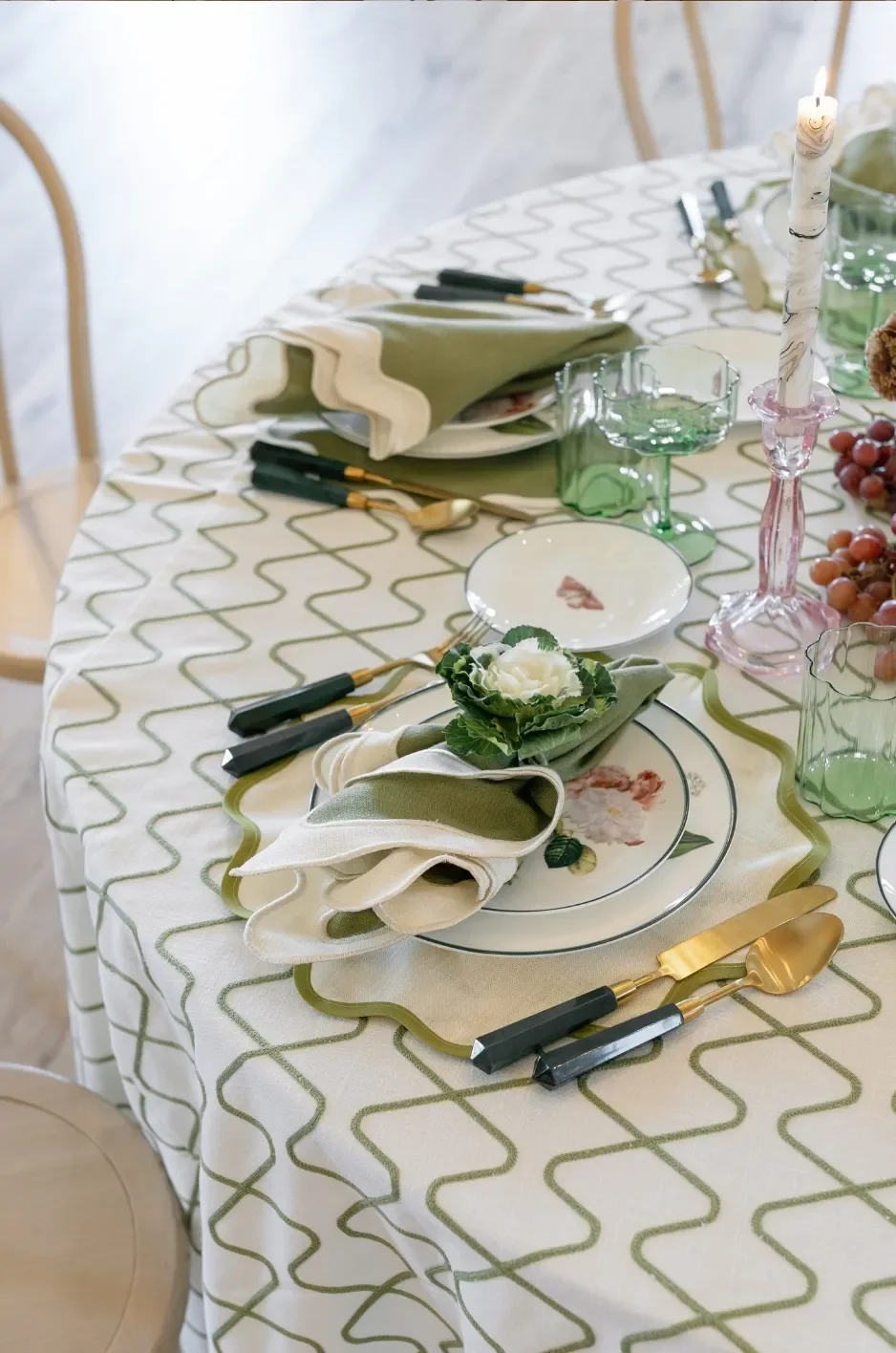
A carefully designed tablecloth can lose its intended effect if it is placed in the wrong orientation or if borders, motifs, and drops are installed inconsistently.
A visibility specification gives the installation team clear instructions for each table.
Record the Orientation of Each Linen
For directional or engineered textiles, identify:
- Front and back
- Top and bottom
- Primary table end
- Border direction
- Motif direction
- Main room-facing side
- Required alignment with chairs or focal points
These instructions should be documented rather than communicated verbally during installation.
Mark Which Tables Receive Each Treatment
The placement schedule should list:
- Table number or location
- Table dimensions
- Linen collection
- Linen size
- Pattern orientation
- Custom or rental status
- Related runner, overlay, or napkin
- Primary sightline
- Any special installation instructions
This is particularly important when the reception uses several coordinated tablecloth treatments.
Conduct a Pre-Opening Visibility Check
Before guests enter, review:
- Pattern alignment
- Border position
- Evenness of the drops
- Chair spacing
- Centerpiece placement
- Obscured motifs
- Room-wide repetition
- Main photography views
- Table-number visibility
Any adjustment should be made before candles are lit, service begins, or personal items appear on the tables.
Frequently Asked Questions
How Much of a Wedding Tablecloth Usually Remains Visible?
There is no universal percentage. Visibility depends on the table dimensions, place-setting width, centerpiece footprint, chair placement, linen drop, and number of decorative elements.
A full table mockup provides a more accurate answer than a general estimate.
Is an Allover Pattern Better Than a Border?
Neither treatment is always better.
An allover pattern works well when broad tabletop areas remain visible and the design must read from several directions. A border may be more effective when the center is heavily covered but the perimeter or drop remains exposed.
Can a Large Pattern Work on a Small Wedding Table?
Yes, provided the motif remains recognizable after the place settings and centerpiece are installed.
The repeat should be tested at actual scale. An oversized motif may create a strong cropped effect, but it should not disappear entirely beneath the tabletop elements.
Should a Tablecloth Be Selected Before the Centerpiece?
The general linen direction may be established first, but final approval should consider the centerpiece’s dimensions, vessel material, height, color density, and placement.
The floral and linen plans should be reviewed together before either is finalized.
How Can Planners Keep Patterned Linens From Overwhelming the Room?
Use controlled repetition, coordinating solids, restrained place settings, and sufficient visual rest between statement surfaces.
A strong pattern may be reserved for selected tables rather than repeated across the entire reception.
Do Custom Borders Need Exact Table Measurements?
Yes. The tabletop dimensions, table height, desired drop, border width, and intended placement must all be confirmed.
Without accurate measurements, the border may sit beneath the place settings, disappear into the folds, or hang lower than intended.
How Should a Directional Tablecloth Be Installed?
The placement schedule should identify the main room-facing side, table ends, pattern direction, and any required alignment with chairs, walkways, the stage, or other focal points.
The installation team should complete a visibility check before the room opens.
Conclusion
A luxury wedding tablecloth should be evaluated as part of a completed reception table. Pattern, color, texture, border placement, and custom details only create value when they remain visible within the final installation.
A linen visibility map helps planners determine where the cloth will be exposed, which zone should carry the design, and how the tablecloth will interact with place settings, florals, chairs, service, and room-wide repetition. It also provides a clearer basis for deciding when an allover pattern, engineered border, quiet solid, or custom placement will be most effective.
Curated Linen Collection offers premium patterned and solid table linens, coordinating textile formats, custom sizing, and bespoke pattern-development capabilities for design-led weddings and events. By selecting the linen according to the surface guests will actually see, planners can create tables that remain visually intentional from installation through the final course. You can view every fabric in our luxury linen rentals collection.