
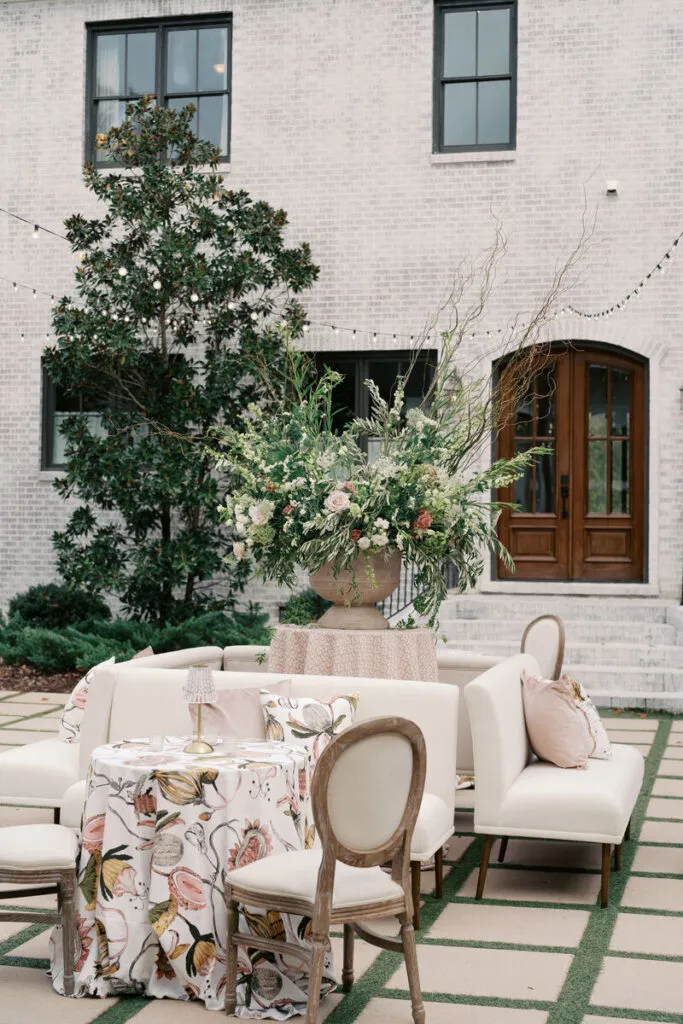
Event linens are usually selected at the scale of an individual table. Planners compare swatches, coordinate napkins with dinnerware, and assess how a pattern relates to the floral design. Guests, however, first encounter those choices at the scale of the entire venue.
From the entrance, tables appear as groups of color, pattern, and vertical fabric. One statement linen may draw attention toward the head table, while a repeated solid can connect a dispersed dining area. A custom border positioned on the room-facing side of a banquet table can reinforce an architectural axis without altering the venue itself.
This is where table linens begin to function as soft architecture. They do not replace walls, platforms, or permanent design features. Instead, movable textile surfaces help define visual destinations, clarify functional zones, connect separated areas, and direct attention through the room.
Curated Linen Collection offers table linens in varied sizes alongside runners, napkins, pillows, specialty overlays, and custom options, allowing planners to build coordinated textile systems across multiple event surfaces.
Conduct a Sightline Survey Before Selecting Linens
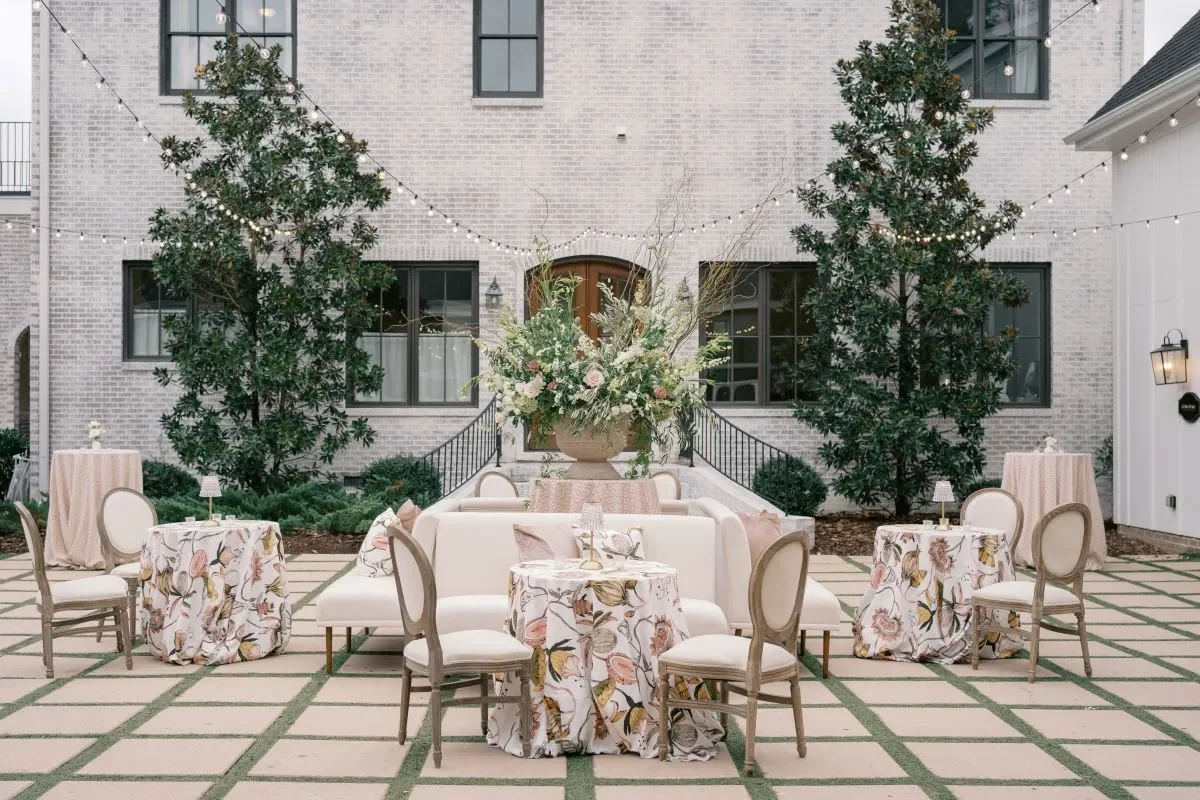
The first linen decision should not be a fabric, pattern, or color. It should be an assessment of how guests will experience the room.
A sightline survey identifies the venue’s strongest existing features, the directions from which guests will approach, and the tables that naturally attract attention. It also reveals where the room feels visually disconnected or where several focal points compete.
This information provides a more reliable foundation for the linen plan than evaluating each table independently.
Mark the Primary Arrival View
Stand at the entrance guests will use and note what appears within the first few seconds.
The initial view may include:
- A head or sweetheart table
- A central banquet table
- The dance floor
- A fireplace
- A bar
- A staircase
- A stage
- A window wall
- Several rows of guest tables
- A floral or escort-card installation
Determine which feature should become the visual destination. The linen plan can then lead attention toward it, frame it, or remain restrained enough to prevent another surface from competing.
For example, if a historic fireplace already anchors the far end of a ballroom, the nearby head table may not need the strongest pattern in the room. A controlled solid or bordered linen could connect the table to the architecture without covering the focal area in another layer of visual information.
In a modern venue with no obvious architectural endpoint, a long table dressed in a distinctive linen may provide the destination the room otherwise lacks.
Identify the Venue’s Existing Visual Anchors
Permanent architectural features already possess visual weight. They should be treated as part of the composition rather than as backgrounds that need to be decorated.
Potential architectural anchors include:
- Ornate mantels
- Arched windows
- Decorative ceilings
- Columns
- Sculptural lighting
- Historic murals
- Grand doors
- Exposed beams
- Monumental staircases
- Glass walls
- Large-scale artwork
Record which features are visible from the entrance, guest tables, dance floor, and primary walkways.
A strong linen placed directly beneath dense ornament may compete with it. Conversely, a statement cloth positioned in a quieter portion of the room can balance the composition and prevent all visual attention from collecting on one side.
The objective is not to match every architectural detail. It is to understand where the room already has visual authority and where textiles need to provide structure.
Locate Broken or Obstructed Sightlines
Columns, partial walls, service stations, AV equipment, stairs, and large installations can divide a venue into areas that feel disconnected.
Walk through the room and identify where a guest loses sight of:
- The head table
- The dance floor
- Other dining areas
- The bar
- The stage
- A major architectural feature
- The main event entrance
Linens can help reestablish continuity across these interruptions. Repeating one napkin color or related tablecloth pattern on both sides of a column can signal that the tables belong to the same design system.
A stronger textile placed at the end of a broken sightline can also give the eye a destination. However, too many unrelated statement linens may emphasize the fragmentation rather than solve it.
Classify Linen Areas as Anchors, Bridges, or Backgrounds
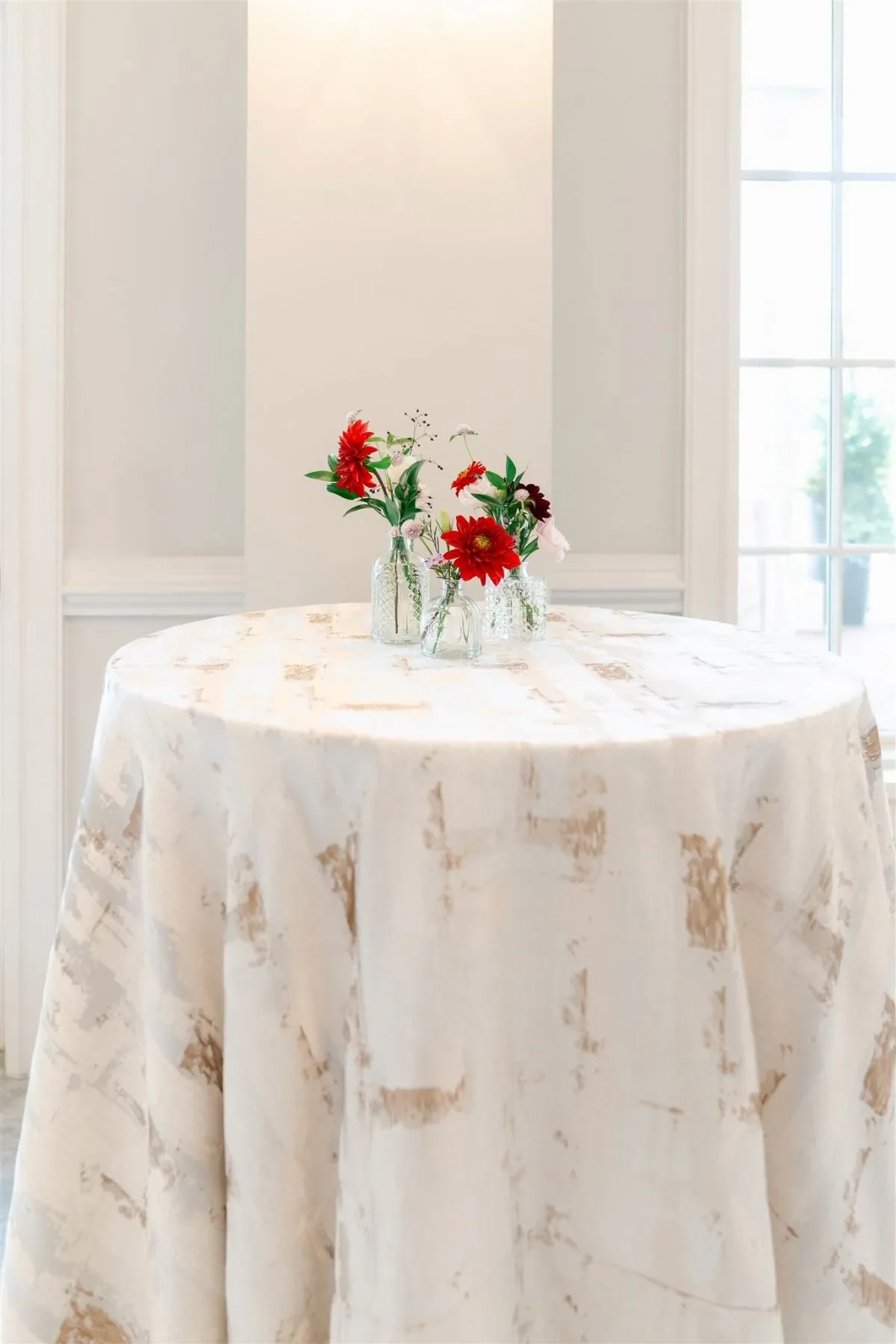
Every linen-bearing surface should receive a spatial role before a specific product is assigned. An anchor, bridge, and background system prevents the room from becoming a collection of equally prominent tables.
The categories describe how each surface functions within the venue, not its quality. A background linen can still be premium and carefully chosen; it simply supports the wider composition instead of demanding immediate attention.
Assign Anchor Linens to Visual Destinations
Anchor linens belong on surfaces that should attract attention or help guests understand the room’s organization.
Potential anchor locations include:
- The head or sweetheart table
- A central banquet table
- A prominent bar
- A cake display
- An escort-card table
- A table at the end of a long room
- A focal table aligned with the main entrance
- A surface positioned beneath a visually quiet architectural area
An anchor treatment may use:
- A stronger pattern
- Greater color contrast
- A custom border
- A saturated solid
- A distinctive textile format
- A specially positioned motif
The strongest linen does not automatically belong on the head table. If the head table is concealed by columns or positioned outside the primary arrival view, another surface may be more effective as the room’s first textile anchor.
Most rooms benefit from one primary anchor and a limited number of secondary destinations. When every focal table receives an unrelated statement cloth, the space loses hierarchy.
Use Bridge Linens to Connect Separated Areas
Bridge textiles repeat selected details from the anchor without copying its complete design.
They may connect areas through:
- A shared napkin color
- A coordinating solid
- A simplified motif
- A related runner
- A repeated border
- Similar pattern scale
- One recurring accent tone
Suppose a custom botanical linen appears on the central banquet table. Nearby guest tables might use a solid drawn from the pattern, while the bar repeats a simplified botanical border. The three areas remain distinct, but the shared details help guests read them as parts of one composition.
Bridge linens are particularly useful when a room is divided by columns, level changes, or furniture groupings. They can carry the design across physical interruptions without placing the same statement pattern everywhere.
Keep Background Linens Deliberately Restrained
Background linens create a visual field around the anchors and bridges.
They may be appropriate for:
- Peripheral guest tables
- Tables near ornate architectural features
- Areas carrying elaborate florals
- Service-adjacent surfaces
- Less visible cocktail tables
- Tables outside primary guest pathways
A background treatment might use a refined solid, subtle woven design, tonal pattern, or quieter version of the central palette.
Restraint should be intentional. The linen still needs to coordinate with the venue and tabletop, but it should not create another destination that competes with the planned anchor.
Background areas also provide visual rest. Without them, patterns and saturated colors can merge into an undifferentiated room-wide field.
Use Linen Mass to Define Spatial Boundaries
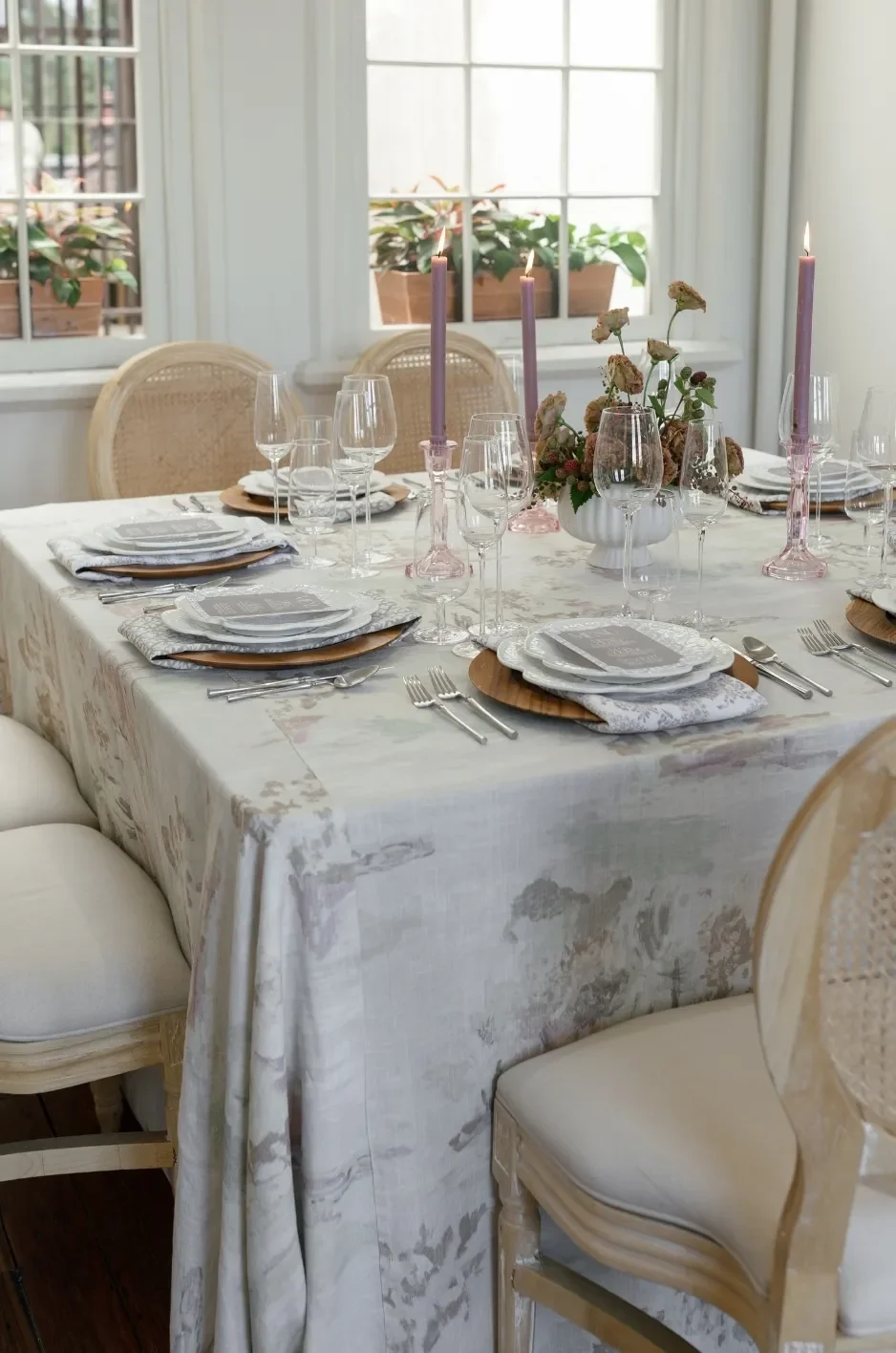
A full-length tablecloth creates more visual mass than a runner, napkin, or exposed table. When several covered tables are grouped together, their repeated vertical surfaces can make a dining area feel like a defined zone inside a larger venue.
This effect is particularly useful in open rooms where dining, cocktails, lounges, dancing, and service occupy the same uninterrupted floor plan.
Create a Unified Dining Field
Guest tables should read as members of one group even when they are not identical.
The dining field may be unified through:
- One foundation color
- A common pattern family
- Repeated drop treatment
- Coordinating napkins
- Consistent textile weight
- Alternating patterned and solid linens
- Shared runner orientation
Uniformity is not required. A room can alternate two coordinated tablecloths while retaining a clear dining identity.
The connection must be visible from across the room. A detail that appears only in a close-up place setting may not be sufficient to unify 20 dispersed tables.
For example, alternating patterned and solid tablecloths can work when both share a common background color and consistent full-length treatment. From the entrance, the group still reads as one designed field rather than two unrelated table styles.
Mark the Edges of the Dining Area
The boundary between dining and another event function does not require a physical divider. A controlled change in textile treatment can indicate that guests are entering a different zone.
Potential boundary markers include:
- Stronger cocktail-table linens around the perimeter
- A shift from patterned dining linens to solid lounge textiles
- Coordinating pillows at the edge of the seating area
- A repeated runner on transition tables
- One distinctive cloth on the final table in a dining row
- A related textile treatment at the bar
The change should be clear but not abrupt. The adjoining areas should retain one connecting detail, such as color or motif, so the event continues to feel cohesive.
Use Vertical Drop to Strengthen a Zone
From across the venue, guests often see more of the tablecloth drop than the tabletop. Chairs, dinnerware, and centerpieces conceal the upper surface, while the hanging fabric remains visible between and beneath the seats.
Consistent full-length drops can:
- Give the dining area greater visual weight
- Establish rhythm across rows of tables
- Distinguish dining furniture from exposed lounge pieces
- Make a large room feel less fragmented
- Create a controlled repeated silhouette
In contrast, a mix of unrelated drop lengths can make a zone appear visually unsettled, even when the individual textiles coordinate.
The decision should be based on the room-level effect rather than the assumption that every table must receive the same treatment. A focal banquet table might use a more substantial drop, while cocktail or transition tables remain lighter.
Frame Historic Architecture Without Imitating It
Historic venues often contain established pattern, proportion, craftsmanship, and material depth. The linen plan should create a deliberate relationship with those elements without attempting to reproduce every carved detail, mural color, or decorative motif.
The strongest approach frames the architecture, preserves its hierarchy, and introduces temporary event design as a distinct but compatible layer.
Preserve the Room’s Primary Symmetry
Many historic interiors are organized around a strong central axis. Paired doors, balanced windows, fireplaces, chandeliers, or staircases create a formal sense of order.
Linen placement should reinforce that structure by:
- Aligning focal tables with the centerline
- Balancing both sides of the room
- Avoiding accidental competing axes
- Supporting the primary architectural endpoint
- Coordinating table groups across symmetrical sections
A statement linen placed slightly off center may appear more disruptive in a symmetrical ballroom than it would in an irregular modern loft.
If the furniture layout cannot follow the architecture precisely, bridge linens can help restore balance. Similar treatments on opposite sides of the room may visually connect table groups even when columns or circulation paths require different arrangements.
Move Strong Pattern Away From Dense Ornament
A detailed ceiling, patterned floor, carved fireplace, or mural already provides a substantial amount of visual information.
Tables placed directly beside those features may benefit from:
- Solids
- Tonal patterns
- Quiet woven surfaces
- Limited contrast
- Custom borders instead of allover prints
- Restrained napkin treatments
Stronger patterns can be moved into architecturally quieter sections where they have enough negative space to register.
This prevents the event design from becoming a competition between permanent and temporary ornament. It also allows both the textile and the architecture to remain legible.
Use Contemporary Linens as Controlled Contrast
A historic venue does not require historically styled linens.
A simplified geometric pattern, clean custom border, or modern color field can create a clear distinction between the venue’s original architecture and the event’s temporary design. This contrast can make both feel more intentional. You may also find How Custom Table Linens Transform Event Design helpful.
The key is repetition. An isolated modern textile may appear disconnected, but a controlled detail repeated through napkins, a runner, or a bar treatment establishes a clear event-specific language.
Contemporary contrast should clarify the architecture rather than conceal it.
Give Modern Open Spaces a Clear Visual Structure
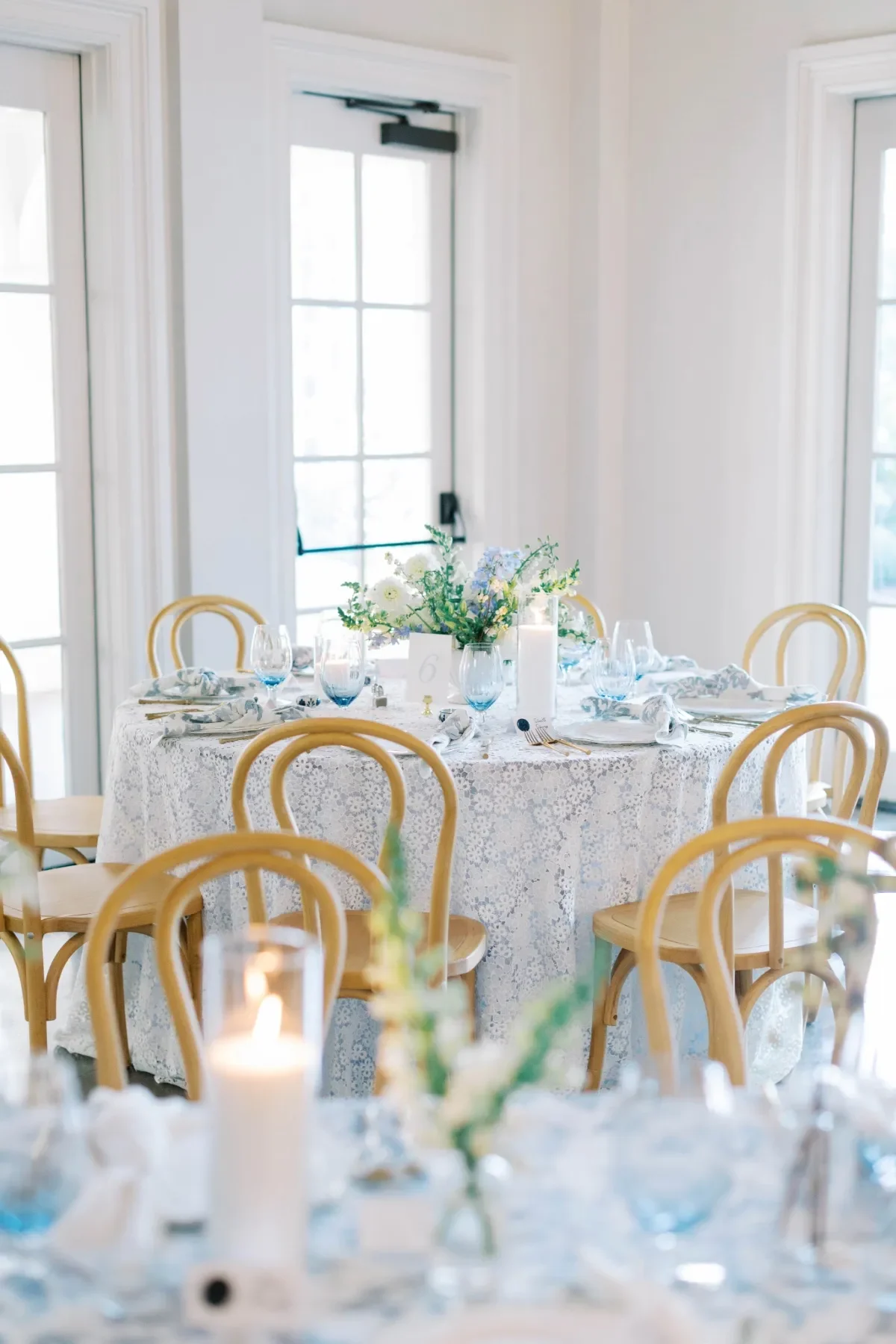
Modern event spaces often contain fewer decorative details but greater openness, height, reflection, and uninterrupted floor area. Individual tables can appear isolated inside that volume unless the linen plan creates a visible system.
The objective is not to fill every empty area. It is to use pattern, color, coverage, and repetition to organize the room.
Prevent Guest Tables From Appearing Disconnected
Select one element that will connect all guest tables from a distance.
It may be:
- A repeated foundation linen
- One consistent napkin color
- A pattern family
- Coordinated borders
- Alternating related solids
- Shared runner direction
- Consistent full-length coverage
The repeated element should remain visible after chairs and tabletop pieces are installed.
In a large glass-walled room, for example, a pale napkin detail may disappear from across the venue, while a shared tablecloth color or repeated border may provide enough mass to connect the tables.
Use Pattern to Create Rhythm Across Open Floor Plans
Repeated pattern can create a visual beat across a spacious modern venue.
Before applying one linen throughout the room, consider:
- Table count
- Distance between tables
- Pattern scale
- Directionality
- Contrast against the flooring
- The strength of the repeat from a distance
- The relationship to focal areas
A small motif may merge into a tonal surface from across the room. A high-contrast print may create more movement than expected when repeated 20 times.
Patterned tables can also alternate with coordinating solids to create rhythm without overwhelming the room. The sequence should appear deliberate from major guest viewpoints.
Account for Glass and Reflective Architecture
Glass walls, polished floors, mirrors, and glossy surfaces can duplicate or intensify textile color and pattern.
During a venue walkthrough, assess whether reflections:
- Double the visual strength of a pattern
- Increase perceived color saturation
- Make metallic finishes overly prominent
- Expose the back of a directional design
- Create clutter around tables near glass walls
- Change as daylight fades
A textile that feels appropriately bold in a matte room may appear excessive beside a reflective wall. Quieter linens may provide stronger balance in these locations.
Reflections should be treated as part of the room-wide composition, not as incidental background conditions.
Calibrate Visual Weight at Room Scale
Visual weight describes how strongly a linen attracts attention inside the complete room. It is shaped by surface area, color contrast, pattern density, repetition, placement, and vertical coverage.
A fabric does not need to be dark or ornate to carry substantial room-wide weight. A moderately patterned linen repeated across many large tables may become the dominant feature of the venue.
Compare Surface Area Before Pattern Strength
Begin by calculating how much of the textile will appear throughout the room.
Consider:
- Number of tables
- Linen dimensions
- Full-length or partial coverage
- Amount of exposed fabric
- Distance between tables
- Repetition across sightlines
One dramatic cloth on a cake table may have less room-wide influence than a restrained solid repeated across every guest table.
This distinction helps planners allocate statement textiles more deliberately. A focal linen should be strong enough to remain distinct from the repeated guest-table field, but it does not always need the highest contrast available.
Distinguish Local Impact From Room-Wide Impact
Assess each proposed linen at several scales:
- Close-range impact
- Seated-table impact
- Across-room impact
- Repeated room-wide impact
A detailed woven textile may feel substantial at the place setting but become visually quiet at a distance. A broad color block may appear simple in a swatch but dominate when multiplied across the room.
The correct classification depends on how the textile will be used. A linen intended as a subtle bridge may have enough room-wide weight once repeated, while a primary anchor might need stronger contrast or more strategic placement.
Balance the Room Rather Than Every Individual Table
Not every table needs to appear complete as an independent design statement.
The room should contain:
- A primary anchor
- Secondary destinations
- Transitional surfaces
- Quieter fields
- Areas of visual rest
A restrained guest table may perform an important spatial function by allowing the head table, bar, or architecture to remain dominant.
Evaluating the room as one composition prevents planners from adding another pattern or layer simply because an individual table appears quiet in isolation.
Design the Guest’s First View Through Linen Placement
The entrance view establishes how guests understand the reception. They should be able to identify the primary destination and the broad organization of the room without consciously analyzing the décor.
Linens can support that understanding by controlling the foreground, directing the eye through the middle distance, and establishing a clear endpoint.
Establish a Clear End Point
Select one feature that should hold the guest’s attention at the end of the arrival view.
It may be:
- The head table
- A major architectural feature
- The dance floor
- A central banquet table
- The bar
- A floral installation
- A stage
A statement linen can reinforce that endpoint through pattern, color, or border placement.
Avoid placing several equally strong textiles along the same view. When the foreground, middle distance, and far end all compete, the guest’s eye has no clear direction.
Control the Foreground Linens
Tables nearest the entrance occupy a disproportionate amount of the initial view.
Decide whether those linens should:
- Introduce the main pattern
- Remain restrained to reveal the focal point beyond
- Frame the central axis
- Repeat a small detail from the anchor
- Mark the beginning of the dining zone
A strong foreground pattern can create an immersive entry, but it may also block the visual destination behind it. A quieter foreground can act as a frame and create greater depth.
The appropriate decision depends on the room’s proportions and the position of the principal focal area.
Build Depth Through Progressive Linen Intensity
Linen treatments can change gradually as the eye moves through the space.
A progression might include:
- Restrained entrance tables
- Coordinated patterned guest tables
- A stronger custom linen at the far-end focal surface
Another room may reverse the sequence, beginning with a prominent entry installation and becoming quieter toward an architectural view.
Progressive intensity creates spatial depth without relying on additional freestanding décor.
Use Custom Linens to Reinforce Directional Sightlines
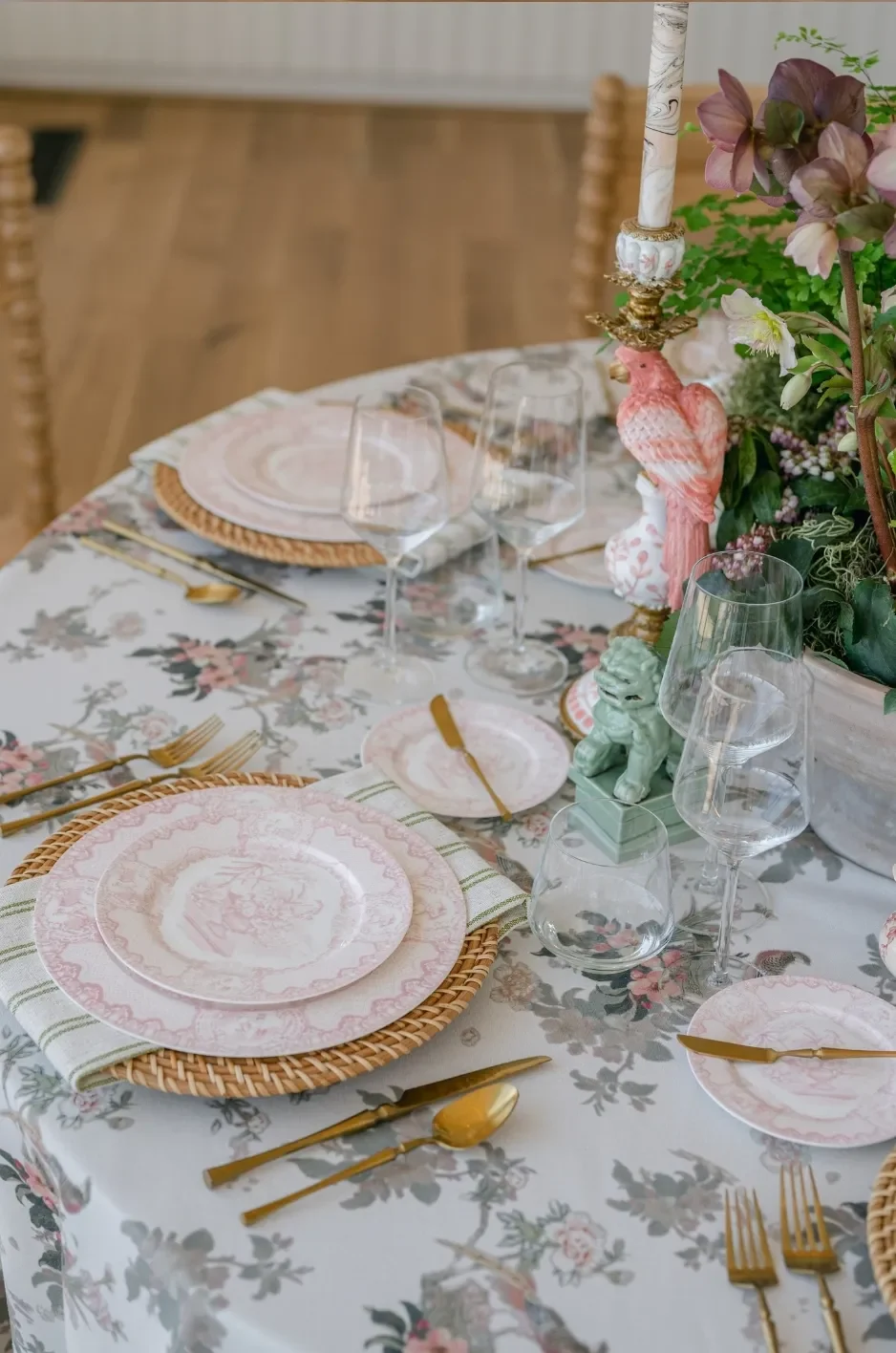
Custom development can respond to the room’s orientation in ways that an allover standard textile cannot. A border, motif, or concentrated area of color can be positioned specifically on the side guests will see. We cover this further in Designing Signature Event Looks With Custom Table Linens.
Curated Linen Collection offers custom sizes and one-of-a-kind designs, while its broader bespoke capabilities support tailored textile development for specific event concepts. Read more in How Custom Table Linens Improve Event Cohesion.
Position Borders on the Room-Facing Side
A custom border may be placed:
- Along the front of the head table
- At the end of a long banquet table
- On the side facing the entrance
- Around the visible perimeter of a bar
- Along the edge facing the dance floor
- Beside a primary guest walkway
This concentrates design detail where it contributes most to the spatial composition.
The border does not need to continue with equal strength around every side if some areas face walls, service zones, or dense chair groupings. Its placement should reflect the table’s role within the room.
Align Directional Motifs With the Venue Axis
Botanical, geometric, or illustrated motifs can be oriented toward:
- The main entrance
- A staircase
- The dance floor
- A window wall
- A stage
- A central aisle
- A major architectural endpoint
Directional artwork should be documented clearly for installation. Without orientation instructions, the most important part of the design may face a wall or back-of-house area.
Exact table placement and room-facing sides should be confirmed before custom production begins.
Translate One Motif Across Spatial Roles
One custom concept can appear differently according to each surface’s role. We cover this further in From Concept to Custom Linen: A Planner’s Guide.
It might become:
- A full pattern on the primary anchor table
- A border on bridge linens
- A simplified motif on napkins
- A runner on a transition table
- A small panel on the bar
- A coordinating pillow in the lounge
This creates continuity without repeating one print at equal intensity across the entire venue.
Existing rentals can support the custom textile through related solids, patterns, runners, napkins, pillows, or overlays. The custom element remains distinctive while the surrounding pieces extend its spatial logic. Read more in High-End Gala Tablecloth Rentals & Custom Drapes: A Guide.
Prepare a Sightline-Based Linen Installation Map
The intended spatial effect depends on accurate installation. A directional tablecloth placed backward or an anchor linen assigned to the wrong table can alter the balance of the entire room.
The installation team should receive a map that explains both the assignment and orientation of every significant textile.
Number Every Linen-Bearing Surface
For each table or installation, document:
- Table number or name
- Venue location
- Dimensions
- Linen collection
- Linen size
- Spatial role
- Pattern direction
- Primary room-facing side
- Related napkin, runner, or overlay
- Any special installation note
The spatial role—anchor, bridge, or background—helps the team understand why substitutions or placement changes should not be made casually.
Mark Directional and Custom Pieces Clearly
Directional linens should include instructions for:
- Front and back
- Table ends
- Border placement
- Motif orientation
- Room-axis alignment
- Chair alignment
- Relationship to the centerpiece
- Side facing the entrance or focal view
Labels, diagrams, and reference photographs are more dependable than verbal instructions provided during a busy installation.
Conduct a Room-Wide Review Before Styling Is Complete
Review the linen placement before florals, dinnerware, candles, and stationery make adjustments more difficult.
Check:
- Balance across the room
- Strength of the primary anchor
- Pattern repetition
- Alignment with architecture
- Disconnected visual areas
- Competing focal points
- Incorrect orientation
- Unplanned clusters of saturated color
- Consistency of major drops
This is the appropriate stage to exchange a strong and quiet linen, rotate a directional cloth, or correct an unintended visual imbalance.
Frequently Asked Questions
What Does “Soft Architecture” Mean in Table-Linen Design?
Soft architecture refers to using movable textile surfaces to influence how a room is perceived and organized.
In table-linen design, this can include:
- Establishing visual anchors
- Connecting separated areas
- Defining dining and lounge zones
- Reinforcing sightlines
- Creating room-wide rhythm
- Framing architectural features
It does not require covering walls, ceilings, or permanent venue details.
Can Table Linens Make a Large Room Feel More Organized?
Yes. Repeated table coverage creates visible mass, while coordinated colors, patterns, and drops help tables read as one group.
A carefully placed statement linen can also provide a focal destination in a room that otherwise lacks one. Bridge linens then connect that destination to surrounding zones.
Should the Strongest Linen Always Go on the Head Table?
No. The strongest linen should be assigned according to the room’s primary sightline and visual hierarchy.
The head table may be the appropriate anchor when it is visible from the entrance or positioned at an architectural endpoint. In another layout, a central banquet table, bar, or cake display may provide a more effective spatial focus.
How Many Linen Anchors Should One Venue Have?
The appropriate number depends on the room’s scale and complexity.
Most venues benefit from one clearly dominant anchor and a limited number of supporting destinations. Too many equally strong linens can make the room feel fragmented and reduce the importance of each focal area.
Can Patterned Linens Compete With Historic Architecture?
They can when their scale, contrast, or placement ignores the room’s existing ornament.
Pattern can still work effectively in a historic setting when it is:
- Positioned in visually quiet areas
- Balanced with restrained solids
- Limited to selected anchor surfaces
- Scaled appropriately
- Used as controlled contemporary contrast
How Do Linens Help in Minimal Modern Venues?
Linens can provide visual mass and repetition where the architecture offers few decorative cues.
They may:
- Connect dispersed guest tables
- Define a dining field
- Establish focal destinations
- Create rhythm across an open floor plan
- Separate dining, lounge, bar, and cocktail zones
- Introduce controlled color and pattern
When Is a Custom Directional Linen Worth Considering?
Custom development may be useful when:
- A border needs to face the entrance
- A motif must align with an architectural axis
- Detail should appear only on the room-facing side
- A focal table has unusual dimensions
- One design needs to connect several areas in adapted forms
The custom treatment should respond to a clear spatial objective.
What Should Be Included in a Linen Sightline Plan?
A complete plan should include:
- Venue floor plan
- Main viewing directions
- Architectural anchors
- Linen-bearing surfaces
- Anchor, bridge, and background assignments
- Product and size information
- Pattern orientation
- Custom details
- Installation notes
- Room-level reference photographs
Conclusion
Soft architecture does not require filling a venue with more fabric. Its value lies in the controlled use of table linens and related textiles to direct attention, define functional areas, and connect individual surfaces to the larger room.
A historic venue may need linens that preserve its symmetry and give ornate architecture enough visual space. A modern open room may need stronger repetition and textile mass to prevent tables from appearing disconnected. In both cases, the planner should begin with sightlines and spatial roles before choosing individual colors or patterns.
Curated Linen Collection supports this approach with table linens, runners, napkins, pillows, specialty overlays, and custom design options that can be coordinated across anchor, bridge, and background surfaces. See how these ideas come together in our linen gallery.
When every textile has a spatial purpose, linens do more than finish the tablescape. They help guests understand the room, recognize its focal points, and experience the venue as one coherent event environment. When you are ready to plan your linens, request a quote from our team.