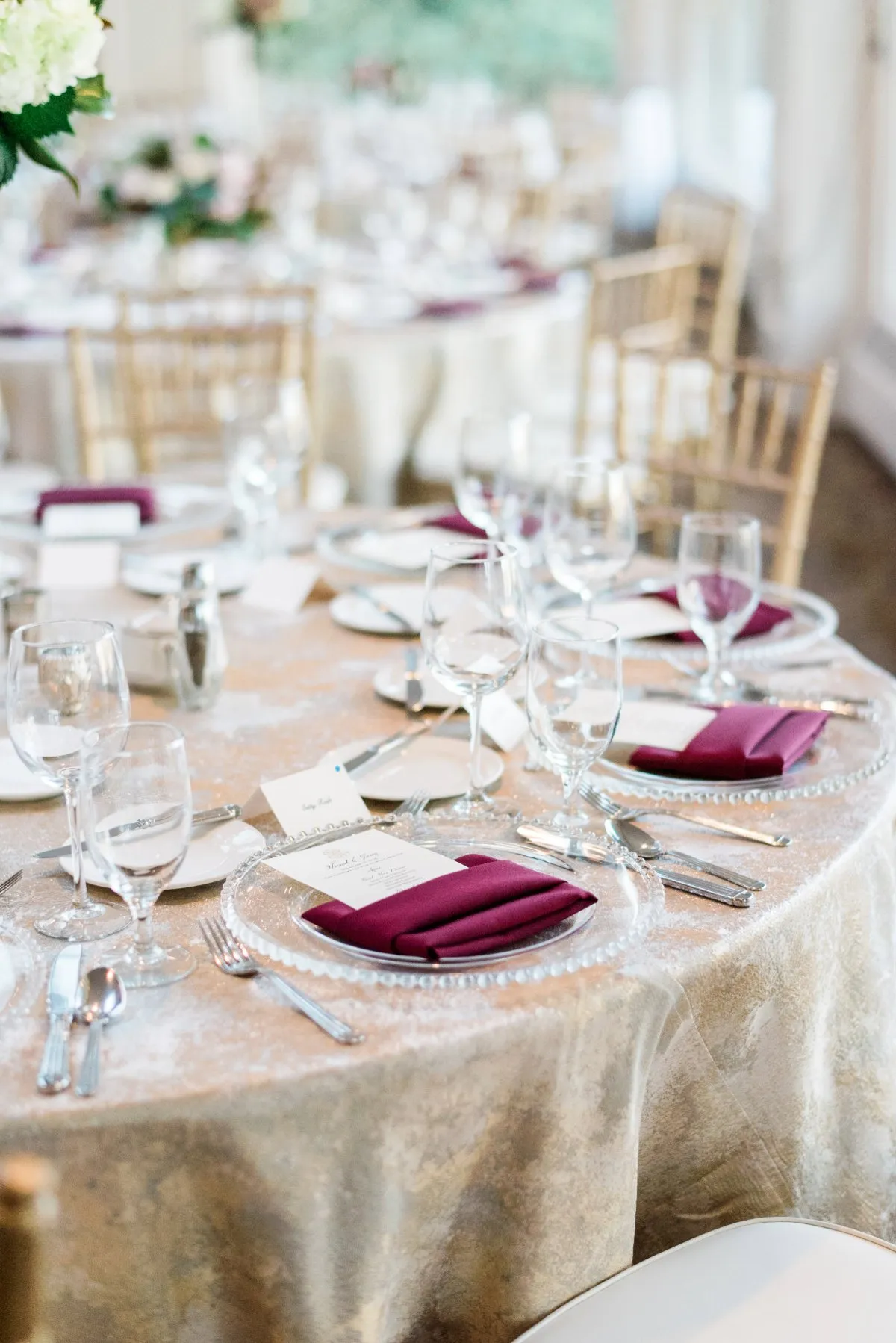
Large corporate dinners and award nights are designed at a different scale than intimate receptions. A linen that feels striking on a single sample table must also work across an entire ballroom, remain visually balanced beside a stage or presentation screen, and support the many table types that make up the event.
For event planners, choosing corporate event linen rentals is therefore less about selecting one beautiful fabric and more about creating a linen strategy for the room as a whole. Color, pattern, texture, table placement, lighting, and program flow all influence how the finished environment will feel once guests arrive.
The most successful linen plans create cohesion without making every table identical. They establish visual hierarchy, give important areas the right amount of emphasis, and support the larger event design without competing with it.
Start With the Full Room Before Selecting Individual Linens
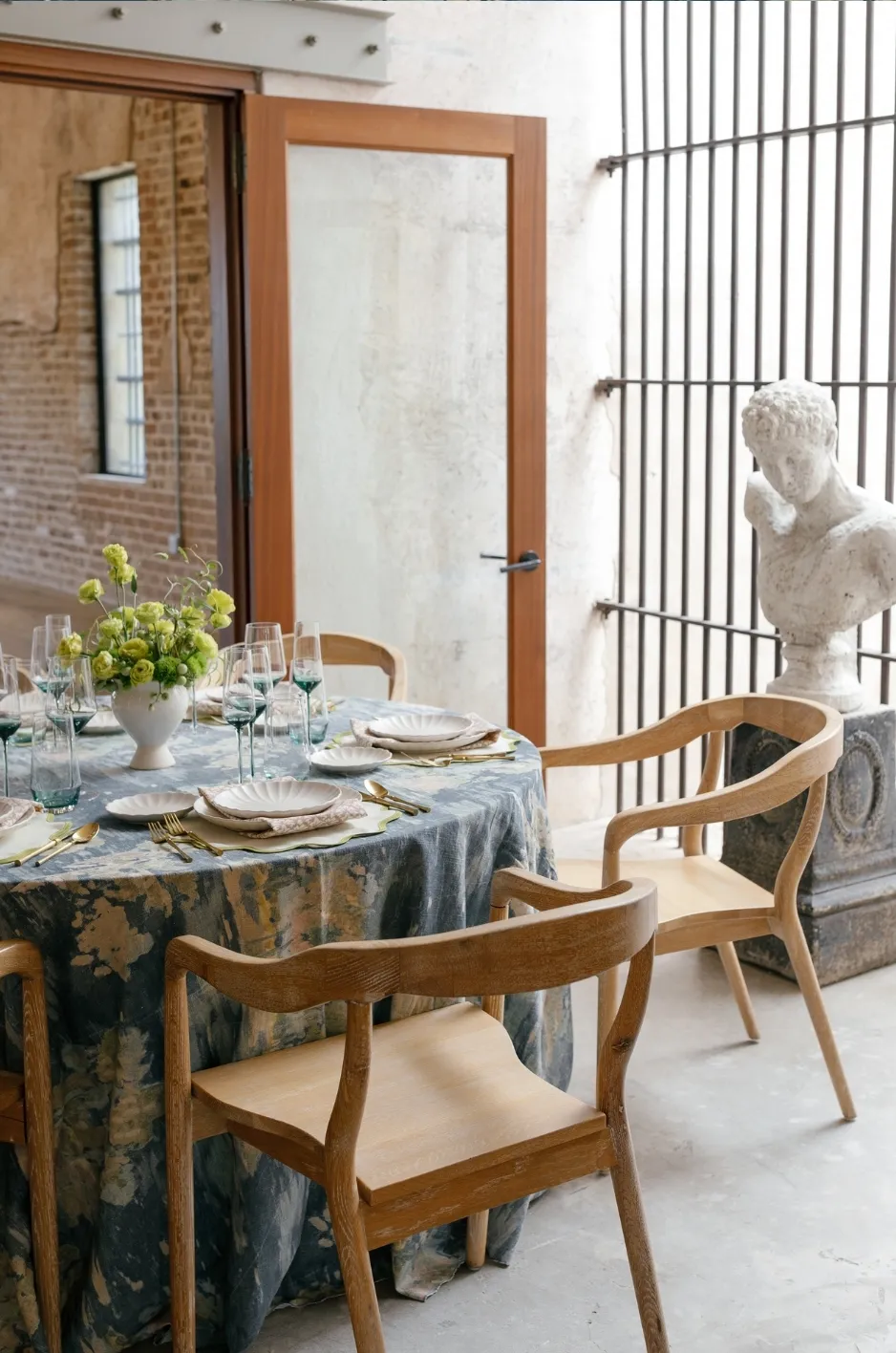
Large-scale linen planning should begin with the event environment rather than an individual swatch. A fabric may look refined at close range but produce a very different effect when repeated across dozens of tables.
Before finalizing a direction, planners should consider how the linens will interact with the floor plan, stage placement, lighting, architecture, tabletop design, and primary guest sightlines. Looking at these elements together makes it easier to determine where the room needs consistency and where it can support more visual distinction.
Read the Linen Concept Against the Floor Plan
The floor plan reveals how much visual space the linens will occupy. Fifty rounds dressed in the same strong pattern, for example, create a much different room than six long tables using that pattern selectively.
Table density also matters. Closely arranged tables create a larger uninterrupted field of color and texture, while a more spacious layout allows individual treatments to stand apart.
Planners can use the floor plan to identify where a dominant linen should establish continuity and where secondary treatments might add dimension. This is particularly helpful in large ballrooms where one treatment used everywhere may feel flat, but too many unrelated linens can make the room appear fragmented.
Account for the Stage and Primary Sightlines
At an awards dinner, the dining tables are not the only visual focus. A stage, presentation screens, scenic elements, lighting installations, or branded graphics may command attention throughout much of the evening.
The linen plan should support those elements rather than compete with them. If the stage design already carries strong color, pattern, or visual movement, quieter guest-table linens can give the room balance. If the stage treatment is restrained, the tables may be able to carry more texture or pattern.
It also helps to consider what guests will see while seated. Looking from the back of a ballroom toward a brightly lit stage is very different from looking across a room where the tables themselves provide the primary visual interest.
Identify the Tables That Need Greater Visual Emphasis
Not every table needs to carry the same visual weight.
Leadership tables, host tables, award-recipient seating, or other designated areas may benefit from a more distinctive linen treatment. A richer texture, specialty overlay, bolder pattern, or contrasting element can provide enough differentiation to establish importance without creating an entirely separate design language.
Making these decisions early allows planners to build hierarchy intentionally rather than trying to make every table equally decorative.
Build a Clear Linen Hierarchy Across the Dining Room
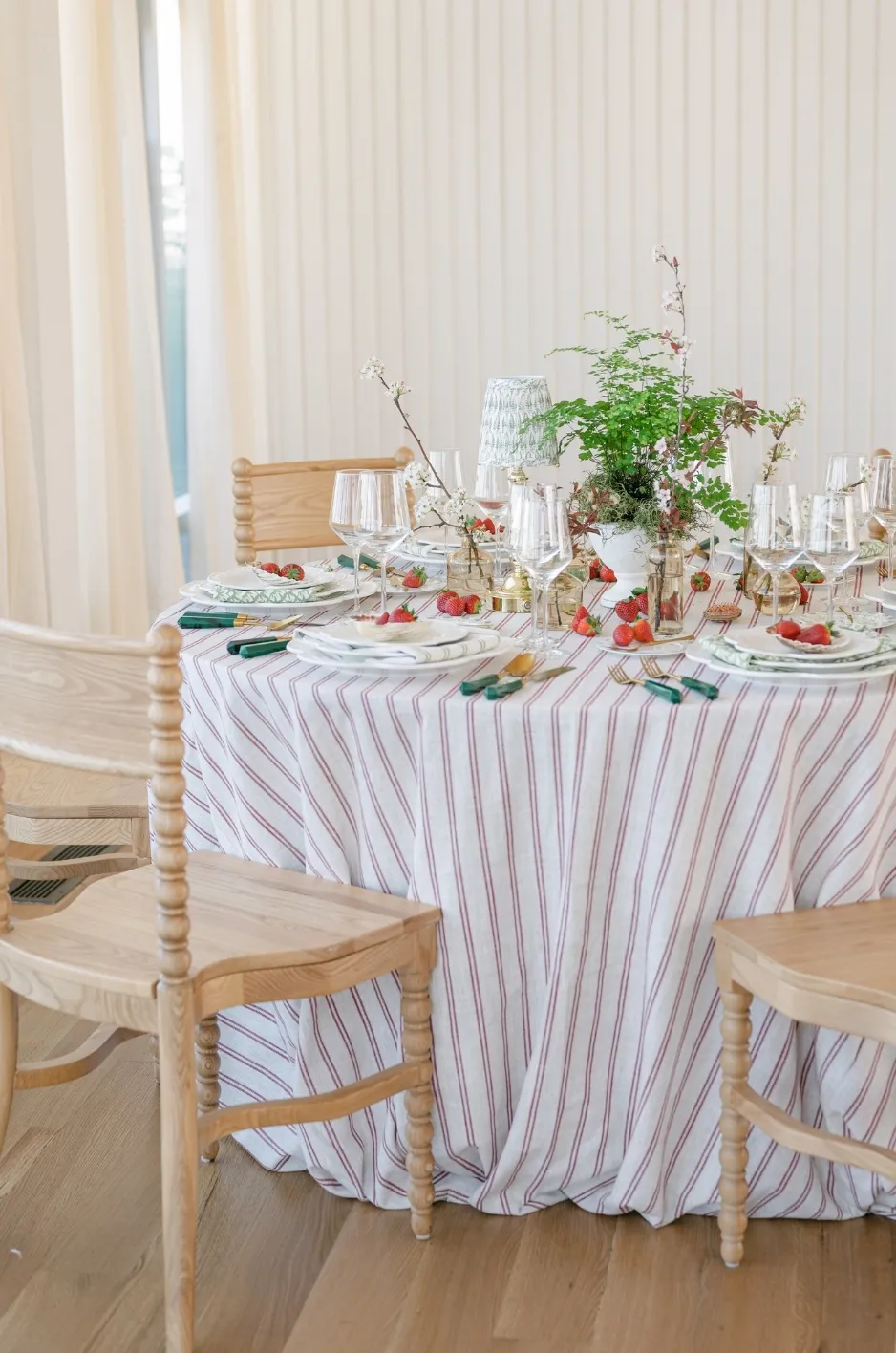
A large room benefits from repetition, but repetition should have structure. When every surface looks exactly the same, the design can lose depth. When too many unrelated treatments are introduced, the room can lose cohesion. A strong linen hierarchy begins with a recognizable foundation and then uses controlled variation to distinguish selected areas.
Establish a Consistent Foundation for Guest Tables
Because guest dining tables typically occupy the largest portion of the room, their linens create the visual baseline for the entire event.
That foundation may be a sophisticated solid, a subtle texture, or a pattern with enough restraint to work in repetition. The important consideration is whether the treatment can hold the room together when viewed collectively.
The base linen does not need to be neutral, but it should leave enough room for the other elements of the event—tabletop pieces, florals, lighting, menus, and stage production—to remain visible.
Create Variation Without Making the Room Feel Fragmented
Variation works best when the linen selections share something in common. Two table treatments might use different textures within the same color family, or a patterned linen might be paired with a quieter solid drawn from one of its tones. Napkins or runners can also carry an accent color across several table groups without requiring a completely different base linen.
This approach gives the room movement while preserving a clear connection from one area to another.
Rather than asking whether every table matches, planners can ask whether every table appears to belong to the same event.
Give Focal Tables a Deliberate Point of Difference
Once the main guest-table treatment is established, focal tables can carry greater contrast. A specialty overlay may distinguish a leadership table. A stronger pattern could be reserved for a limited number of prominent tables. A solid foundation might be paired with a more expressive napkin or runner where additional emphasis is needed.
The difference should be noticeable without feeling disconnected. When the focal treatment pulls color, texture, or pattern from the wider linen story, the hierarchy feels intentional instead of decorative for its own sake.
Use Pattern and Texture at Large-Event Scale
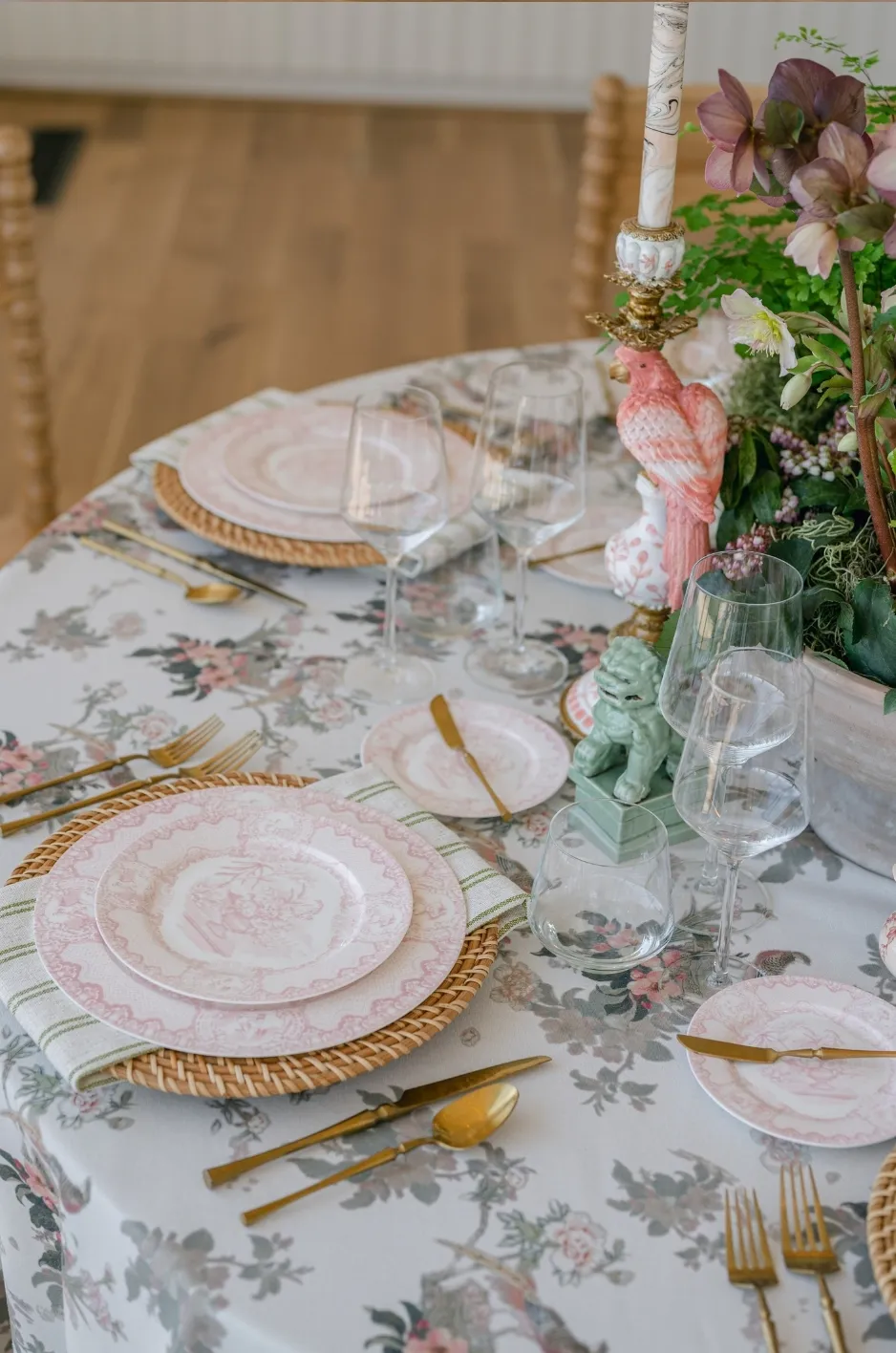
Pattern and texture behave differently when multiplied across a room. What appears subtle in a small sample may become visually dominant across dozens of tables, while a detail that looks dramatic up close may nearly disappear when viewed from across a ballroom.
For planners, evaluating linens at scale is one of the most important steps in creating a polished corporate dinner.
Evaluate Pattern Scale Across Multiple Tables
Pattern scale determines how much movement a linen introduces into the room. Small, densely repeated motifs can create an almost textural effect from a distance, while larger motifs may remain clearly visible across the space. Neither approach is inherently better; the appropriate choice depends on the table dimensions, surrounding décor, architecture, and intended visual emphasis.
It is also useful to consider repetition. A statement pattern appearing on four focal tables reads as an accent. The same pattern used across forty tables becomes a defining feature of the event.
Thinking in terms of the complete room prevents a beautiful individual selection from becoming visually overwhelming once installed.
Balance Statement Linens With Visual Restraint
A room rarely needs every surface to make the same statement. If patterned linens carry much of the visual interest, supporting tables can use quieter solids or restrained textures. Conversely, if the majority of tables use a subtle foundation, selected statement linens can create purposeful points of contrast.
This balance becomes particularly valuable for award nights because the room often contains several strong visual components beyond the dining tables. Screens, florals, lighting, stage graphics, printed materials, and production elements all compete for attention if each is treated as the primary feature.
Use Repetition to Create Rhythm Rather Than Sameness
Repetition can help organize a large room when it is planned strategically.
For example, related linen treatments can repeat according to table zones, alternating groups, or different table functions. A patterned treatment might appear at key intervals while a complementary solid provides continuity throughout the remaining space.
This creates rhythm without making the arrangement feel overly formulaic. The goal is controlled variation: enough repetition for the room to feel cohesive and enough distinction for it to feel layered.
Coordinate Corporate Event Linen Rentals With the Awards Program
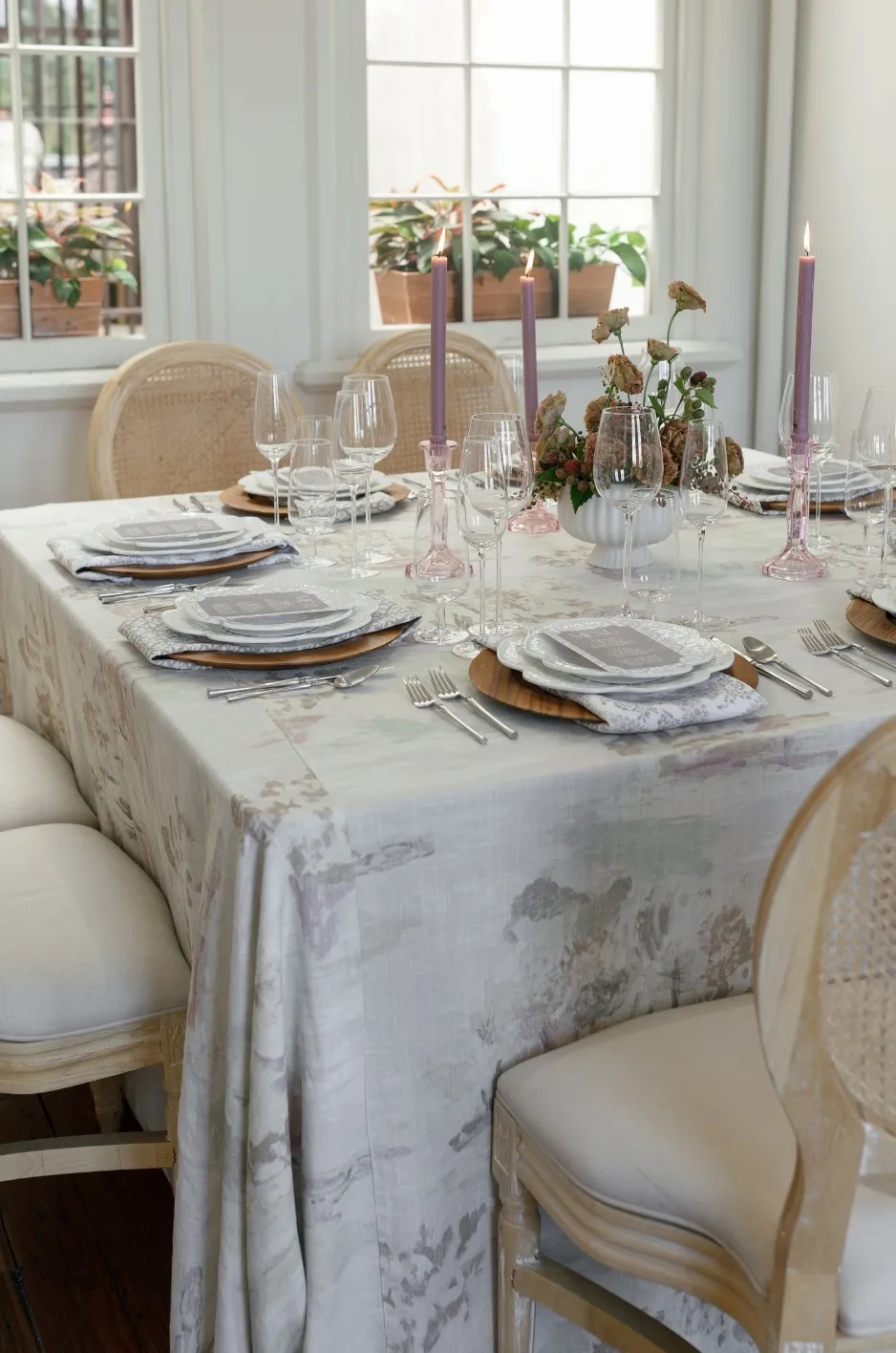
An awards dinner is both a dining experience and a live program. The room must work before the presentation begins, while guests are dining, during speeches and awards, and often during a reception or networking period afterward.
Because the linens remain part of the visual environment throughout each phase, they should be considered alongside the program rather than treated as a separate decorative decision.
Keep the Dining Room Supportive of the Main Stage
During the awards portion of the evening, the stage becomes the dominant focal point.
Guest-table linens should create enough presence to keep the room feeling finished without drawing attention away from the program. Highly contrasting patterns immediately adjacent to a stage, for example, may create unnecessary visual competition when screens and scenic elements are already active.
A more restrained linen foundation can provide a strong framework around a prominent production design, while selected texture or pattern elsewhere in the room can preserve visual interest.
Consider How Linens Read Under Changing Event Lighting
The linen selected during a daytime design meeting may appear quite different once the ballroom lighting changes.
Deep colors can become richer or more subdued. Metallic or lustrous details may become more pronounced. Textures can gain dimension under directional light, while subtle patterns may either become clearer or recede depending on the lighting conditions.
For events with significant production lighting, planners should consider how the linen palette will perform through different phases of the program rather than evaluating the selection under only one lighting condition.
Maintain Visual Cohesion Through Different Program Phases
A formal corporate event may shift significantly over the course of the evening.
Arrival lighting can be brighter and more architectural. Dinner may bring a warmer atmosphere. The awards program may introduce dramatic stage lighting, followed by a more relaxed environment later in the night.
The linen design should remain appropriate through those transitions. A well-balanced palette and controlled use of pattern help the room continue to feel intentional even as the lighting, guest focus, and energy of the event change.
Match Linen Treatments to Table Function
Large dinners often involve more than one table configuration. Guest dining tables may be joined by cocktail tables, leadership seating, registration surfaces, auxiliary tables, or other functional areas.
These tables do not need identical linens, but their treatments should feel related enough to maintain continuity throughout the event.
Plan Guest Dining Tables Around the Main Room Composition
Guest dining tables establish the largest linen footprint, so they should usually anchor the design.
Whether the layout uses rounds, long tables, or a combination of configurations, the primary treatment should support the overall visual direction and provide a reliable foundation for the surrounding elements.
Once that foundation is defined, it becomes easier to determine how much contrast other table types can carry without pulling the event in a different direction.
Differentiate Cocktail and Auxiliary Tables Without Starting a New Design
Cocktail tables often benefit from some distinction because they serve a different function and are viewed differently from seated dining tables.
Rather than introducing an unrelated linen, planners can carry over a color from the main tables, use a related texture, or introduce a pattern already present elsewhere in the event.
The result should feel like a continuation of the same visual vocabulary, even when the treatment itself changes.
Give Functional and Focal Tables the Appropriate Visual Weight
Some tables need greater presence, while others are primarily functional.
A prominent host or leadership table might warrant a specialty treatment. A supporting surface elsewhere in the room may work better with a quieter linen that blends into the overall scheme.
Allocating visual emphasis according to function prevents every surface from competing for attention and allows the most important areas to stand out naturally.
Coordinate Linens With the Complete Tabletop
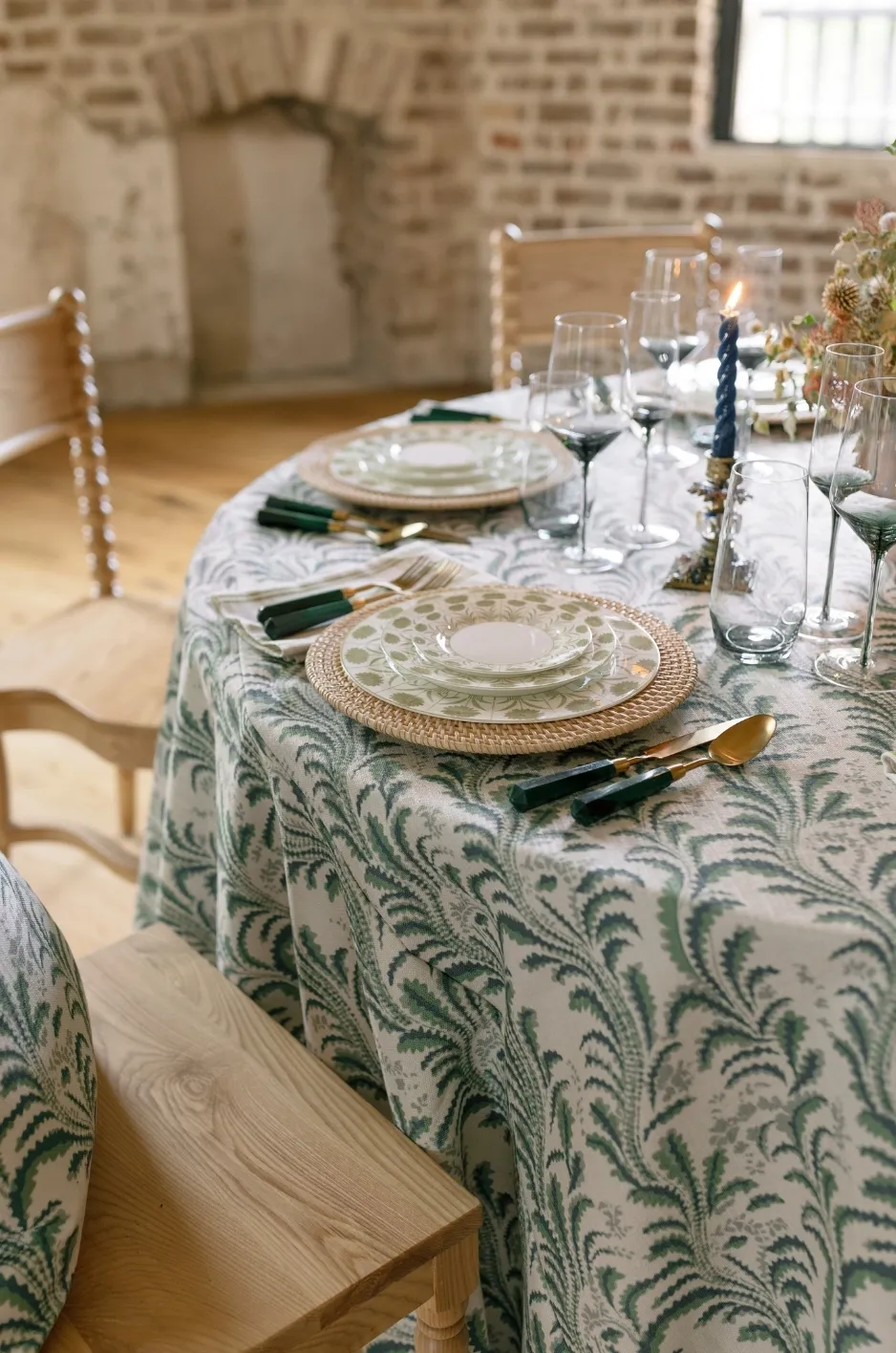
Linens form the foundation of the table, but much of that foundation may eventually be covered by chargers, plates, menus, glassware, florals, candles, and other event details.
For planners, the linen selection should therefore be evaluated as part of the complete tablescape rather than in isolation.
Consider How Much of the Linen Will Actually Remain Visible
A richly layered table can conceal a surprising amount of fabric.
If a table includes large floral arrangements, multiple glassware pieces, layered place settings, menus, table numbers, and additional details, an intricate linen pattern may have limited room to read clearly.
A simpler tabletop, on the other hand, may leave enough exposed surface for a detailed pattern or distinctive texture to become one of the primary design elements.
Understanding how much linen will remain visible helps planners decide where complexity will have the greatest impact.
Balance Strong Linens With Detailed Tabletop Designs
The strongest tablescapes usually have a clear visual hierarchy.
A highly patterned or textured linen can become the dominant foundation, allowing the tabletop to remain more controlled. When the floral or tabletop design is already elaborate, a quieter linen can provide the visual space those details need.
This does not mean every element must be understated. It means the components should support one another rather than all demanding equal attention.
Use Napkins and Runners as Supporting Design Tools
Smaller linen elements can help connect different parts of a tablescape without changing the primary foundation.
A napkin can introduce a secondary color, echo a detail from another table group, or create contrast against a more restrained base. A runner can add direction and definition to a long table or create an additional layer without replacing the linen beneath it.
Used strategically, these elements give planners another way to build depth while keeping the larger linen program controlled.
Adapt the Linen Strategy to Different Corporate Dinner Formats
The appropriate linen approach depends on how the event functions. A stage-centered awards banquet has different visual priorities from a private executive dinner, even when both take place in formal settings.
Identifying those priorities allows planners to determine where the linens should create presence and where they should remain deliberately restrained.
Stage-Centered Awards Banquets
When the stage is the central visual feature, the dining room benefits from a strong but controlled linen foundation.
Guest tables can maintain continuity through a consistent palette or texture, while limited statement treatments add depth in strategic areas. This keeps the ballroom polished without allowing the tables to compete with presentations, screens, or production lighting.
The result is a dining environment that frames the awards program instead of functioning as a separate visual experience.
Executive and Leadership Dinners
Smaller executive gatherings often call for greater restraint. Texture, nuanced color, and precise detailing may create more impact than an overtly bold treatment. Pattern can still play a role, but it may be introduced in a quieter way through selected tables or smaller linen elements. This approach creates a refined setting that feels considered without becoming overly thematic or heavily branded.
Large Dinners With Mixed Table Shapes
Mixed table shapes create an opportunity for variation, but they also make cohesion especially important.
Round dining tables, long banquet tables, and cocktail tables do not need the same linen treatment to feel connected. Instead, a shared palette, related texture family, or recurring pattern can establish continuity.
Long tables might carry a runner or a more directional treatment, while rounds use a coordinating full linen. The treatments can respond to each table shape while remaining part of the same larger composition.
Know When a Custom Linen Is Worth Introducing
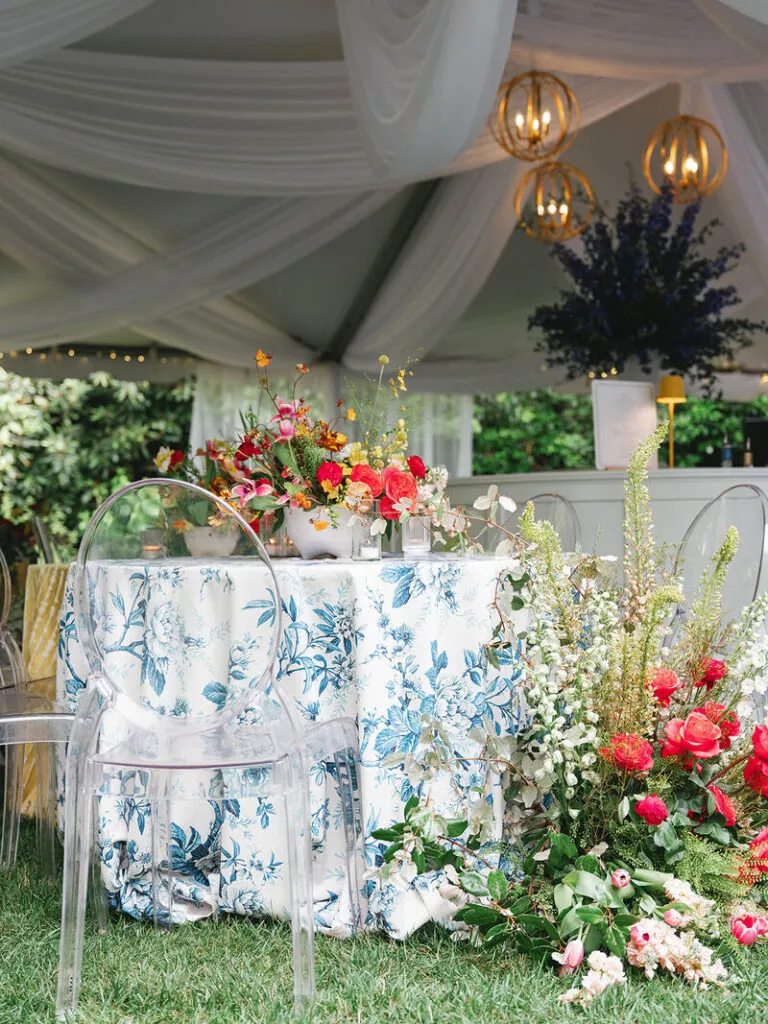
Custom linens can be highly effective when they solve a specific design need. For a large corporate event, however, customization does not necessarily need to extend across every table.
A focused custom application can provide a distinctive element while allowing the broader linen program to be built from complementary collection pieces.
Reserve Custom Design for High-Impact Applications
Custom work is most useful when there is a clear reason an existing selection cannot fully accomplish the design objective.
That may involve a particular pattern, color relationship, unusual dimension, or focal application that plays an important role in the event concept.
Using custom design selectively can also make the piece feel more intentional. A distinctive textile placed where guests will notice it often has greater impact than using the same treatment uniformly throughout the room.
Integrate Custom Pieces With the Existing Linen Collection
A custom textile does not need to stand alone. It can become the starting point for a wider linen palette, with solid or patterned rental pieces supporting the custom design across other table groups. A tone from the custom pattern might carry into guest-table linens, napkins, or runners, creating connection without requiring every textile to be fabricated specifically for the event.
Curated Linen Collection’s patterned and solid selections give planners room to build these relationships while keeping the overall design cohesive.
Use Custom Details to Solve a Design Challenge
The strongest custom applications have a purpose beyond novelty. A uniquely sized table may require a specific solution. An important focal table might need a textile that carries the event concept more clearly. A distinctive pattern may be needed to connect several visual elements within the room.
Approaching custom linens as a design tool helps keep the final result sophisticated and relevant to the event rather than decorative simply for the sake of customization.
Working With Curated Linen Collection on Large Corporate Events
Large-scale linen planning requires enough variety to create depth and enough consistency to keep the room unified. For planners, the process becomes easier when individual pieces are considered as part of a broader linen story instead of as isolated selections.
Curated Linen Collection can support that process through patterned and solid linens, specialty pieces, and custom capabilities that allow planners to develop both foundational and focal treatments within the same event direction.
Build From Patterned and Solid Linen Options
Patterned and solid linens perform different roles within a large room. Patterns can establish character, provide focal moments, or introduce movement, while solids can ground the palette and give more expressive elements space to stand out.
Using the two together often creates more dimension than relying exclusively on one approach. The key is identifying which treatment should lead and which should support it.
Introduce Specialty Pieces Selectively
Runners, napkins, overlays, and other linen accents give planners additional ways to establish hierarchy without changing the complete table treatment.
These pieces can distinguish one table category from another, introduce a secondary color, or add texture to a focal area while maintaining a recognizable relationship to the main linen program.
Selective use keeps the room layered rather than overly coordinated.
Develop Custom Pieces When the Event Calls for Them
When the approved design requires a unique pattern, specific dimensions, or another treatment outside the existing collection, custom pieces can be incorporated into the broader event strategy.
Curated Linen Collection’s custom capabilities allow these elements to be developed with the overall composition in mind, so the custom piece works with the rest of the linen palette rather than appearing separate from it.
For planners, that flexibility is particularly useful when the event needs one memorable textile moment without abandoning cohesion across the larger room.
Frequently Asked Questions
Should Every Table at a Corporate Awards Dinner Use the Same Linen?
No. Using the same linen across every table can create strong continuity, but it is not the only way to achieve cohesion.
Planners can vary pattern, texture, or smaller linen details while maintaining a common palette or design language. Focal tables may carry stronger treatments, while the majority of guest tables establish a consistent foundation. The goal is for the variations to feel intentional rather than unrelated.
How Can Event Planners Keep a Large Linen Installation From Looking Repetitive?
Start by establishing a primary treatment and then introduce controlled variation.
Related solid and patterned linens, selective overlays, contrasting napkins, or different treatments for specific table zones can add depth without disrupting the room. Changing every table is usually unnecessary; a few well-placed variations can create enough visual movement.
How Do You Choose Between Solid and Patterned Linens for a Large Ballroom?
Consider the entire room rather than the linen alone. A ballroom with elaborate stage production, detailed florals, strong lighting, or complex tabletop pieces may benefit from a more restrained linen foundation. A simpler environment may have room for stronger pattern.
Pattern scale also matters. A design that feels subtle on one table can become significantly more prominent when repeated throughout a large space.
Can Different Table Shapes Use Different Linens and Still Look Cohesive?
Yes. Cohesion does not require identical treatments. Rounds, long tables, and cocktail tables can use different linens as long as the selections share a relationship through color, texture, pattern, or another recurring element. Using table shape as a reason for intentional variation can actually make the overall design feel more considered.
When Should a Planner Use Custom Linens for a Corporate Event?
Custom linens are most effective when they address a specific design requirement that the existing collection cannot fully resolve.
That could include unusual sizing, a distinctive pattern, a specific color direction, or an important focal application. Custom pieces can then be paired with coordinating rental linens throughout the rest of the room.
How Should Event Lighting Affect Linen Selection for an Awards Dinner?
Lighting can significantly change the appearance of color, texture, and finish. Planners should consider how the linen will look during guest arrival, dinner, and the awards presentation, especially when production lighting changes throughout the evening. Textured or reflective details may become more prominent under certain lighting, while darker colors or subtle patterns may shift considerably as the room dims.
Create a Cohesive Linen Strategy for the Entire Event
For large dinners and award nights, successful corporate event linen rentals should work at more than the individual-table level. The linen plan needs to support the floor plan, establish visual hierarchy, respond to lighting and stage production, coordinate with the tabletop, and maintain cohesion across multiple table functions.
Rather than making every surface identical, planners can use color, pattern, texture, and selective contrast to give the room structure. A strong foundation can unify the guest tables, while thoughtfully placed specialty or custom treatments create emphasis where it matters most.
With a carefully developed linen strategy, Curated Linen Collection gives planners the flexibility to create formal corporate environments that feel layered, intentional, and complete from every point in the room.