Rent or Customize? Building a Flexible Linen Strategy for a Luxury Wedding
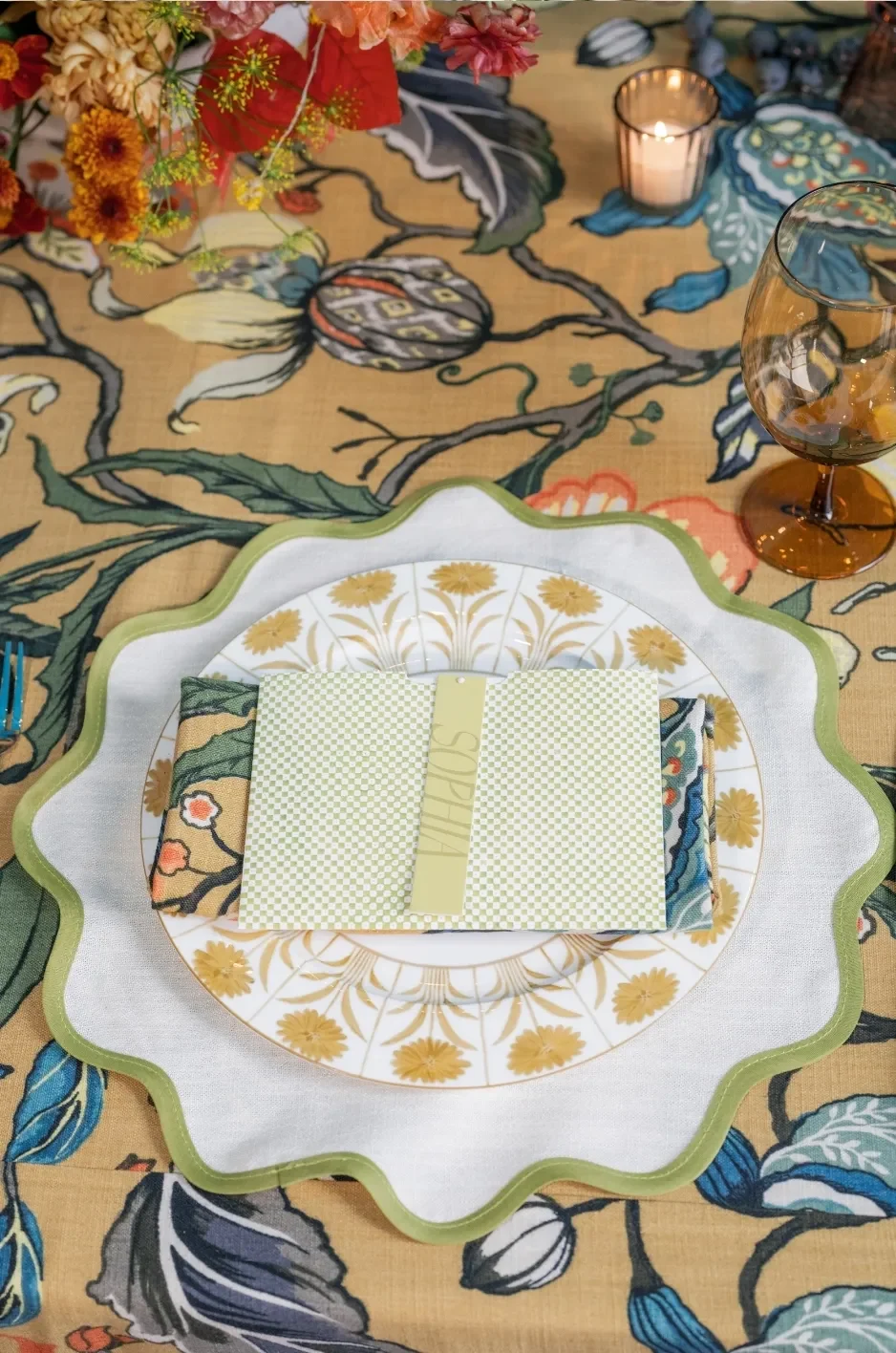
Luxury wedding linens do not need to follow one uniform approach. A reception may use an existing patterned rental across most guest tables, a custom-sized cloth for an unusual focal table, and a bespoke printed textile for the bar or head table. The right solution depends on the dimensions, quantities, design role, and timeline associated with each surface.
This flexible approach allows planners to begin with Curated Linen Collection’s established rental inventory and introduce customization only where it addresses a specific need. Existing patterns and solids can provide the foundation, while custom sizing or one-of-a-kind textile development can distinguish selected areas without requiring every linen to be created from the beginning.
The linen plan should therefore be made surface by surface. Each tablecloth, runner, napkin, placemat, pillow, or specialty overlay should have a clear function within the event design and a clearly defined place within the order.
Define the Available Linen Paths Before Making Selections
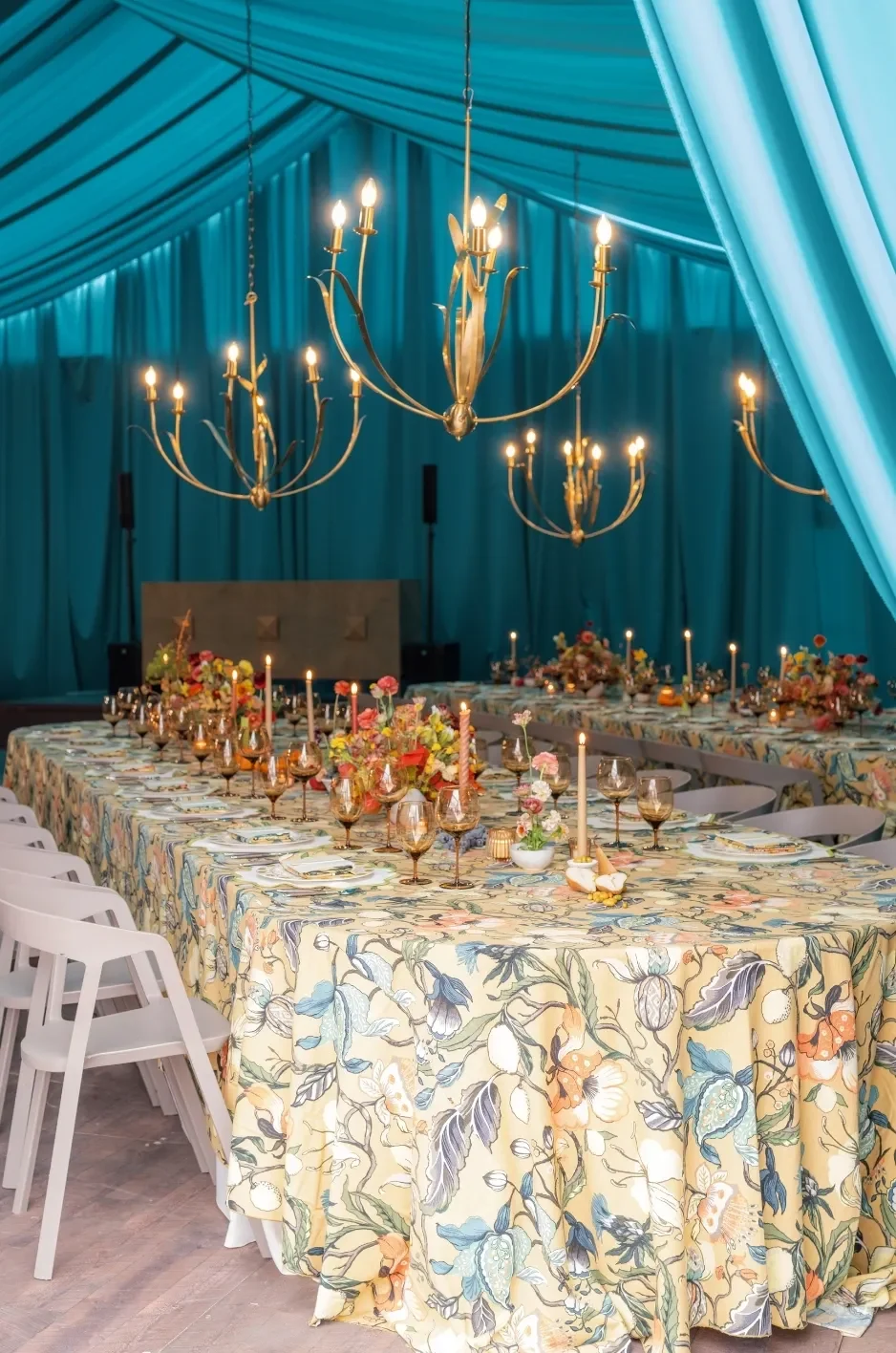
The distinction between standard and custom linens is not always absolute. An existing collection may already provide the correct color, texture, and pattern but require a different size. Another event may need an original print or a textile developed around a specific piece of artwork.
Understanding the available paths helps planners avoid unnecessary customization while identifying the areas where bespoke work can make a meaningful difference.
Existing Collection Rental
An existing collection rental is selected from Curated Linen Collection’s current inventory. This may include:
- Patterned and solid table linens
- Tablecloths in multiple sizes
- Runners
- Napkins
- Placemats
- Pillows
- Specialty overlays
- Coordinating textile accents
This path works well when the required color, pattern, format, and dimensions are already available.
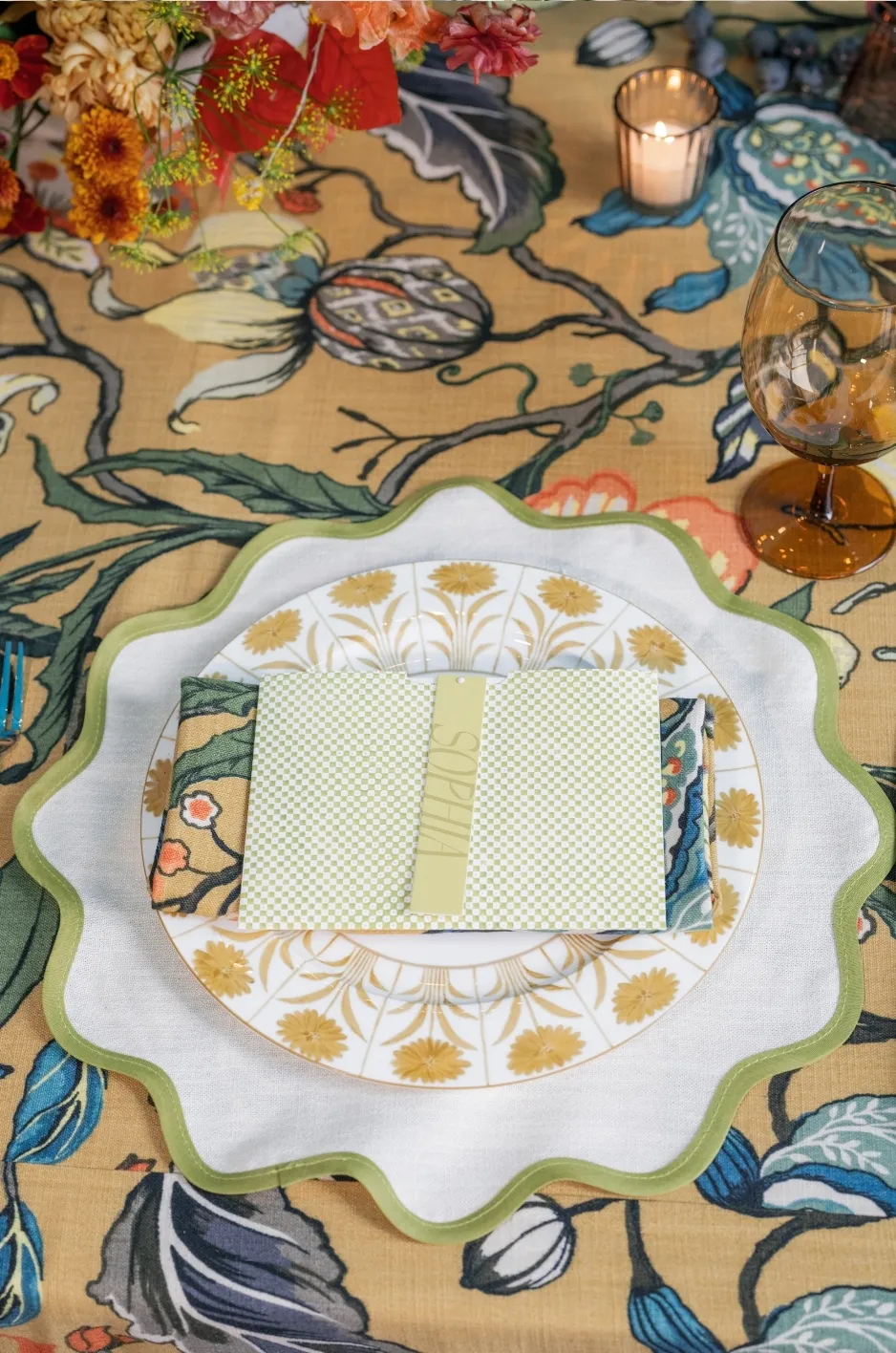
Existing rentals can still produce a distinctive event design. A patterned tablecloth may be paired with a restrained solid napkin, while a different linen from the same palette appears on the cake table or bar. The result can feel highly specific to the wedding even though the individual pieces come from an established collection.
Custom-Sized Linen Project
A custom-sized project may be appropriate when the preferred textile already exists but the event surface requires a nonstandard dimension.
This can be useful for:
- Unusually wide banquet tables
- Custom-built bars
- Oversized display tables
- Specialty rounds
- Long communal tables
- Surfaces requiring a particular drop
Accurate measurements are essential. The project should account for the table’s length, width or diameter, height, intended linen drop, and any directional pattern or border that may affect placement.
Custom sizing addresses a practical requirement without necessarily introducing a new pattern or fabric concept.
Bespoke Custom-Design Project
A bespoke project may be considered when the wedding requires a one-of-a-kind textile direction that is not available within the current collection.
Depending on the project, Curated Linen Collection’s custom process may involve:
- Pattern ideation
- Color selection
- Fabric printing
- Cutting
- Sewing
- Finishing
- Development of a textile for a specific event surface
A bespoke design may interpret artwork, stationery, architecture, florals, or another meaningful visual reference. It can be used as a focal statement or coordinated with existing rental linens throughout the rest of the reception.
The exact scope, proofing process, timeline, rental terms, and return requirements should be confirmed during consultation.
Begin With the Requirements of Each Event Surface

The strongest linen plan does not begin by deciding that all products must be standard or custom. It begins by examining what each table or installation needs to accomplish.
Guest-table quantities, focal-table visibility, table dimensions, place-setting density, and venue sightlines all influence the appropriate linen path.
Use Existing Rentals for High-Quantity Guest Tables
Guest-table linens are usually needed in the largest quantities. They may also need to accommodate more than one table shape or dimension.
Using existing rentals can simplify the process of coordinating:
- Round guest tables
- Rectangular banquet tables
- Cocktail tables
- Family tables
- Display surfaces
- Supporting service areas
An established rental collection also makes it easier to build variation without introducing unrelated designs. Patterned guest tables can alternate with coordinating solids, or one foundation linen can be repeated with different napkin treatments.
The objective is not to make every table identical. It is to create a consistent textile system that can be executed across the required quantities.
Evaluate Focal Surfaces for Customization
Customization often has the greatest effect when it is concentrated on a highly visible surface.
Potential focal areas include:
- The head table
- The sweetheart table
- A central banquet table
- The cake display
- The bar
- The escort-card installation
- The welcome table
- The guest-book table
These surfaces may justify a custom size, original pattern, specially placed motif, or printed detail because they receive greater visual attention and require fewer pieces.
For example, a custom textile on the head table may establish the design direction, while existing solids and patterns carry related colors throughout the guest tables.
Assess Smaller Textile Formats Independently
Napkins, runners, placemats, pillows, and specialty overlays should not automatically follow the same path as the primary tablecloth.
Each format should be evaluated according to:
- Required quantity
- Dimensions
- Guest contact
- Design visibility
- Pattern scale
- Relationship to surrounding linens
- Practical role within the tablescape
A runner may introduce a custom border without requiring a complete custom tablecloth. A solid napkin can repeat one color from a bespoke print, while lounge pillows can carry a related texture into another part of the venue.
Smaller textiles are often most effective when they echo the primary design rather than reproduce it exactly.
Build the Wedding Around a Rental Foundation
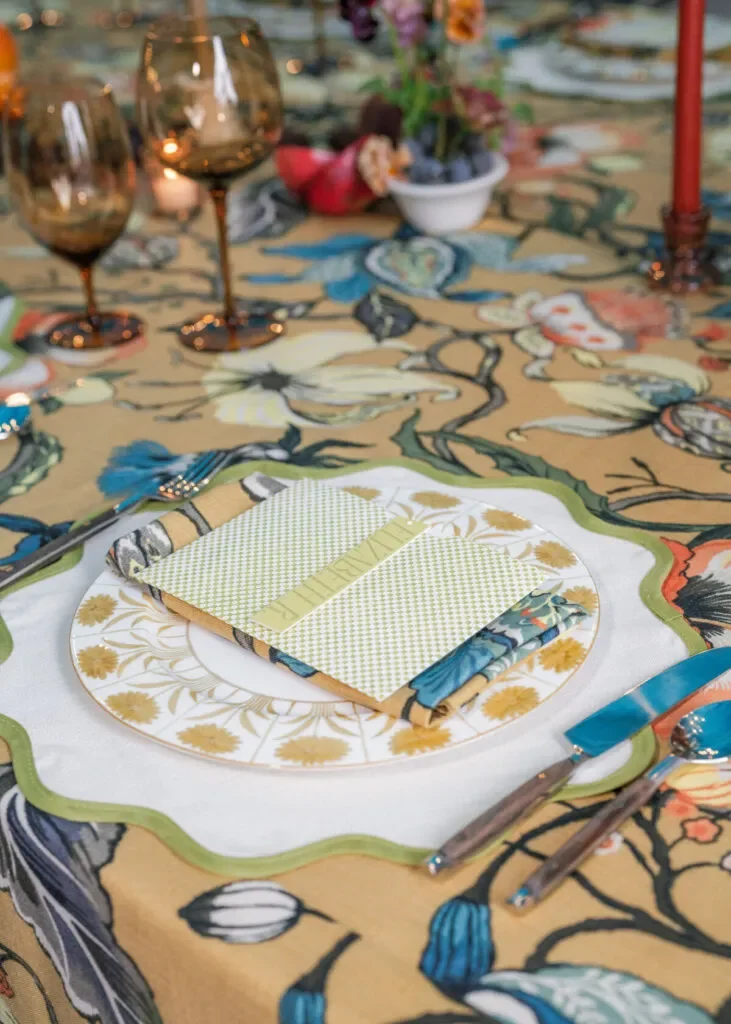
A hybrid linen strategy works best when each product category is reviewed independently. Tablecloths, napkins, runners, placemats, pillows, and overlays have different quantities, dimensions, functions, and potential for future use.
The acquisition model should reflect those differences.
Rent High-Quantity Guest-Table Linens
Guest-table linens are often needed in the largest quantities. They may also depend on exact table diameters, heights, and desired drops.
Renting can reduce the responsibility associated with:
- Managing dozens of large tablecloths
- Accommodating guest-count changes
- Sourcing several table sizes
- Cleaning heavily used linens
- Pressing and preparing the pieces
- Storing the full inventory
- Replacing damaged items
- Reproducing additional matching pieces
A wedding with round guest tables, rectangular family tables, cocktail tables, and display surfaces may require several sizes. An established rental collection can provide the necessary range without creating a permanent inventory for the client.
Evaluate Focal Tables for Custom Development
Focal tables may justify custom work because they receive greater visual attention and require fewer pieces.
These areas may include:
- The head table
- The sweetheart table
- A central banquet table
- The cake display
- The bar
- The escort-card installation
- The welcome table
- A guest-book table
A custom-printed tablecloth or engineered border can create a memorable design moment without requiring every guest table to use the same bespoke textile.
This approach concentrates customization where it will be most visible in the room and in photography.
Assess Smaller Textiles Separately
Smaller pieces should not automatically follow the same path as the primary tablecloths.
Napkins, runners, placemats, pillows, and decorative panels should be assessed according to:
- Required quantity
- Level of personalization
- Guest contact
- Future adaptability
- Storage volume
- Cleaning requirements
- Whether the dimensions are event-specific
- Whether the design has sentimental value
A runner may be easier to reuse than a full floor-length tablecloth. A custom napkin may have keepsake potential, but purchasing one for every guest can still create a large post-event inventory.
Avoid Purchasing Complete Quantities for One Keepsake Goal
A couple may want to preserve a textile because it incorporates a personal pattern, crest, floral motif, or artwork. That does not mean every piece used at the reception must be purchased.
Where available, a smaller keepsake arrangement may be more practical, such as retaining:
- One runner
- One small cloth
- A pair of napkins
- A printed panel
- A framed fabric sample
Any retained items should be documented separately from the rental order and confirmed in the agreement.
Build the Wedding Around a Rental Foundation
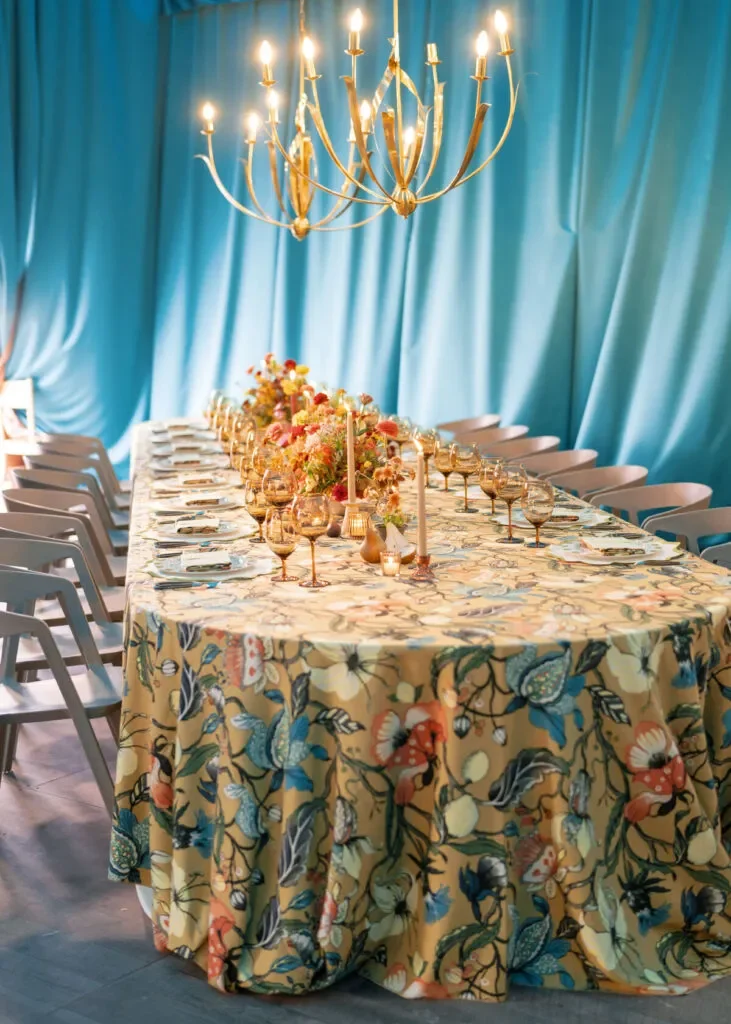
A rental foundation establishes the essential linen requirements before custom work is introduced. It provides a reliable base for guest tables and supporting surfaces while preserving the option to develop selected bespoke pieces.
Curated Linen Collection’s patterned and solid inventory can be combined across multiple formats, allowing planners to create visual variation without assembling several unrelated textile stories.
Establish the Core Guest-Table Linen
Begin with the textile that will appear across the largest number of tables.
Confirm:
- Collection or pattern
- Color
- Linen size
- Quantity
- Table dimensions
- Desired drop
- Relationship to the venue
- Compatibility with florals
- Compatibility with chairs and tabletop rentals
The core linen establishes the room’s overall visual field. Its color, pattern, and vertical drop will be repeated across the reception, so it should be assessed from both a seated perspective and across the full venue.
Add Supporting Rentals With a Clear Purpose
Supporting linens should contribute variation without weakening the overall design.
They may include:
- Coordinating napkins
- Contrasting runners
- Alternating patterned and solid tablecloths
- Specialty overlays
- Placemats
- Pillows
- Different treatments for focal areas
Each supporting textile should have a defined role. A napkin may introduce a secondary color, while a runner organizes florals and candles along a banquet table. A specialty overlay may distinguish the cake table without creating another unrelated pattern.
Reserve Customization for a Defined Need
Custom development should address a specific design or dimensional requirement.
It may be appropriate when:
- The desired color is not represented in the collection
- A meaningful motif needs to be translated into fabric
- A table requires a nonstandard size
- A pattern must be scaled for a particular surface
- A border needs to appear in a controlled location
- One textile must connect several event areas
- A focal installation requires a distinctive treatment
Beginning with the need keeps the custom process focused. It also helps the design team determine whether the solution requires a new pattern, adjusted color direction, custom printing, custom sizing, or another form of textile development. Read more in Discover the Art of Custom Linen Design for Events.
Create a Cohesive Standard-and-Custom Linen Plan
Existing rentals and custom textiles should feel like parts of one design system. A bespoke piece should not appear disconnected from the rest of the reception simply because it was developed separately. You may also find How Custom Table Linens Transform Event Design helpful.
Color repetition, pattern relationships, scale, and visual hierarchy can connect the different linen paths.
Choose One Primary Design Anchor
Begin with one element that will organize the textile palette.
The anchor may be:
- A hero pattern
- A dominant color
- A botanical motif
- A repeated border
- A woven texture
- A tonal contrast
- A detail from the stationery
- An artwork or architectural reference
The anchor does not need to appear identically on every linen. Its purpose is to provide a recognizable point of connection.
A custom floral pattern, for example, might appear fully on the head table. Guest tables could use solid linens in colors extracted from the print, while the bar introduces a coordinating runner.
Repeat Selected Details Across Existing Rentals
Custom and existing pieces can be linked through: We cover this further in Luxurious Weddings Made Special with Custom Table Linens.
- One shared color
- Related pattern scale
- Coordinated texture
- Similar visual weight
- Repeated edging
- A consistent matte or softly reflective finish
- A simplified version of the main motif
The connection should be visible without forcing every textile to match. Exact repetition can make the room feel overly uniform, while controlled variation creates a more layered composition.
Limit the Number of Custom Statements
The ability to customize multiple surfaces does not mean each one should receive a separate design.
A controlled wedding linen plan may include:
- One primary custom textile
- One or two supporting references
- Existing rental linens across the remaining surfaces
Several unrelated bespoke prints can divide the room into competing visual concepts. A smaller number of intentional custom details usually creates a clearer hierarchy. For more detail, see our article Bespoke Linen Curation: Designing Custom Tablescapes for Luxury Events.
Preserve Visual Hierarchy
Custom does not automatically mean dominant. A bespoke napkin, border, or runner may provide a subtle personal detail, while an existing patterned tablecloth creates the room-scale statement.
Assign each textile a role:
- Dominant
- Supporting
- Transitional
- Functional
- Background
This prevents every table and accessory from competing for equal attention.
Consider Flexibility Before Confirming the Linen Model
Wedding plans can change after the initial linen selection. Guest counts may increase or decrease, table layouts may shift, and venue requirements may affect where certain surfaces can be placed.
Existing rental and bespoke projects may respond differently to those changes, so flexibility should be considered before the final order is approved.
Plan for Guest-Count Adjustments
Guest-count changes can affect:
- Number of tables
- Number of napkins
- Linen quantities
- Table sizes
- Distribution of patterns and solids
- Placement of focal linens
Curated Linen Collection will do its best to accommodate changes requested before shipping. Planners should contact the team as early as possible because availability and additional fees may affect revisions.
Custom work may become less flexible once fabric has entered production, particularly after it has been printed, cut, sewn, or finished.
Account for Table-Layout Changes
A shift from round tables to rectangular banquet tables can affect:
- Required linen dimensions
- Linen drop
- Pattern direction
- Border placement
- Runner lengths
- Quantities
- The relationship between focal and supporting pieces
The furniture plan should be sufficiently stable before custom production begins. Table measurements should be confirmed with the venue or furniture provider rather than estimated.
Follow the Appropriate Planning Timeline
Curated Linen Collection recommends allowing approximately four to six weeks for standard linen orders and at least eight to twelve weeks for custom designs.
Bespoke projects may benefit from additional time when they involve:
- Original pattern development
- Several coordinated pieces
- Unusual dimensions
- Custom printing
- Detailed placement requirements
- Project-specific proofing or approval steps
- Large quantities
The team should be consulted about the review and production process that applies to the specific project.
Identify an Alternative Within the Existing Collection
A backup selection can protect the design direction if timing, availability, layout, or production requirements change.
The alternative may be:
- A related solid
- A similar pattern
- A coordinating runner
- A quieter specialty linen
- Another focal-table treatment
A backup does not need to duplicate the bespoke concept. It should preserve the primary color, visual weight, or design relationship so the event remains cohesive.
Clarify the Bespoke Project Scope Before Production
A custom proposal should define both the creative work and the practical order details. Terms such as custom or bespoke may encompass several services, so the planner should confirm exactly what is included.
Clear documentation helps align design expectations, production timing, payment requirements, shipping, and return responsibilities.
Confirm What the Custom Project Includes
Ask whether the proposal includes:
- Pattern ideation
- Color selection
- Fabric printing
- Custom sizing
- Cutting and sewing
- Finishing
- Digital proofs
- Physical samples, where applicable
- Revisions
- Shipping
- The required rental quantities
Not every bespoke project will require the same process. A custom-size tablecloth may involve fewer design stages than an original printed textile.
Confirm the Review and Approval Process
Before production, establish:
- How colors will be evaluated
- Whether proofs or samples will be provided
- Who has final approval authority
- How revisions will be handled
- When changes can no longer be made
- How pattern scale will be confirmed
- How orientation or border placement will be documented
The final approval should account for the actual table dimensions and intended application rather than reviewing the textile only as a small isolated sample.
Confirm Rental and Return Requirements
The proposal should state how the custom pieces will be handled after the event.
Confirm:
- Which pieces must be returned
- The return deadline
- Packaging requirements
- Shipping-label instructions
- Damage provisions
- Whether any project-specific conditions apply
Custom development should not be assumed to change the standard rental responsibilities unless the written agreement states otherwise.
Plan Shipping, Installation, and Return Responsibilities
Curated Linen Collection ships rental orders nationwide. The planner should assign responsibility for receiving, inspecting, installing, gathering, and returning the linens before the event.
These roles may be handled by different members of the event team, but each responsibility should be documented.
Assign a Receiving Contact
One person should be responsible for:
- Monitoring tracking information
- Receiving the cartons
- Checking the shipment
- Confirming quantities
- Storing the linens securely
- Retaining the original packaging
- Reporting discrepancies promptly
The receiving address and hours should be confirmed in advance, particularly when shipping to a hotel, venue, warehouse, or planner’s office.
Prepare a Linen Placement Schedule
Curated Linen Collection’s standard rental service should not be assumed to include event-day installation.
The planner should confirm who will place the linens, such as:
- The planning team
- The venue
- The caterer
- A production company
- A designated installation crew
The placement schedule should identify:
- Table number or location
- Linen collection
- Size
- Related napkin, runner, or overlay
- Pattern direction
- Custom or existing collection status
- Any special orientation requirements
Assign a Return Coordinator
One person should oversee the post-event return process.
Responsibilities may include:
- Gathering linens from all event areas
- Reconciling quantities
- Separating linens from other rental products
- Allowing damp pieces to air-dry
- Repacking the original cartons
- Applying the supplied return labels
- Confirming pickup
- Retaining tracking information
- Reporting missing or damaged pieces
Rented linens should not be laundered by the client. They should be handled and returned according to the instructions supplied with the order.
Create a Surface-by-Surface Linen Worksheet
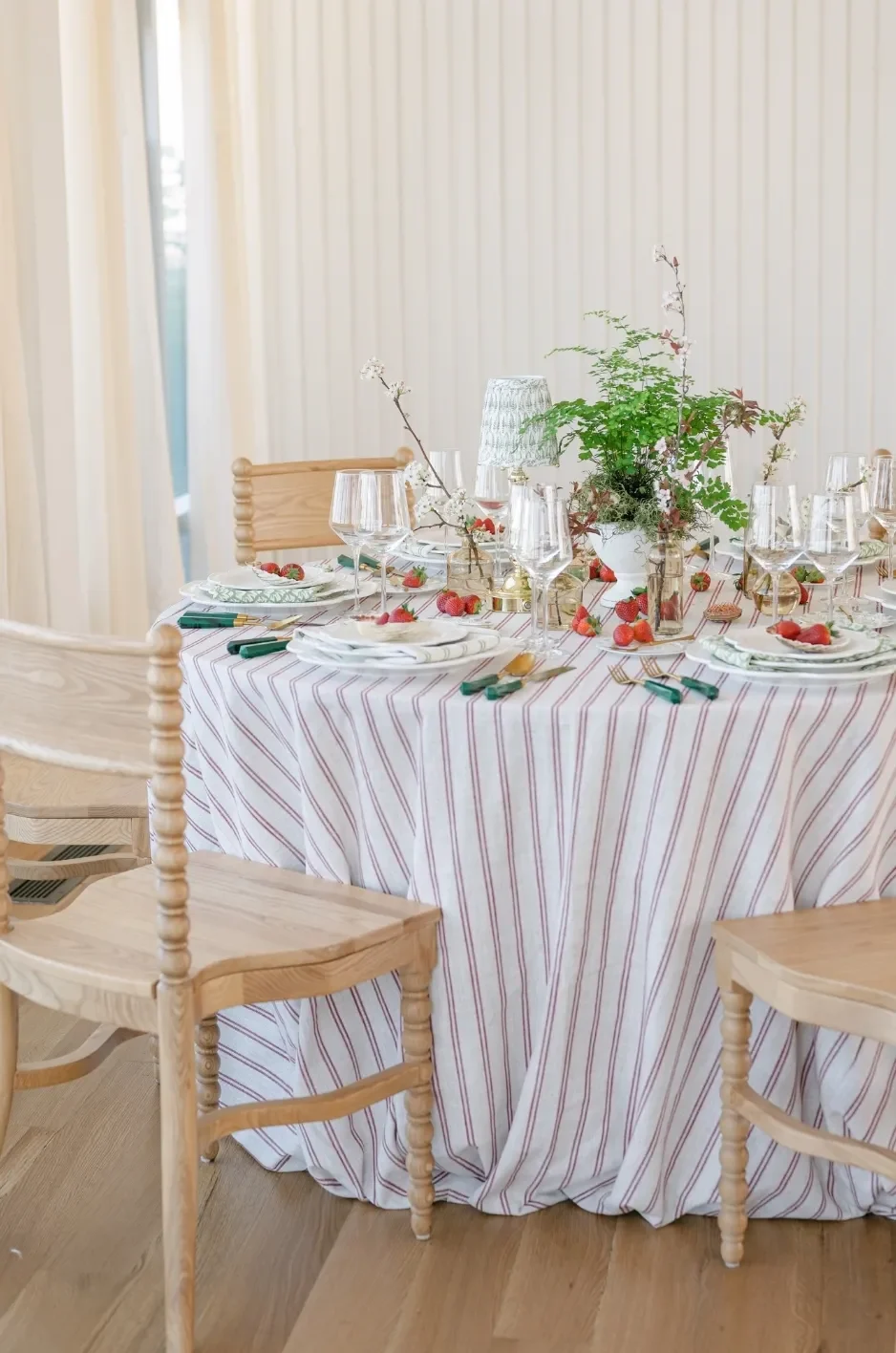
A worksheet turns the linen strategy into an executable order. Instead of describing the event as simply standard or custom, it records the appropriate path for every textile-bearing surface.
This document can be used to review the quote, support installation, and confirm that no secondary event areas have been overlooked. For help choosing linens for your event, request a quote.
Record the Requirements for Every Surface
For each table or installation, document:
- Surface type
- Dimensions
- Quantity
- Desired linen format
- Color or pattern direction
- Visual priority
- Required drop
- Customization need
- Related napkin, runner, placemat, pillow, or overlay
Possible surfaces include:
- Guest dining tables
- Head or sweetheart tables
- Cocktail tables
- Bars
- Cake displays
- Escort-card installations
- Welcome tables
- Lounge areas
Assign the Appropriate Linen Path
Classify each requirement as:
- Existing collection rental
- Custom-sized project
- Bespoke custom-design project
- No linen required
This helps planners identify where customization is truly necessary and where the established collection already provides an appropriate solution.
Review the Worksheet Against the Quote
Confirm that the final proposal accurately reflects:
- Product names
- Sizes
- Quantities
- Custom-development scope
- Shipping
- Payment deadlines
- Revision terms
- Return requirements
- Damage provisions
- Special placement or orientation notes
The worksheet, proposal, and installation schedule should all describe the same order.
Frequently Asked Questions
Frequently Asked Questions About Standard and Custom Wedding Linens
The appropriate linen path depends on the event’s dimensions, quantities, design needs, and timeline. These questions address common considerations when combining existing rentals with custom work.
Can Existing Rentals and Custom Linens Be Used Together?
Yes. A wedding can use existing patterned and solid rentals across most tables while introducing custom-sized or bespoke pieces on selected focal surfaces. For more detail, see our article From Canvas to Tablescape: Building a Bespoke Linen Palette for a Fine Art Wedding.
Shared colors, textures, motifs, or borders can connect the categories.
When Is Custom Sizing Necessary?
Custom sizing may be useful when a table or installation does not work with available dimensions or when the design requires a specific linen drop.
Exact measurements should be confirmed before the order is placed.
Does Every Focal Table Need a Custom Linen?
No. An existing patterned, textured, or specialty linen may already provide sufficient distinction.
Custom development should address a defined design need rather than being treated as a requirement for every focal surface.
Can Changes Be Made After the Order Is Placed?
Curated Linen Collection will do its best to accommodate changes requested before shipping. Availability and additional fees may affect what can be revised.
Custom projects may have more limited flexibility after production begins.
How Far in Advance Should Wedding Linens Be Planned?
Standard linen orders should generally be planned approximately four to six weeks before the event. Custom designs should be started at least eight to twelve weeks in advance.
Complex projects, unusual dimensions, large quantities, and designs requiring several review stages should begin earlier.
How Are Rental Linens Returned?
The linens should be gathered, reboxed in the provided packaging, and returned using the supplied instructions and label. Damp pieces should be allowed to air-dry before packing, and rented linens should not be laundered by the client.
Conclusion
Existing collection rentals and custom projects should not be treated as competing approaches applied to the entire wedding. Different tables and textile formats may require different levels of selection, sizing, and design development. Browse our luxury linen rentals to see these fabrics and colors in full.
An existing rental foundation can provide access to coordinated patterns, solids, runners, napkins, placemats, pillows, specialty overlays, and multiple linen sizes. Custom sizing can address surfaces with specific dimensional requirements, while bespoke design may be considered when the wedding calls for a one-of-a-kind pattern, color direction, or custom-printed detail.
Curated Linen Collection supports these approaches through its premium rental inventory, custom sizing, design guidance, pattern ideation, color selection, fabric printing, cutting, sewing, finishing, and nationwide shipping.
By evaluating each textile according to its quantity, dimensions, function, design role, and timeline, planners can build a wedding linen program that feels personal, cohesive, and practical for the event.