Pattern and texture can change the entire character of a table, but they do not create the same effect. When comparing printed vs embroidered linens, the most useful question is not which treatment looks more elevated. It is what the linen needs to contribute to the overall event design.
Printed linens are especially effective when color, illustration, repetition, or large-scale movement should carry across a table. Embroidered linens bring dimension through stitched detail, making them well suited to tactile accents, refined motifs, and close-up moments. Understanding how each treatment reads from across a room and at the place setting makes it easier to choose one, combine both, or use them selectively.
Printed vs Embroidered Linens: The Core Design Difference
Printed and embroidered linens can both introduce pattern, but they create that pattern in different ways. Print relies primarily on color and artwork applied to the fabric, while embroidery builds a design through thread stitched into the textile. That difference affects visual weight, texture, scale, and how the linen interacts with the rest of the tablescape.
Print Creates Pattern Through Color
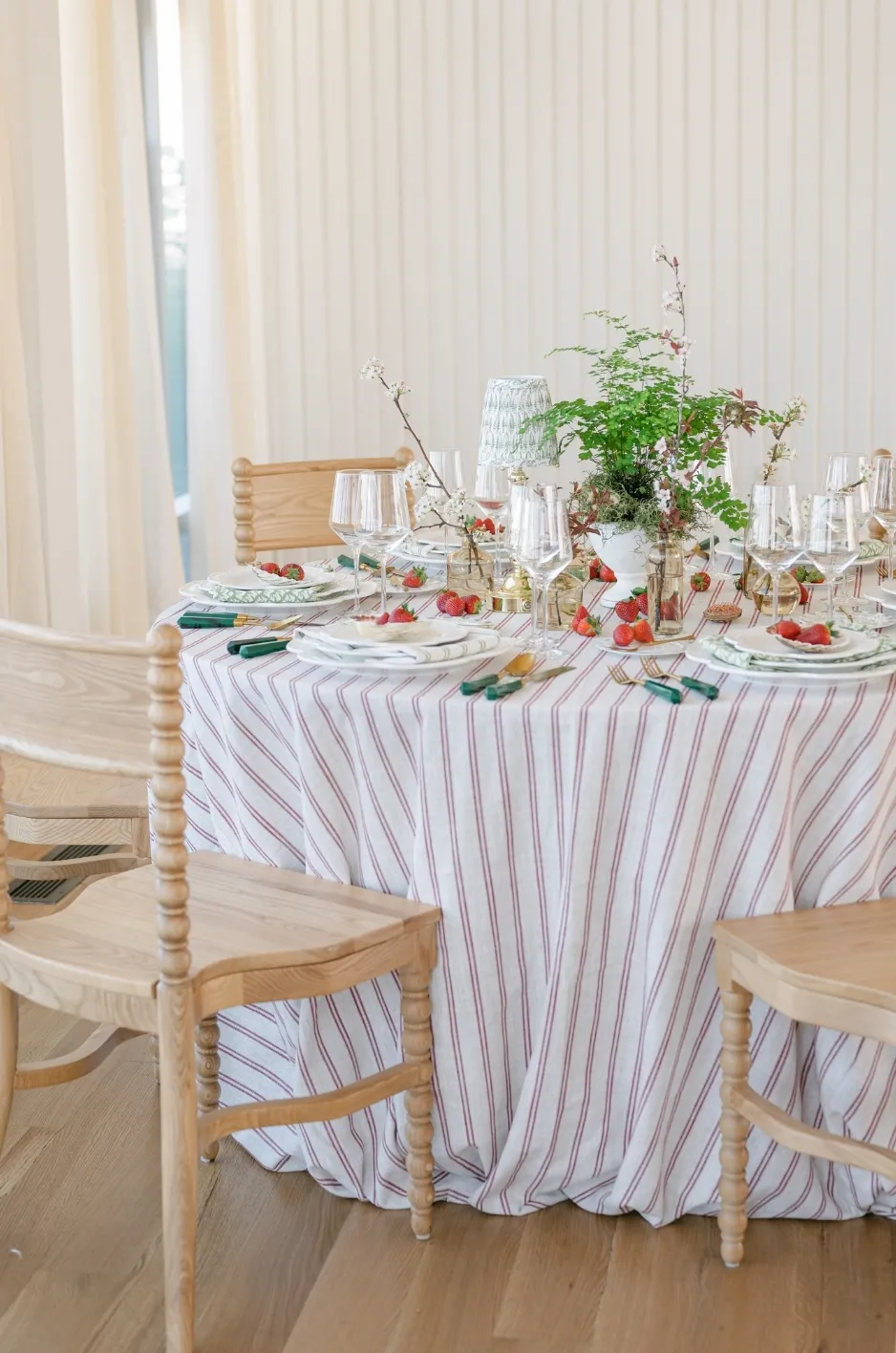
Printed fabric can carry repeated botanicals, stripes, painterly artwork, geometric motifs, crests, or other graphic details across a broad surface. Because the pattern itself does not depend on raised stitching, print can cover a large area while keeping the visual focus on color, line, and composition.
That makes it particularly useful when the linen needs to establish the event palette or introduce movement across multiple tables. A large floral print can make a round table feel expressive, while a directional pattern can create rhythm along a banquet table or runner.
Embroidery Adds Physical Dimension
Embroidery creates pattern through stitched thread, so the design has a tactile quality as well as a visual one. Depending on the motif, thread color, density, and base fabric, embroidery can read as subtle texture from a distance and reveal much more detail up close.
This is one reason embroidered linens work so well for place-setting details, borders, focal tables, and textiles guests are likely to see at close range. The relief of the stitching gives the fabric depth without requiring a large or high-contrast pattern.
The Right Choice Depends on the Design Job
Instead of treating print and embroidery as interchangeable decoration, decide what the linen is meant to do. If it needs to establish a strong color story or be noticed across a large room, print often gives the design more visual reach. If the goal is detail, craftsmanship, or tactile interest, embroidery may be the stronger direction.
The rest of the table should also influence the choice. A linen does not need to carry every design idea at once; it should create a clear foundation for florals, tabletop pieces, menus, lighting, and other decorative elements.
When Printed Linens Make the Most Sense
Printed linens are a strong choice when pattern is central to the event concept rather than a quiet supporting detail. They can introduce visual identity across the room, echo artwork developed elsewhere in the event, and connect different table types through a repeated motif or palette.
Choose Print for Large-Scale Pattern and Movement
A printed tablecloth has enough surface area to show a pattern as a full composition. Large florals, expressive botanicals, marbled effects, stripes, and repeat motifs can change how a room feels even before guests reach the table.
Scale matters. A pattern that looks intricate on a swatch may read as a field of color from several feet away, while a larger motif can remain legible across a ballroom, tent, or open reception space. When the linen is expected to create room-level impact, review the pattern from the distance guests will actually experience it.
Use Print to Extend a Visual Motif
Print is especially useful when the event already has distinctive artwork or a recognizable visual language. A motif inspired by stationery, venue architecture, florals, a destination, or a brand identity can be adapted into a textile pattern without requiring the linen to match another design element exactly.
For custom-printed projects, the process can move from pattern ideation and color selection through fabric printing, cutting, sewing, and finishing. This makes custom linen design especially relevant when a planner or host wants the textile to feel connected to the broader creative direction rather than selected as a separate finishing touch.
Let Print Carry Color Without Overloading the Table
Printed linens can introduce several related colors within one surface, which gives the rest of the tablescape natural points of connection. A floral print might contain a muted green that reappears in a napkin, a warm neutral that connects with dinnerware, and a deeper accent that appears in candles or paper details.
The key is restraint. Once a printed linen becomes the hero element, surrounding pieces can become quieter. Solid napkins, simple chargers, controlled floral palettes, and clear glassware can give the pattern enough visual space to work.
When Embroidered Linens Are the Stronger Choice
Embroidery works best when the surface itself should feel considered and dimensional. Rather than relying on broad fields of color, stitched detail can introduce texture, line, and craftsmanship in a way that rewards a closer look.
Choose Embroidery for Texture and Close-Up Detail
At a place setting, guests see napkins, runners, and tablecloth edges from a much shorter distance than they see the room as a whole. Embroidery can make those close-range moments feel richer because the stitchwork changes how the surface catches light and how the fabric feels in hand.
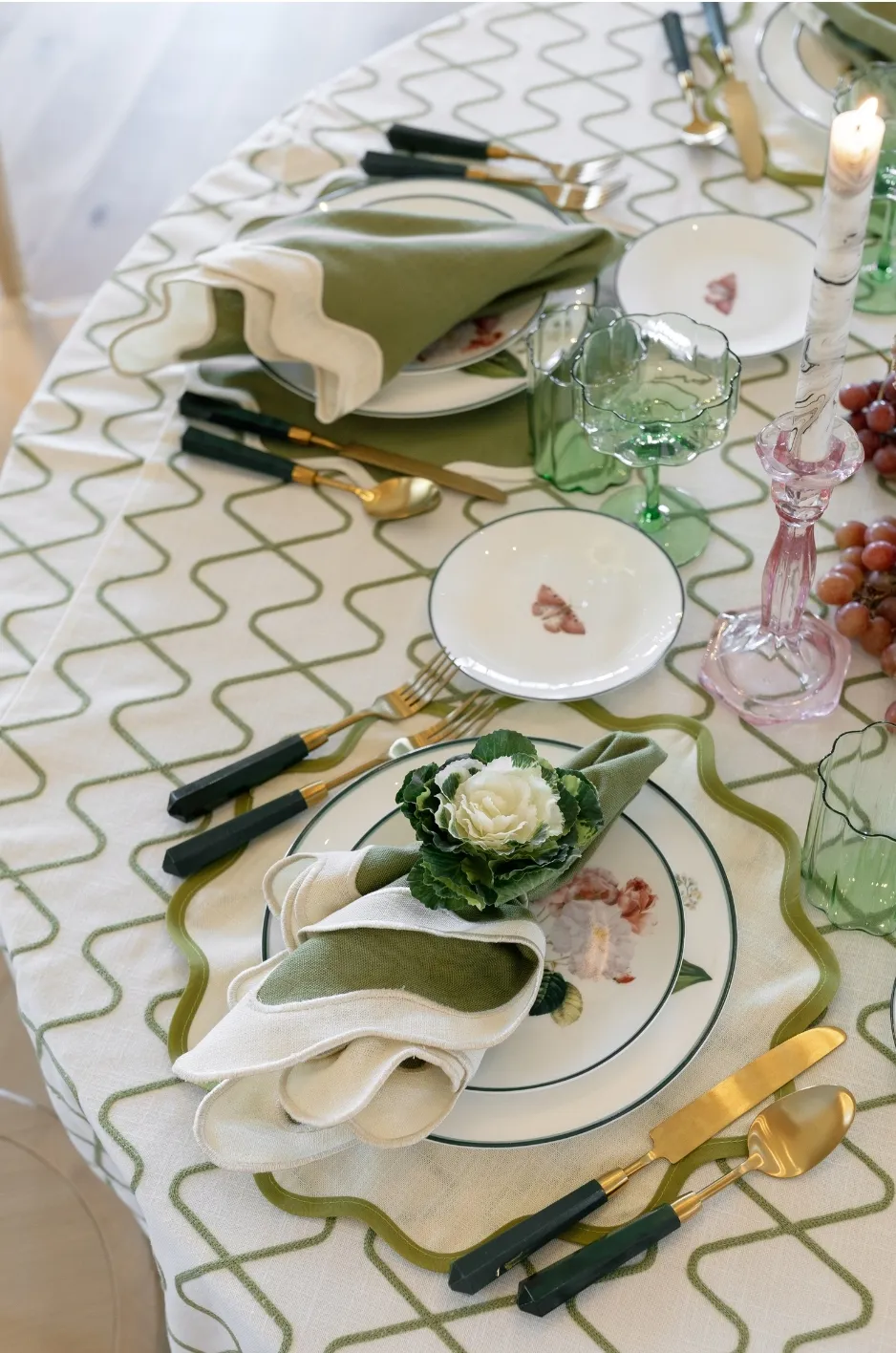
An example in the collection is Amelia Bloom, an embroidered linen with floral vines stitched in soft blush, golden yellow, and sage tones on a warm ivory ground. The design is available in table linens, napkins, and pillows, showing how an embroidered motif can move between focal surfaces and smaller accents.
Use Embroidery When the Motif Should Feel Refined
Embroidery is well suited to details that benefit from precision rather than broad coverage. Monograms, crests, small botanical elements, borders, and line-based motifs can be effective because the thread itself becomes part of the design language.
Tonal embroidery can keep the effect quiet, while contrasting thread makes the motif more visible. Neither approach is inherently more formal; the final impression depends on scale, placement, color contrast, fabric, and how the stitched element relates to the rest of the event.
Give Embroidery Space to Be Seen
A detailed embroidered linen can lose impact if it is surrounded by too many other high-texture or heavily patterned elements. If the stitching is meant to be noticed, consider pairing it with cleaner tabletop pieces, simpler florals, or solid supporting linens.
Placement also matters. Embroidery often has the greatest effect where guests can actually see it, such as a folded napkin at each setting, the edge of a runner, a sweetheart table, or another focal surface. Selective placement can make the detail feel intentional rather than repetitive.
Where Each Treatment Works Best Across an Event

The same treatment can behave differently depending on where it appears. A full tablecloth has visual reach, a runner creates a narrower line of pattern, and a napkin is experienced at close range. Matching the technique to the application can be as important as choosing between print and embroidery.
Full Tablecloths Need Room for the Design
A printed tablecloth gives artwork space to develop across the table, which can suit botanicals, painterly motifs, stripes, or other patterns that benefit from broad coverage. An embroidered cloth can create a quieter focal effect when stitched detail remains visible around place settings and centerpieces.
For either option, consider what guests will actually see once the table is fully set. The exposed areas of fabric should carry enough of the design to remain intentional.
Runners and Napkins Support Focused Detail
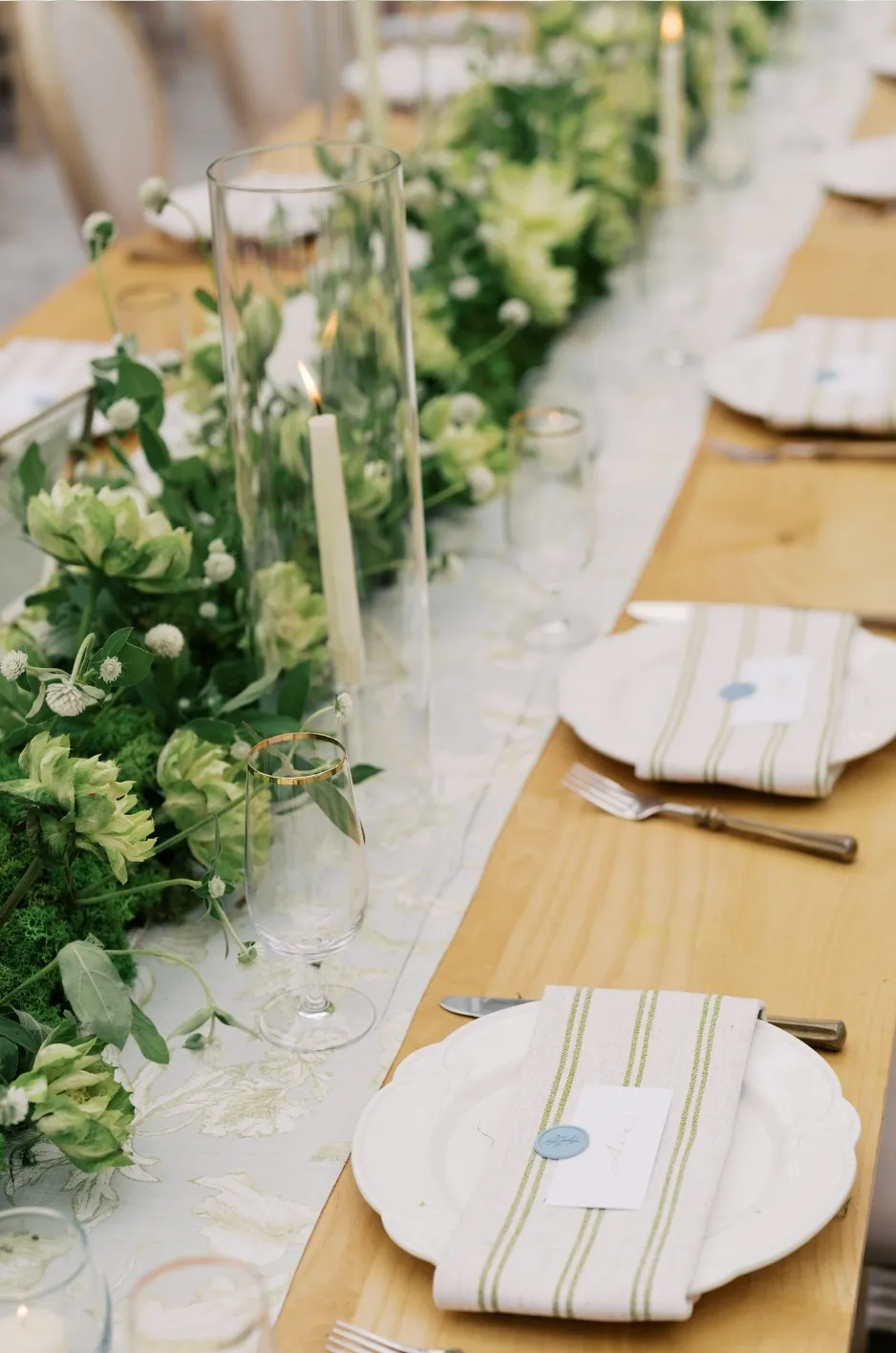
Runners suit directional patterns, borders, and repeated motifs because they concentrate attention along the center or length of a table. Napkins offer a smaller canvas and are handled directly by guests, which makes them especially effective for embroidery when stitch texture, a monogram, or a small motif matters.
Printed napkins work differently. They can repeat color or pattern at every place setting, creating rhythm without requiring the tablecloth to carry the same visual weight.
Accent Pieces Can Extend the Textile Story
Pillows and other textile accents can repeat a color, motif, or design language beyond the dining table when those applications fit the event plan. The strongest approach is selective rather than literal.
A printed motif might lead on one surface and return as a smaller accent elsewhere, while embroidery can echo a related line or color in tactile form. This creates continuity without making every textile identical.
How to Choose the Right Treatment for Your Event
The decision becomes easier when print and embroidery are evaluated within the full event environment. Venue scale, table shape, viewing distance, lighting, stationery, florals, and the amount of detail already present all influence how a linen will read.
Start With Viewing Distance
Ask where the linen needs to make its strongest impression. A tablecloth on guest tables may need to contribute to the room from across the reception space, while a napkin is primarily experienced at arm’s length. Those are different design jobs.
Print often performs well when the pattern needs to register from a distance, especially if the motif has enough scale and contrast. Embroidery tends to reward closer viewing because texture becomes more apparent as guests approach. This is not a hard rule, but it is a useful first filter.
Consider Table Shape and Surface Area
Round tables display a print differently from long banquet tables. A large repeat may feel expansive on a round cloth, while a directional or border-focused design can become more noticeable on a runner or rectangular table. The same principle applies to embroidery, where placement near an edge, hem, or napkin fold can determine whether the stitched motif is visible.
Before committing, think about the actual dimensions and drape. A beautiful design can disappear under place settings or fall below the tabletop if its placement is not planned around the final linen size.
Build a Clear Visual Hierarchy
A successful tablescape usually has an obvious focal point. If the linen is the hero, other elements should support it. If the florals, plates, or stationery already carry significant pattern, the linen may work better as a quieter layer.
Browsing luxury linen rentals by color and style can help identify whether the event needs a solid base, a patterned statement, a textured accent, or a combination. The current collection includes patterned and solid options across table linens and coordinating textile pieces. Treat the linen decision as part of the full composition rather than a separate choice made after everything else.
Coordinate With Stationery, Florals, and Tabletop Details
Coordination does not require exact matching. A printed linen can pull one color from an invitation suite without reproducing its artwork, and an embroidered napkin can echo the shape or tone of a floral motif without copying it.
Look for repetition that feels subtle: a shared curve, a familiar color family, a related botanical shape, or a consistent level of formality. These connections make the design feel cohesive while allowing each element to retain its own character.
Can Printed and Embroidered Linens Work Together?
Using both treatments can create a layered textile story, provided one does not compete with the other. The goal is not to maximize detail but to decide which element leads and which one supports.
Let One Treatment Lead
A printed tablecloth can act as the room-level statement while an embroidered napkin adds close-up texture. The reverse can also work: an embroidered table linen can remain the tactile focal point while a printed runner, pillow, or smaller accent introduces controlled color.
Whichever treatment leads should have the clearest visual presence. The supporting treatment can repeat a color, motif family, or design mood without duplicating every detail.
Control Pattern Scale and Contrast
Two detailed elements are easier to combine when they operate at different scales. A large botanical print, for example, can pair with small, restrained embroidery because the eye reads them at different levels.
Color contrast should be managed the same way. If the print is already saturated or multicolored, tonal embroidery can keep the layered effect sophisticated. If the printed element is quiet, a more visible stitched accent may have room to stand out.
Repeat a Design Idea Selectively
A repeated motif can create cohesion, but literal repetition across every linen often feels too controlled. Instead, carry one idea through the event in different ways. A botanical print on guest tables might be echoed by a small leaf-shaped embroidered detail at a focal table, while the color story remains consistent elsewhere.
This approach allows print and embroidery to feel related without turning the event into a single repeated pattern.
Frequently Asked Questions
Are Printed Linens Less Formal Than Embroidered Linens?
No. Formality depends on the fabric, pattern, color palette, scale, styling, and surrounding tabletop elements. A restrained printed linen can feel highly formal, while playful embroidery can feel relaxed. Choose the treatment that supports the event’s visual direction rather than treating one as automatically more elevated.
Which Is Better for Wedding Napkins?
Embroidered napkins are useful when the goal is tactile detail, a monogram, crest, border, or small motif. Printed napkins work well when color and pattern should be visible across many place settings. The right choice depends on how the napkin relates to the tablecloth, menus, florals, and dinnerware.
Can I Use a Printed Tablecloth With Embroidered Napkins?
Yes. This is one of the clearest ways to combine the two treatments because the printed tablecloth can establish the larger pattern story while the embroidered napkin adds a smaller, close-range detail. Keep color and scale coordinated so the two layers feel intentional.
Should Custom Linens Match the Invitation Suite Exactly?
Usually, exact matching is unnecessary. A stronger approach is often to reference one or two elements, such as color, linework, a crest, botanical inspiration, or the overall mood. That connection can make the design feel cohesive without making every surface look identical.
How Early Should I Decide Between Print and Embroidery?
Decide once the main visual direction, table types, linen applications, and key design elements are reasonably clear. Custom work can involve additional design and production steps, so it is useful to discuss the intended motif, dimensions, quantities, and event date early enough for the final textile plan to be developed appropriately.
Choosing the Linen Treatment That Fits the Design
Printed and embroidered linens solve different design problems. Print is especially effective for color, artwork, movement, and larger-scale pattern, while embroidery adds dimensional texture and detail that becomes more meaningful at close range. Neither treatment needs to dominate an entire event; thoughtful placement is often what gives it impact.
Start with the role the linen needs to play, then consider viewing distance, table shape, palette, surrounding décor, and the amount of texture already present. From there, choose print, embroidery, or a controlled combination that supports the full event rather than competing with it.
Our collection includes patterned and solid linens as well as custom-printed details, with nationwide shipping available. For custom printing or a bespoke project, schedule a consultation to discuss the event, applications, and design goals.