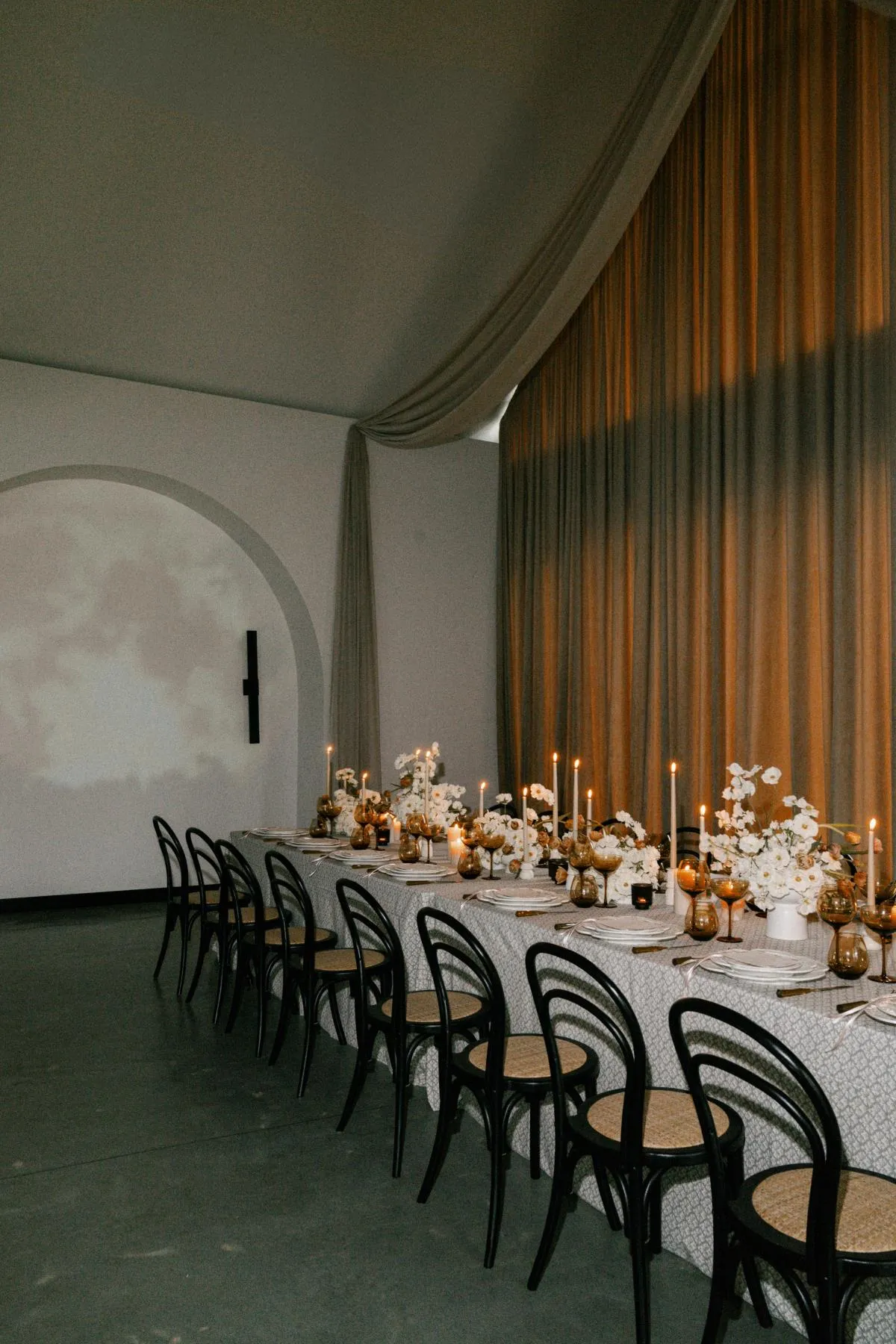
Specialty table overlays can change the structure of a reception table without replacing the full linen design beneath them. A square overlay placed diagonally over a round table creates defined points, while a smaller round overlay can frame the center of the table with a consistent border of base linen. On focal tables, a custom overlay can direct attention toward a front-facing pattern, border, or personalized motif. You may also find 6 Specialty Linen Overlay Ideas to Elevate Wedding Tables helpful.
The effectiveness of an overlay depends on more than its color or texture. Its shape must relate to the table beneath it, its dimensions must produce an intentional drop, and its placement must leave enough room for place settings, florals, candles, and service. Even a carefully selected textile can appear uneven or incorrectly sized when its corners are misaligned or too much of the base linen is concealed.
Curated Linen Collection offers specialty overlays alongside tablecloths, runners, napkins, custom sizing, and bespoke textile designs. These options allow couples and planners to develop layered tables that feel dimensional without introducing unnecessary fabrics or competing decorative elements.
This guide explains how to style specialty table overlays through geometry, proportion, visible base linen, controlled drape, and accurate event-day placement.
Read the Table Before Selecting the Overlay
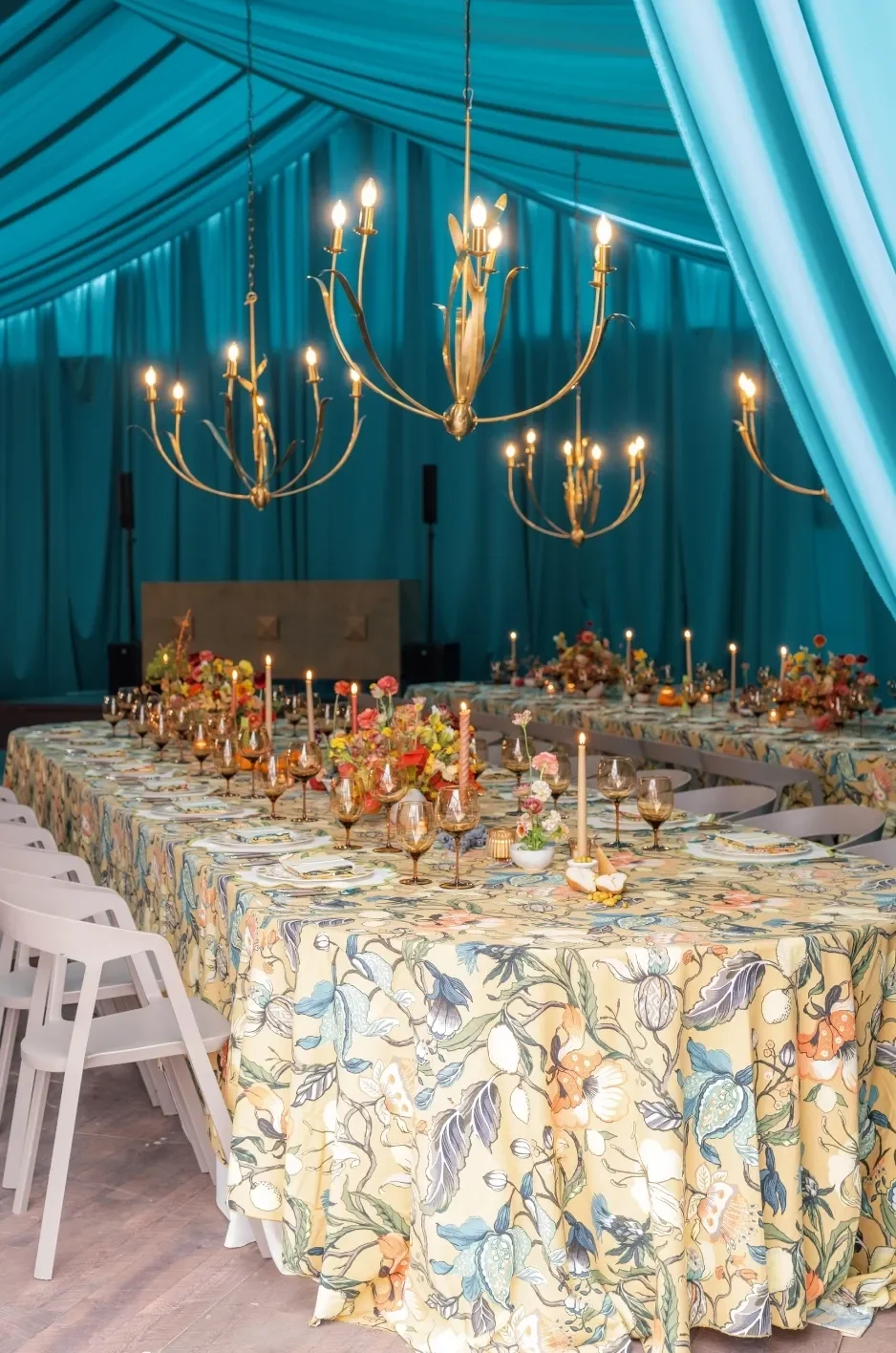
An overlay should respond to the table beneath it. The table’s dimensions, shape, seating arrangement, and primary viewing angle determine whether the overlay will create an intentional frame or make the surface feel crowded.
Before selecting a product, document how the table will function and what the base linen already contributes to the design.
Confirm the Exact Table Shape and Dimensions
Begin with the table’s actual length, width, diameter, and height. Do not rely solely on descriptions such as “standard round” or “small rectangular,” since tables within the same general category may have different measurements.
Also note:
- The shape of the table edges
- The location of the legs or base
- Whether several tables will be joined
- Any extensions or uneven sections
- The number of tables using the same treatment
These measurements determine how far the overlay will extend, where its corners will fall, and how much base linen will remain visible.
Identify the Table’s Main Viewing Angle
Guest tables are usually viewed from several directions, while sweetheart, cake, welcome, and escort tables may be seen primarily from the front.
Consider whether the table will be viewed:
- From all sides
- From the room entrance
- From the aisle
- From the ends
- Directly from the front
- From an elevated photography angle
The viewing angle affects the placement of borders, directional prints, custom motifs, and longer drops. A front-facing design should not be positioned according to the same rules as an overlay intended for a table viewed equally from every side.
Map the Usable Tabletop Surface
The overlay must share the table with functional and decorative elements. Before determining its size, map the space needed for:
- Chargers and plates
- Flatware
- Glassware
- Napkins
- Menus and place cards
- Floral vessels
- Candles
- Table numbers
- Serving pieces
A large overlay may look balanced on an empty table but feel excessive once the complete place settings are added.
Determine What the Base Linen Contributes
The base linen is not simply a surface beneath the overlay. It may provide the primary color, establish a visible border, introduce a contrasting texture, or create full-length coverage around the table.
Decide whether the base should remain prominent or serve as a restrained foundation. This will help determine whether the overlay needs to be smaller and more defined or large enough to create a more integrated layered effect.
Define the Overlay’s Specific Role
Before adding an overlay, identify what it needs to accomplish. Its purpose may be to:
- Frame the table
- Introduce a contrasting shape
- Add controlled pattern
- Create a central focal area
- Change the table’s visual proportions
- Distinguish a specialty table
- Add dimension to a solid foundation
When the overlay does not solve a clear design need, the additional layer may make the table feel busier rather than more refined.
Match the Overlay Shape to the Table Geometry

The relationship between the overlay and the table determines the silhouette of the layered linen. A successful arrangement creates intentional points, borders, or panels rather than accidental unevenness.
Use a Square Overlay to Create Points on a Round Table
A square overlay rotated over a round table creates a diamond formation, with four points extending around the perimeter.
For a balanced result:
- Center the overlay precisely.
- Align opposite corners.
- Compare the length of each point.
- Leave similar amounts of base linen visible between the corners.
- Position the points so they do not interfere with chairs.
The arrangement should be reviewed from above as well as from the guest perspective. An overlay can appear centered from one side while remaining noticeably uneven from another.
Keep a Round Overlay Concentric With a Round Base
A round overlay placed over a round table preserves the circular silhouette and creates a consistent visible border.
This approach may work well when:
- Symmetry is important to the place-setting layout.
- The base linen provides the primary contrast.
- The centerpiece already contains substantial detail.
- A softer shape is preferred over pointed corners.
- The table will be viewed evenly from all sides.
The overlay should remain centered so the width of the visible base linen appears consistent around the table.
Frame Square Tables With Evenly Aligned Edges
A square table can support an overlay aligned directly with the edges or rotated to create a diamond.
An aligned overlay produces a structured border around the table. A rotated overlay introduces diagonal points and more visible base linen at the corners.
Whichever treatment is selected, check the alignment from all four sides. Unequal borders or off-center points become especially noticeable on a geometric table.
Treat Rectangular Tables as Directional Surfaces
Rectangular tables have a strong visual direction, so overlays should generally respond to the length of the surface.
Possible treatments include:
- A centered rectangular top layer
- A shorter panel defining the middle of the table
- A directional overlay extending along the length
- A front-facing textile panel for a focal table
A square overlay placed without considering the table’s proportions may create awkward drops and uneven coverage. Long tables often require a more tailored shape or custom dimensions.
Adapt the Treatment to Specialty Shapes
Oval, curved, serpentine, antique, and unusually proportioned tables may not work well with standard overlay sizes.
A standard square or round overlay can create irregular borders, excessive fabric, or points that fall unpredictably. Custom sizing allows the overlay to follow the table’s proportions while producing the intended drop and visible base-linen border.
Control the Overlay’s Drape at Every Corner
An overlay may be correctly centered but still look uneven when its corners, folds, and drops are not controlled. The full table should be reviewed rather than judging the placement from only one side.
Compare Opposing Corner Lengths
Opposite corners should generally fall to similar lengths unless the design intentionally uses asymmetry.
Check the table from:
- The front
- Both sides
- Each end
- A wider room perspective
Small differences may become more apparent when several identically styled guest tables are viewed together.
Position Points Between Chairs
On round and square tables, overlay points should usually fall between seating positions. A long corner placed directly in front of a chair may extend into the guest’s lap, become caught beneath the seat, or interfere with movement.
Chair placement should therefore be included in the linen mockup rather than added after the overlay dimensions are finalized.
Prevent Unplanned Pooling
Excess fabric can gather around the table base, become trapped beneath chairs, or extend into a service path.
Pooling may be appropriate for a controlled focal-table design, but it should not happen because the overlay is incorrectly sized. Confirm how the table is positioned within the floor plan and whether guests or staff will move near the extended fabric.
Preserve Clean Lines on Structured Fabrics
Structured overlays hold their corners and folds more visibly than fluid textiles. This can produce a tailored effect, but it also makes inconsistent placement easier to notice. We cover this further in How to Style Linen Overlays for Summer Tables Without Overcrowding.
Each table should use the same orientation, corner alignment, and visible base-linen width. Setup photographs can help the event team reproduce the approved arrangement.
Let Softer Fabrics Move Without Losing Balance
A more fluid overlay can create gentle folds and movement. However, softness should not become uneven bunching or an off-center drop.
Allow the fabric to drape naturally while maintaining the overall geometry. Opposite points should still relate to one another, and the base linen should remain visible in a controlled way.
Shape the Center of the Table Without Crowding It
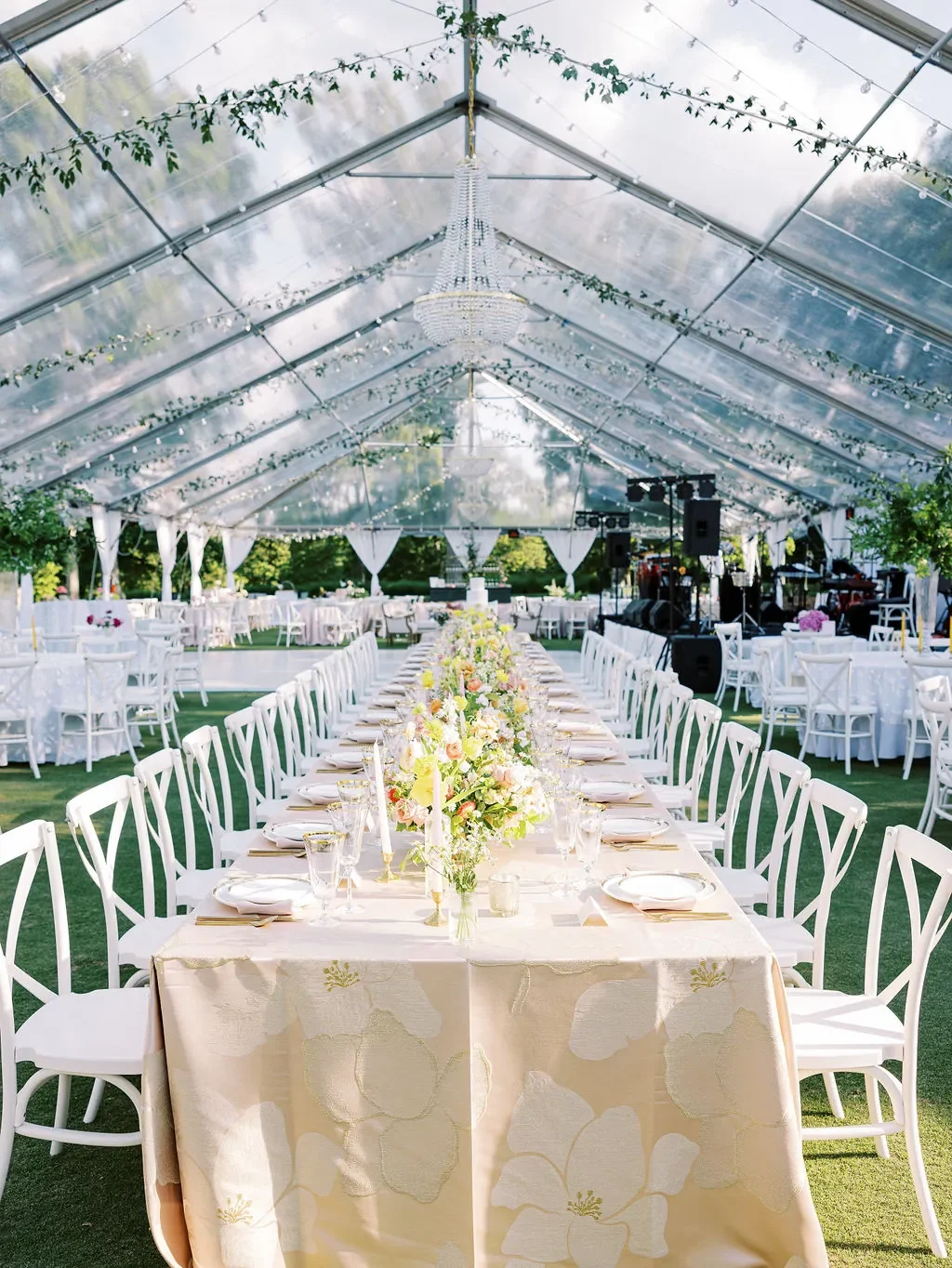
The overlay often defines the central styling area, but that area must remain functional. Centerpieces and decorative elements should respond to the overlay without hiding it completely.
Scale the Centerpiece to the Overlay
Consider the base width of floral vessels and candleholders, not only their height.
A broad arrangement may cover most of a smaller overlay, while several narrow vessels can leave more textile visible between them. The centerpiece should feel connected to the overlay’s shape without occupying every part of it.
Preserve Areas of Visible Textile
Leave open sections where the overlay’s color, pattern, or texture can be seen.
These visible areas help connect the centerpiece with the place settings and make the overlay part of the composition rather than a hidden layer beneath the décor.
Use Repeated Elements to Reinforce the Overlay Shape
Candles and small floral groupings can reinforce the geometry established by the overlay.
On a square overlay, repeated elements might follow the directional lines without tracing every edge. On a round overlay, a centered arrangement can support the circular shape while leaving an even textile border.
Maintain Clear Guest Sightlines
The overlay should support a centerpiece arrangement that allows guests to see and speak across the table.
Low arrangements, narrow vessels, or elevated designs with open space beneath them can maintain visibility without eliminating the central focal area.
Keep Service Routes Open
The table must remain accessible for water service, course delivery, clearing, and shared dishes.
An overlay should not encourage so many central elements that staff must move candles or floral pieces during service. Practical space is part of a successful layered design.
Use Contrast to Clarify the Layering
The overlay should remain visibly distinct from the base linen, tableware, and surrounding decorative details. Contrast may come from color, texture, pattern, or finish.
Pair a Patterned Overlay With a Restrained Base
A solid or tonal foundation gives a patterned overlay enough space to lead the textile design.
When the overlay is expressive, supporting details may need to remain quieter. Solid napkins, restrained menus, and uncomplicated china can prevent the table from becoming visually crowded.
Add Texture Over a Smooth Foundation
A dimensional overlay can create depth over a smooth base linen without introducing a dramatic color change.
This works especially well when the wedding palette is intentionally controlled but the tables still need greater visual interest. We cover this further in Linen Overlays That Elevate Summer Wedding Tables.
Use Tonal Contrast for a Subtle Table
Closely related shades can produce a sophisticated layered effect when the two textiles differ in texture, pattern, or sheen.
A matte base with a gently luminous overlay, for example, may create enough separation even when the colors are similar.
Separate Similar Colors With Edge Definition
Borders, trims, scallops, and a clearly visible perimeter can prevent tonal layers from merging.
The finishing detail should remain visible after the overlay is positioned and should not be hidden completely beneath plates or centerpieces.
Evaluate the Combination Under Reception Lighting
Lighting can reduce or intensify the distinction between the two layers.
Review the textiles under:
- Natural daylight
- Warm interior lighting
- Candlelight
- Uplighting
- Flash photography
A combination that appears clearly layered during the day may merge after sunset if both fabrics are dark or similarly reflective.
Adapt Overlay Placement to Different Reception Tables
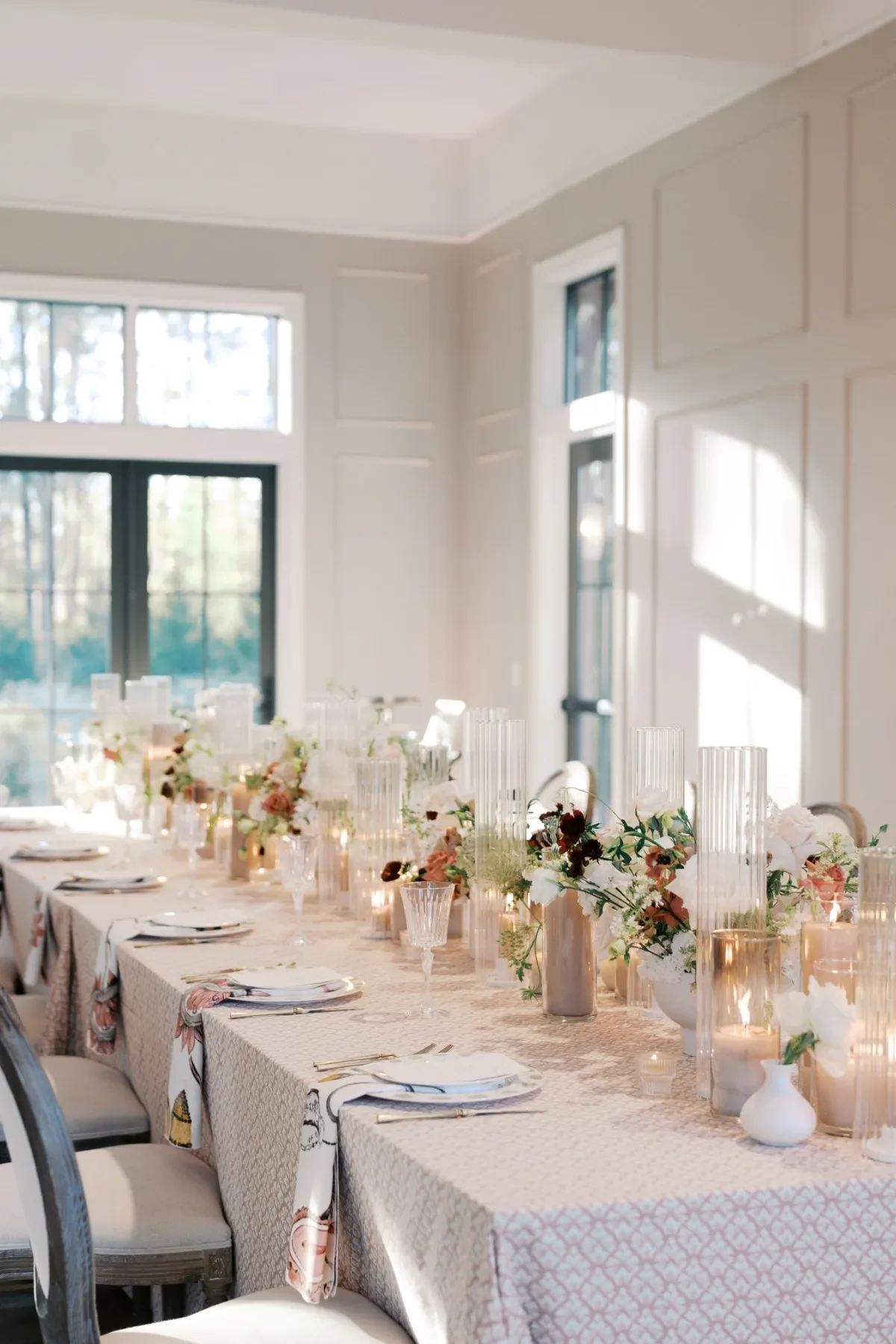
Overlay placement should respond to how each table is used and viewed. Not every table category needs the same treatment.
Keep Guest-Table Placement Consistent
When overlays are repeated across guest tables, maintain consistency in: You may also find Specialty Linen Overlays for Luxury Summer Weddings helpful.
- Orientation
- Corner placement
- Visible base width
- Pattern direction
- Drop length
- Centerpiece position
Consistent placement creates visual rhythm across the reception and prevents one table from appearing incorrectly styled.
Give the Sweetheart or Head Table a Front-Facing Treatment
Focal tables may use:
- A centered front motif
- A stronger border
- A custom-sized panel
- A longer front drop
- A placement designed for photography
The treatment should connect with the guest tables through color, texture, pattern, or napkin selection while providing additional distinction.
Preserve Display Space on Cake and Dessert Tables
The overlay should frame the display rather than disappear beneath it.
Consider where the cake stand, dessert pieces, florals, and signage will sit. Important motifs and borders should remain visible from the primary viewing angle.
Account for Signage on Welcome and Escort Tables
Welcome and escort displays may include signs, cards, florals, frames, and decorative objects.
The overlay should be positioned so its edges or pattern remain visible around these elements. A placement print should not be hidden behind the largest sign.
Use Overlays Selectively Rather Than Everywhere
A reception may use overlays only on focal tables, alternating guest tables, cocktail tables, or display surfaces.
Shared base linens, napkins, colors, or finishing details can maintain cohesion across tables that do not use an overlay.
Know When the Overlay Should Be the Final Layer
An overlay may already provide enough pattern, texture, and visual structure. Adding another runner or patterned textile can reduce clarity rather than improve the design.
Skip the Runner When the Overlay Defines the Center
If the overlay already establishes a strong central shape, a runner may create an unnecessary second direction.
The two layers can compete, particularly on round or square tables where the overlay geometry is already prominent.
Simplify Napkins Around an Expressive Overlay
Solid napkins can pull a supporting color from a patterned or textural overlay without introducing another focal point at every seat.
Decorative edges or contrast trim may add detail while keeping the overall composition controlled.
Restrain Menus and Place Cards
Illustrated or heavily patterned stationery may become difficult to read against a detailed overlay.
Use clear contrast, restrained typography, or a solid backing surface to preserve legibility.
Reduce Decorative Objects When Texture Is Strong
A highly dimensional overlay may need fewer candles, vessels, and tabletop accessories.
The textile already contributes visual weight, so additional objects should be selected carefully rather than used to fill every open area.
Remove a Layer When the Table Loses Clarity
Review the complete table and identify the visual priority.
When the base linen, overlay, runner, napkins, menus, plates, and centerpieces all demand attention, removing one layer usually creates a stronger result.
Translate the Approved Design Into an Accurate Order
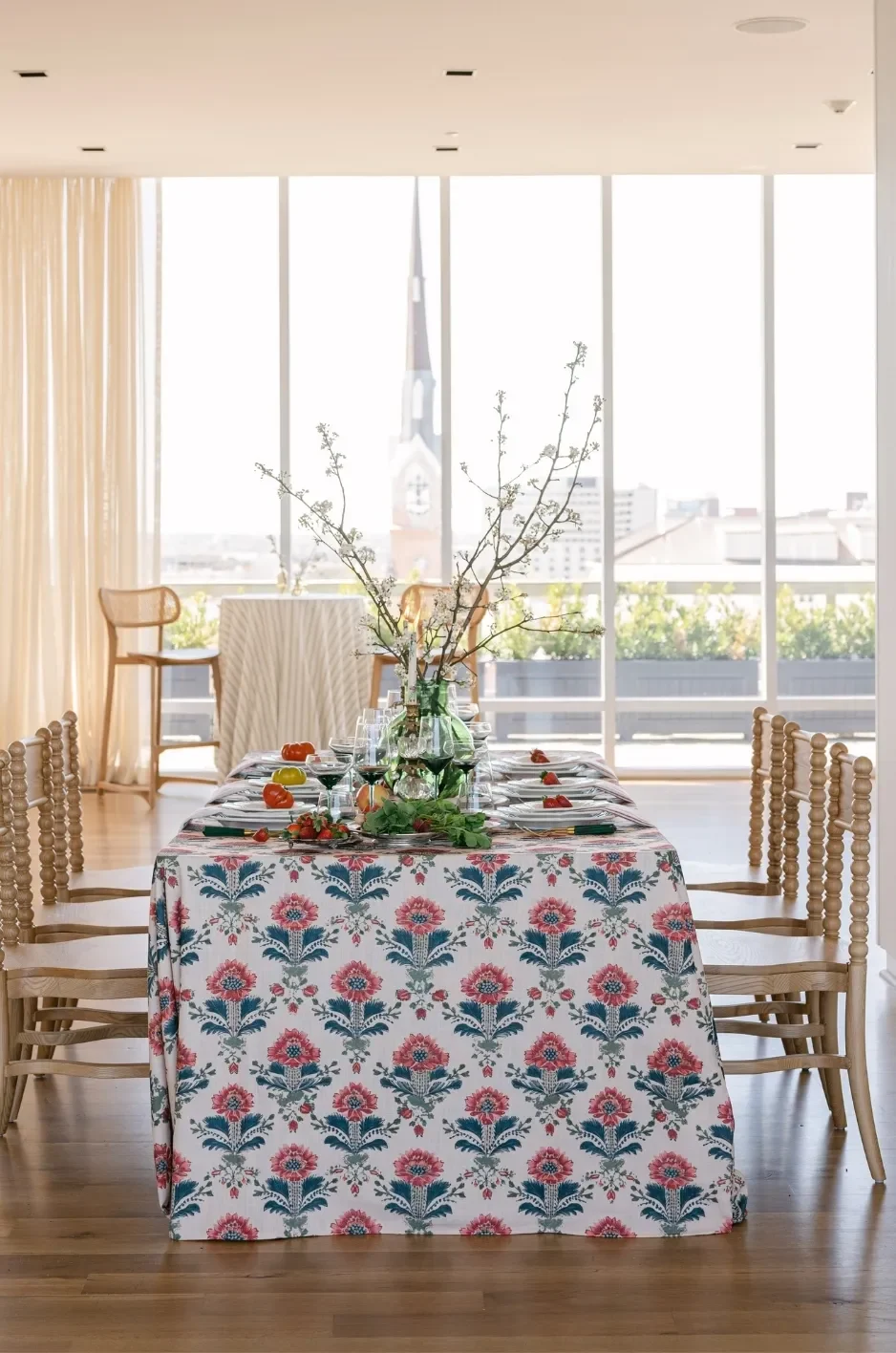
Once the overlay placement has been confirmed, document every product, dimension, quantity, orientation, and table assignment.
Create an Overlay Schedule by Table Type
The schedule should list:
- Table category
- Table dimensions
- Base linen
- Overlay product
- Overlay dimensions
- Quantity
- Orientation
- Setup notes
Separate Standard and Custom Pieces
Clearly distinguish custom-sized overlays from standard rental inventory.
Custom pieces may require specific placement, direction, or table assignments that should not be left open to interpretation during setup.
Reconfirm the Final Floor Plan
Changes to the table quantities, shapes, seating plan, or furniture inventory may affect the overlay order.
Review the final floor plan before confirming sizes and quantities.
Allow Additional Time for Custom Work
Custom dimensions, borders, motifs, samples, and production require more lead time than selecting from existing inventory.
Begin the process after the venue, table measurements, palette, and primary design direction have been established.
Confirm Receiving and Return Responsibilities
Identify who will receive and inspect the shipment, preserve the packaging, direct the linen placement, collect the pieces after the event, and coordinate the return.
Curated Linen Collection offers nationwide shipping, allowing overlays and coordinating linens to be sent to the designated planner, venue, hotel, residence, or other approved receiving contact.
Frequently Asked Questions
Should an overlay match the shape of the table?
Not always. A round overlay can preserve the shape of a round table, while a square overlay can create pointed drops. The choice depends on the desired silhouette and available space.
How much base linen should remain visible?
Enough should remain visible for the two layers to appear intentional. A wider visible border creates stronger contrast, while a narrower border produces a more integrated effect.
Can a square overlay be used on a round table?
Yes. Rotating a square overlay over a round table creates a diamond formation with four points. The textile should be centered and positioned so the points fall between chairs.
Where should the overlay corners fall?
Corners should generally fall evenly and avoid guest seating positions, service paths, and areas where the fabric could become trapped beneath chairs.
Can an overlay be used without a full tablecloth underneath?
It may be possible on an appropriate exposed table, but the surface, overlay dimensions, and desired coverage must be evaluated carefully. The overlay should look intentional rather than undersized.
Should a runner be placed over an overlay?
Only when it solves a clear design need. If the overlay already defines the center of the table, a runner may introduce unnecessary direction or visual competition.
How can an overlay be kept from crowding place settings?
Map the full place-setting footprint before selecting the overlay size. The textile and centerpiece zone should leave adequate room for plates, glassware, menus, and service.
Can specialty overlays be custom sized?
Yes. Custom sizing can support specialty tables, precise borders, controlled corner drops, and custom motif placement.
How should a patterned overlay be positioned?
Review the pattern direction, primary viewing angle, centerpiece footprint, and table shape. Directional motifs should be aligned consistently across all tables.
Do all reception tables need the same overlay?
No. Overlays can be reserved for focal tables, selected guest tables, cocktail tables, or display surfaces while other tables use coordinating base linens and napkins.
Frame the Table With Shape and Intention
A specialty overlay should change the table’s silhouette with purpose. Its shape, dimensions, corner placement, visible base-linen border, and centerpiece relationship should all contribute to one controlled composition.
Begin with the table’s exact geometry and define what the overlay needs to accomplish. From there, determine how its shape should relate to the table, how far its points or edges should fall, and how much of the base linen should remain visible. Place settings, chairs, florals, candles, and service requirements must be considered before the overlay size is finalized.
The strongest layered tables also recognize when the overlay is enough. Once it provides the necessary texture, contrast, or structure, additional runners and decorative textiles may no longer be needed. You can view every fabric in our luxury linen rentals collection.
Curated Linen Collection offers specialty overlays, tablecloths, runners, napkins, custom sizing, and custom-design options for reception and focal tables. Through precise measurements, full-table testing, and documented setup instructions, these textiles can create tables that feel dimensional, balanced, and intentional from every viewing angle. You may also find How to Layer Specialty Table Overlays for Elegant Events helpful.